
|
Getting your Trinity Audio player ready...
|
Fifteen years ago, sending money from one city to another in Haiti meant entrusting cash to a bus driver, requesting the services of a friend, or physically going to one of the few bank branches in the country, knowing already that it would take several days for the money to arrive at its destination.
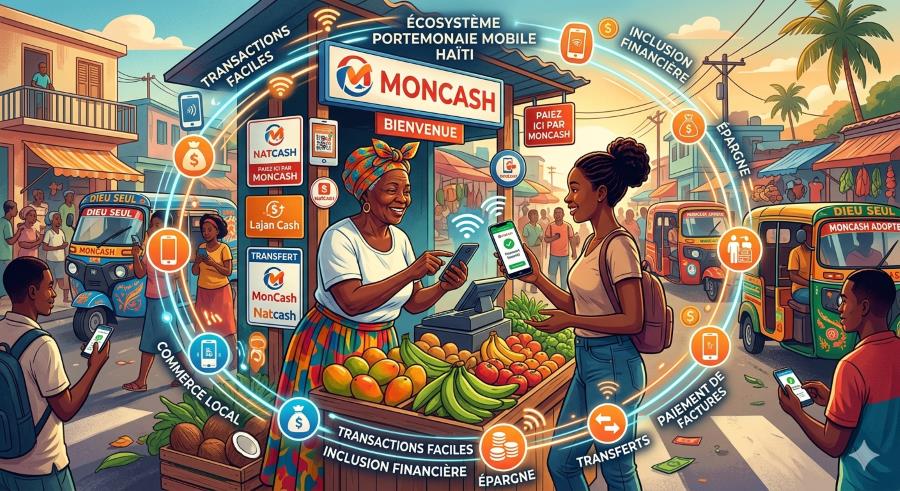
Fifteen years ago, sending money from one city to another in Haiti meant entrusting cash to a bus driver, enlisting the help of a friend, or physically going to one of the country’s few bank branches, knowing full well that it would take several days for the money to arrive. Today, millions of Haitians perform the same operation in seconds using just a phone thanks to mobile wallets. This innovation is possible thanks to the rise of technology, particularly the link between technology and finance, commonly known as “fintech.” In Haiti, two names dominate the mobile wallet sector: MonCash and Natcash[1]MonCash, offered by Digicel Haiti, has the most extensive network. Launched as TchoTcho Mobile in 2010 in partnership with Scotiabank, it was rebranded as MonCash after Scotiabank withdrew from the Haitian market, with Sogebank as its new partner bank. Natcash is operated by Natcom and its main partner is the National Credit Bank (BNC).
In a country where the banking penetration rate remains very low[2] and where the informal economy largely dominates, these platforms have established themselves as an alternative financial infrastructure. But behind this revolution in usage lies a fundamental legal question: what regulatory framework governs these services, and is it adequate to meet the challenges?.Genesis: How did the mobile wallet come about in Haiti?
To understand the current legal framework of the Haitian mobile wallet, we must go back to January 12, 2010. The earthquake highlighted the inability of the traditional financial system to quickly distribute aid to the affected population and the urgent need to strengthen financial inclusion in the country. It was in this context of emergency that international actors, including USAID and the Bill & Melinda Gates Foundation, launched the Haiti Mobile Money Initiative (HMMI). With a budget of $10 million, the objective was to stimulate the development of mobile payments in Haiti by using it as a channel for distributing humanitarian aid and, ultimately, as a tool for sustainable financial inclusion.Since then, these models have continued to develop. That said, the Covid-19 pandemic and successive crises (peyi lok) accelerated the adoption of these services, transforming what was once a supplementary tool into an essential financial infrastructure.
Since April 2022, TapTap Send has allowed the Haitian diaspora to send money directly to MonCash wallets. Other traditional money transfer systems such as Western Union, Ria Money Transfer, and Uni Transfer also offer direct transfers via MonCash, Natcash, and LajanCash from several countries, converting the funds into gourdes before crediting them to the recipient’s wallet. International operators comply with their own AML/KYC obligations, while mobile wallets remain subject to Haitian law. Furthermore, some international organizations use MonCash to distribute monthly allowances to vulnerable households or even to pay their employees. Numerous partnerships also exist with online gaming platforms.The Legal Framework: Circular 121 as the Backbone
Faced with this situation and the rapid emergence of new non-bank actors in the payments sector, the Bank of the Republic of Haiti (BRH) reacted swiftly by publishing Circular 99 in September 2010, the first regulatory text governing mobile financial services in Haiti[3].
The fundamental choice established by this circular and maintained since then is the “bank-led” model: no telecom operator can issue electronic money independently. It must partner with a commercial bank authorized by the BRH, which actually holds users’ funds and assumes prudential responsibility for the service. This architectural choice, inspired by the recommendations of the CGAP (Consultative Group to Assist the Poor) and the FATF standards, has profoundly shaped the structure of the Haitian mobile wallet market.The legal framework for mobile wallets in Haiti is currently based primarily on Circular 121 of the Central Bank of Haiti (BRH), adopted in 2021, which replaced and significantly expanded Circular 99 of 2010. It is aligned with the law of May 14, 2012, on banks and financial institutions, as well as with BRH circulars related to combating money laundering and terrorist financing (AML/CFT).
Circular 121 rests on several fundamental pillars:The float mechanism and fund protection: Funds deposited by users into their electronic wallets are not held by the telecom operator; they are transferred to an authorized partner bank. The Circular mandates that 80% of these funds be deposited on demand in the partner bank, and the remaining 20% invested in BRH (Central Bank of Haiti) bonds. This is the so-called 80/20 rule. This float mechanism aims to guarantee that users can always recover their funds, even if the telecom operator experiences difficulties. However, it does not address the issue of protecting the customer or even the operator in the event of default or bankruptcy of the partner bank itself.Transaction limits: The Circular sets limits on daily deposits, withdrawals, and transfers based on account level. These limits serve a dual purpose: to limit users’ exposure in the event of fraud and to calibrate the level of regulatory oversight according to the risk associated with each account type.
Reporting obligations: Operators are required to regularly submit data to the BRH (Central Bank of Haiti) on their transaction volumes, number of active users, and any security incidents. This reporting allows the regulator to monitor market stability and identify potential systemic risks.
AML/CFT Compliance: In the fight against money laundering and terrorist financing, mobile wallet operators are subject to the same obligations as traditional financial institutions, with one notable adaptation: tiered KYC (Know Your Customer). Lower-tier accounts can be opened with simplified identification requirements, such as a simple phone number or even an identity document, while accounts allowing higher transaction volumes require enhanced verification. This flexibility is deliberate: it aims to promote financial inclusion while maintaining a sufficient level of traceability. Operators are also required to report suspicious transactions to the UCREF (Central Financial Intelligence Unit), the anti-money laundering agency.The Gray Areas of the Circular in a Still Evolving Context
Despite the real progress made possible by Circular 121, several shortcomings remain.
The protection of personal data is one of the most important issues. The expansion of the mobile payments market further increases the risk of data breaches and cyberattacks. Operators collect considerable amounts of information (payment habits, transaction frequency, financial contact networks, geolocation) on their users without any formal law clearly defining their obligations regarding data processing, storage, or security. The emergence of this market without substantial infrastructure risks attracting cyber attackers.
The liability regime in the event of fraud or default by an operator or its partner bank remains insufficiently defined. The general terms of use, drafted unilaterally by the operators, contain very broad limitation of liability clauses whose validity has never been tested in Haitian courts. Similarly, Haiti does not have an independent financial mediator or a consumer protection authority.One of the most significant developments observed in recent months is the integration of mobile wallets between bank accounts and mobile money services. Several Haitian banks now allow their customers to transfer funds directly from their bank accounts to their MonCash or Natcash wallets, and vice versa. This integration represents a major advantage, further accelerating financial inclusion. However, this interconnection raises legal questions regarding fraud, system errors, banking secrecy, and even disputes between the three parties.
It is worth considering whether the Central Bank of Haiti’s (BRH) silence at this time of innovation is deliberate, allowing the innovation to develop. It quickly regulated mobile wallets, unlike countries such as Kenya, which, with their “M-Pesa” model, preferred to let the model evolve before regulating. Could this be a deliberate strategy?However, such a lack of progress is regrettable. More than six years after the implementation of a regulatory framework that is already partially incomplete, a revision could be considered to better adapt it to the current realities of the sector.
The rapid growth of mobile money services demonstrates a strong public demand for solutions that promote both innovation and financial inclusion—needs to which fintechs are now providing concrete answers.
In this context, it might be appropriate for the Haitian government, in collaboration with the Bank of the Republic of Haiti, to consider a gradual evolution of the framework currently focused on mobile wallets. A controlled opening to new payment instruments, such as contactless payments via mobile phone or certain blockchain-based applications, could contribute to the modernization of the Haitian financial ecosystem while strengthening financial inclusion.