Intellectual Property Week closed in style and with great legal formality.
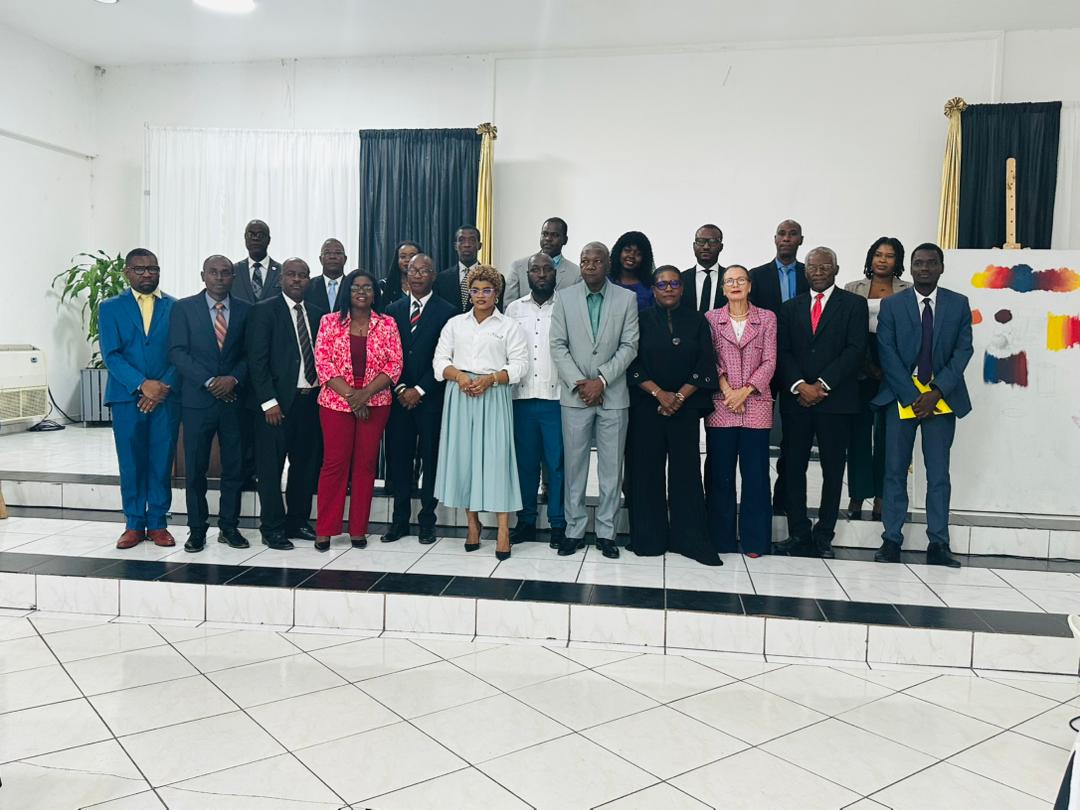
Intellectual Property Week closed in style and with great legal pomp. To wrap up seven days of awareness, the Haitian Copyright Office (BHDA) and the Ministry of Culture and Communication staged, on April 28, 2026, a mock trial that kept lawyers, artists, and creators on the edge of their seats in the hushed setting of the Montana Hotel. Members of the bar, authors, musicians, producers: the call was answered. And for good reason, there was a real trial to follow, even if it was fictional. The Port-au-Prince Court of First Instance relocated its sessions for one evening under the chandeliers of the Montana. At the heart of the dispute: an artist, the complainant, a victim of the unauthorized use of her musical works by Chamy Production. A fictional case, but with terribly real contours, and one that the complainant would win, to the great relief of an enthralled audience.
Taking the floor in turn, the Acting Director General of BHDA, Mr. Ernst Saint Louis, reviewed the outcome of a busy week. The institution recorded a significant number of new creators, particularly in the digital sector, a sign that awareness-raising is bearing fruit. The DG of BHDA announced that a chatbot has been designed to answer authors’ questions about their rights and will be available soon. In order to be close to artists in the far North, he announced the opening of a new office so that the protection of rights does not remain the prerogative of the capital.Furthermore, representing the Minister of Culture and Communication, the Director General of the MCC, Ms. Stéphanie Saint Louis, mentioned that the ministry will stand by content creators. “The protection of works of all kinds, in all forms, is a priority,” she emphasized. Concrete initiatives are announced to stimulate creativity while ensuring strict respect for copyright.The evening was structured around two mock trials, offering the audience an educational insight into the legal mechanisms that govern artistic and literary creation in Haiti. Far from the abstraction of legal texts, these role-plays made concrete the remedies available to any creator whose works were exploited without consent or compensation. An approach that contrasts with usual discourse, and which, evidently, works.
The event concluded as it should: in conviviality and music. A cocktail and entertainment provided by the group Diapason ended this Intellectual Property Week on a note that was both warm and symbolic, because ultimately, all of this is to defend those who keep Haitian culture alive.