
|
Getting your Trinity Audio player ready...
|
The 38th regional seminar of ECLAC on fiscal policy brought together representatives from 11 countries in order to examine stabilization and sustainable development strategies.
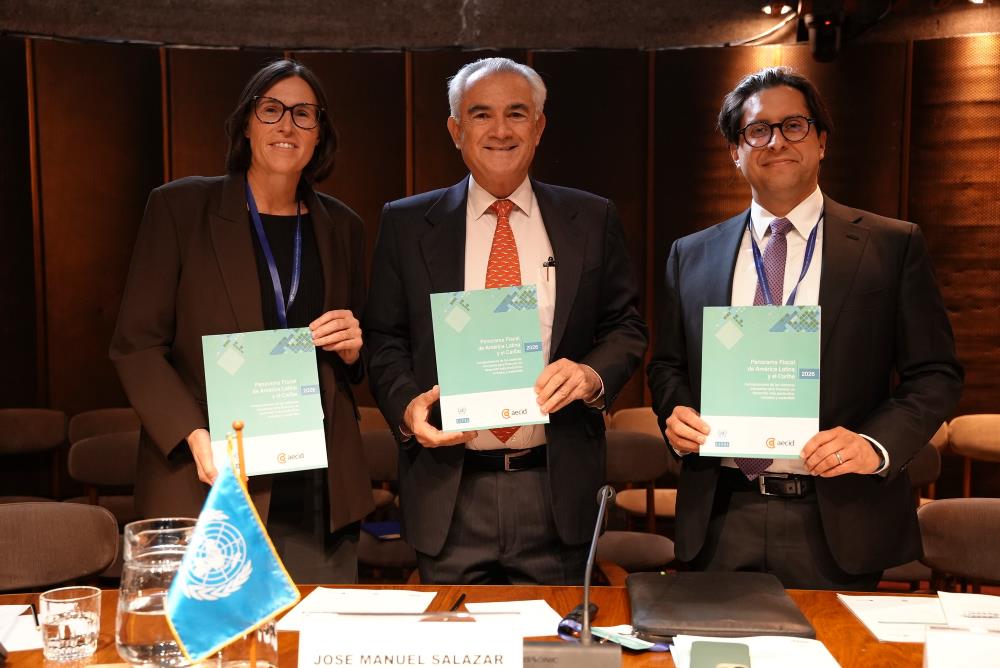
concluded this Wednesday at the headquarters of the Economic Commission for Latin America and the Caribbean (ECLAC) in Santiago, Chile. Participating authorities and experts called for strengthening fiscal policy in order to face the multiplication of external shocks and to promote more productive, inclusive, and sustainable development. The authorities emphasized the importance of a more active role for fiscal policy, supported by strong institutions and prudent debt management, as a prerequisite for strengthening the economic and social resilience of the region.The participants agreed that fiscal policy is an essential tool for promoting macroeconomic stability and fostering sustainable development. This seminar, organized by ECLAC with the support of the Spanish Agency for International Development Cooperation (AECID) and the Inter-American Development Bank (IDB), the Organisation for Economic Co-operation and Development (OECD) and the International Monetary Fund (IMF), has been bringing together for over thirty years representatives of authorities, specialists, civil society, and the academic world in order to examine the fiscal policy challenges facing the countries of the region.As highlighted by the Executive Secretary of ECLAC, José Manuel Salazar-Xirinachs, during the opening session of the seminar on Monday, May 4, the region is facing an extremely volatile external environment, which has caused significant shocks to prices, inflation, and the conditions of national and international financial markets. “Shocks, such as those resulting from the conflict in the Middle East, have become increasingly frequent, with both economic and social negative consequences,” he explained.At the same time, the region is trapped by three barriers to development: low capacity for growth and transformation; high inequalities, low social mobility, and weak social cohesion; and a third, weakness of institutions and governance,” emphasized the senior United Nations official.
“These barriers are not isolated from the external environment. On the contrary, international shocks exacerbate them and make them more difficult to overcome. It is precisely here that fiscal policy must play a central role: as a stabilization mechanism in the face of external shocks and as a strategic tool to stimulate development,” he added.The Spanish ambassador to Chile, Laura Oroz, also spoke during the opening session of the seminar, emphasizing that fiscal policy is not merely a technical tool, but an essential instrument for social cohesion, reducing inequalities, and strengthening the social contract and democratic legitimacy. “Spain is firmly convinced that only close collaborations, based on complementarity and cooperation, will enable the advancement of fiscally sound, socially legitimate, and politically viable reforms. The 38th ECLAC Regional Seminar on fiscal policy represents a privileged space to reinforce this approach, share experiences, and continue developing common solutions,” she emphasized.During the meeting, the Executive Secretary of ECLAC presented the 2026 Latin America and Caribbean Budget Overview, an annual publication in which the United Nations regional organization examines issues relevant to the regional debate on fiscal policy.
According to the report, Latin America continues to have limited fiscal room for maneuver in a context of higher financing costs. Public debt has increased, reaching 52.3% of GDP, compared to 51.9% in 2024. Although this level represents a slowdown compared to the rise recorded in 2020, it remains high, close to the levels reached in the early 2000s, when the region faced a series of economic and financial crises.