
|
Getting your Trinity Audio player ready...
|
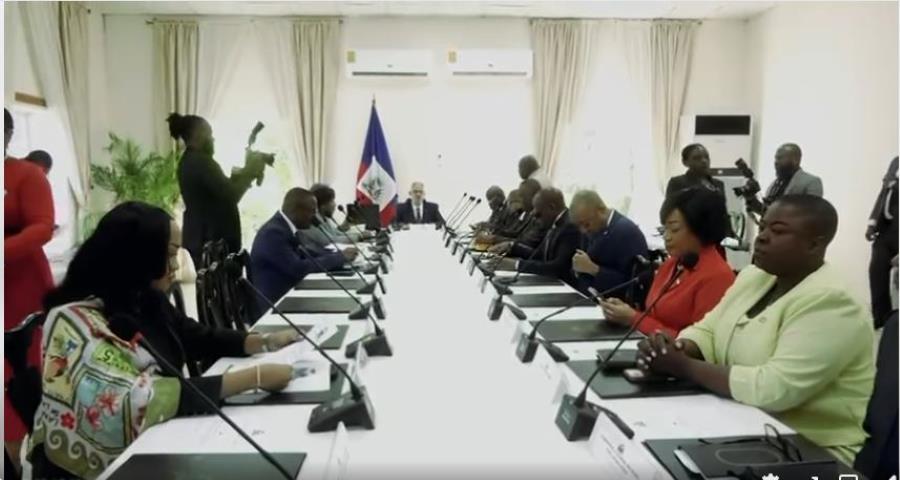
Meeting in Council of Ministers, the transitional government, led by Prime Minister Alix Didier Fils-Aimé, adopted, in Council of Ministers on June 2, 2026, the 2025-2026 amending budget with a total envelope of 360.3 billion gourdes, according to a press release from the Ministry of Economy and Finance.
Meeting in Council of Ministers, the transitional government, led by Prime Minister Alix Didier Fils-Aimé, adopted the 2025-2026 revised budget on June 2, 2026, with a total allocation of 360.3 billion gourdes, according to a press release from the Ministry of Economy and Finance.
This new budget represents a 4.3% increase compared to the initial 2025-2026 budget and aims to strengthen the strategic priorities identified by the transitional government, namely the restoration of public security, the organization of elections, and the macroeconomic stabilization of the country.
of the 2025-2026 Fiscal Year
Two fundamental reasons justify the preparation of this revised budget, according to the press release. These are:
The less unfavorable economic situation the country is currently experiencing, despite the persistence of structural weaknesses.
The real GDP growth, initially projected at +0.3% for 2025-2026, has been revised to -1.9% given the observed trend.
However, the expected economic contraction is expected to remain less pronounced than in 2024-2025, reflecting a relative improvement in the economic environment.
Orientation of the 2025-2026 Revised Budget
Beyond responding to current public safety emergencies, this revised budget, the press release explains, also falls within the framework of the three strategic priorities adopted by the government:
Food security, strengthening the government’s social program, and access to basic social services;
Economic recovery, infrastructure rehabilitation, and agricultural revival;
The organization of elections.
Furthermore, the macroeconomic framework has been revised to preserve macroeconomic stability, while taking into account financing constraints and inflationary risks.
Given the assumptions made regarding public revenue, the tax burden is expected to remain relatively stable compared to 2024-2025.
Moreover, Treasury bond issuances will be adjusted according to market conditions and the absorption capacity of the financial system.
The 2025-2026 Amending Budget will be financed by the General Directorate of Taxes (DGI) and the General Customs Administration (AGD) for 67.5% of the Ways and Means, amounting to 243.1 billion gourdes. Grants and loans total 70 billion gourdes, representing 19.4% of the total.Adding Treasury bonds (24.1 billion gourdes), the BRH loan (16.45 billion gourdes), and other domestic project financing (4.3 billion gourdes) to current revenues, domestic resources total 288.7 billion gourdes and contribute 80.1% of the overall budget.
Current expenditures (213.7 billion gourdes) represent 59.3% of the overall budget, with personnel expenses (31.5% of the total) and expenditures on goods and services (19.4%) being the largest categories.
Capital expenditures total 146.6 billion gourdes and represent 40.6% of the budget, reflecting the government’s commitment to continuing the public investments necessary for public safety and the recovery of the country’s economy.Through this revised budget, the government reaffirms its commitment to rigorous and transparent management of public finances, in order to address the priority challenges facing the population, consolidate macroeconomic stability and promote a sustainable recovery of economic activity, the statement concludes.