
|
Getting your Trinity Audio player ready...
|
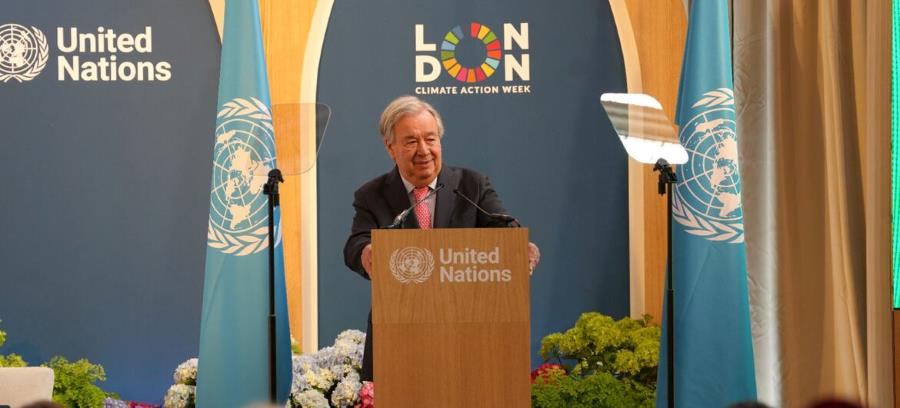
As a deadly heatwave continues to hit Europe on Tuesday, UN Secretary-General António Guterres has made a strong call for more ambitious global action on fossil-fuel-driven climate change to prevent irreversible damage.
As a deadly heatwave continues to hit Europe on Tuesday, UN Secretary-General António Guterres made a strong call for more ambitious global action on climate change caused by fossil fuels, in order to avoid irreversible damage.
In a speech at London’s Climate Action Week, the UN chief urged artificial intelligence (AI) companies to ensure full transparency on the environmental footprint of their data centers, particularly regarding carbon emissions, water use, and land use.The Secretary-General pointed out that the world’s dependence on oil is fueling both the climate crisis and an energy sovereignty crisis, the latter being linked to massive disruptions in shipping traffic through the Strait of Hormuz and the conflict involving Iran, Israel, and the United States.
“These crises may seem separate, but they share the same destructive root: fossil fuels. And they demand the same response: a swift and fair transition to clean energy, along with strengthening adaptation, resilience, and climate justice for those already suffering the harmful effects of climate change,” said Mr. Guterres, urging political leaders to carry out a global transformation similar to what was needed to phase out leaded gasoline and ban chemicals responsible for the ozone hole.
In short: the UN’s plan for energy independence
Cut emissions quickly: emissions need to peak right now and reach net zero by 2050, notably through a global initiative to limit methane pollution.
Speed up clean energy development: we need to keep expanding renewable energy, end subsidies for fossil fuel projects, and tax profits from these to support vulnerable communities and the energy transition.
Clean up AI: require big AI companies to disclose the environmental impact of their data centers and power them with renewable energy by 2030.Ensuring a fair transition: making sure the shift to clean energy creates jobs, supports communities, and brings development benefits to developing countries.
Building climate resilience: increasing investments in adaptation, early warning systems, and other measures to protect the people most vulnerable to the effects of climate change.
Unlocking fair financing: expanding access to affordable funding for developing countries so they can invest in clean energy, climate adaptation, and sustainable development.
Standing up for science and truth: boosting trust in science, fighting climate misinformation, and protecting environmental journalists and human rights defenders.
Extreme weather events linked to climate change are causing droughts and floods like this one in Thailand.
Earth’s tipping points
It’s been more than a decade since world leaders agreed in Paris to limit the global temperature rise to 1.5°C above pre-industrial levels, a remarkable show of international unity under the UN. Today, even though this agreement is still in place—and despite the US officially pulling out for the second time in January of this year—UN-backed scientists warn that average annual temperatures are likely to exceed this threshold in the coming years.”Every fraction of a degree counts,” the Secretary-General stressed, while warning about the irreversible damage to coral reefs, which can’t survive in overly warm waters, the melting of ice sheets that could reshape coastlines and displace millions of people, and the real possibility that some small island states could disappear under the waves.
Faced with this existential scenario, “the task ahead of us is to strictly limit this overshoot, shorten its duration, and bring temperatures back below 1.5°C as quickly as possible,” Mr. Guterres argued.”The mother of all energy shocks”
While emphasizing that “any peace agreement is welcome and would provide much-needed relief,” referring to a 60-day truce aimed at allowing talks between Iran and the United States in Switzerland to continue, the UN chief noted that the crisis in the Middle East had triggered “the mother of all energy shocks,” comparable to the 1970s oil crisis and Russia’s large-scale invasion of Ukraine.
As devastating as the war in the Middle East has been for highly industrialized countries, the UN Secretary-General stressed that developing countries had been hit even harder:
“It’s a debt shock, a food shock, a development shock,” he told the London audience.
A fair future thanks to renewable energy
“The good news is that—unlike all past energy crises—we now have a clear way out, a clean way out,” Mr. Guterres continued.
He pointed out that since 2010, the cost of solar energy has dropped by nearly 90%, that of onshore wind by more than 70%, and battery storage by 95%.
Renewable energy has prevented carbon dioxide emissions greater than the combined annual emissions of the United States, the European Union, and Japan, said the UN chief, adding that investments in clean energy now attract nearly twice as much funding as those in fossil fuels.