
|
Getting your Trinity Audio player ready...
|
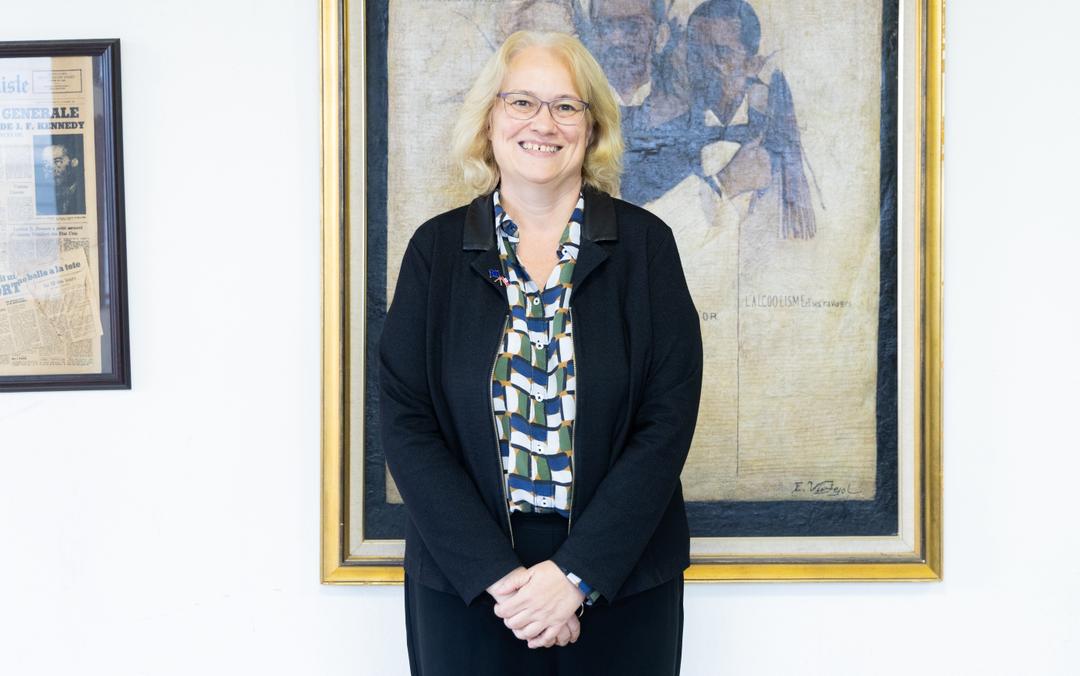
By opening this Monday, June 29, 2026, the very first National Investment Forum of Haiti, the European Union ambassador, Hélène Roos, laid the foundations for a new chapter in the partnership between Haiti and the EU.
By opening on Monday, June 29, 2026, the very first Haiti National Investment Forum, European Union Ambassador Hélène Roos set the groundwork for a new chapter in the partnership between Haiti and the EU. Part of the Global Gateway strategy, the event brings together public authorities, chambers of commerce, financial institutions, and European partners around one goal: to boost productive investment, create quality jobs, strengthen businesses, and improve citizens’ living conditions. Below, we publish the full text of her speech.
Mr. Prime Minister,
Madams and Sirs, the Ministers,
Mr. National Coordinator,
Gentlemen, Ambassadors of France and Spain (I also greet online my colleague,
the Ambassador of Sweden),
Mr. Ambassador of Haiti to the European institutions,
Gentlemen, Presidents of the chambers of commerce,
Dear partners,
Ladies and gentlemen,
First of all, allow me to warmly thank you for being here at this first National Investment Forum. I also greet Jacques Attali, who has agreed to be our special guest. It’s always reassuring to start an investment forum with someone who has already thought about pretty much every possible topic.This event marks an important milestone in the evolution of the partnership between the European Union and Haiti. It could serve as a new starting point.
Three months ago, all the major chambers of commerce in Haiti sent me a letter requesting this seminar. In a context of deep changes, the Haitian private sector expressed a desire to look toward the future, strengthen strategic dialogue with its international partners, and identify investments that create added value, jobs, and economic resilience.
From there, a momentum started. Haiti and the Global Gateway strategy: why not? Why not allow Haiti to re-engage on the international stage through the economic dimension? Why not seize the Haitian private sector’s willingness to move forward, build, and open up? Why not show that the Global Gateway can also apply to a country in a fragile situation?If Haiti’s image today is too often associated with insecurity and gang violence, the initiative from the Haitian private sector, supported by you, Mr. Prime Minister, shows another Haiti: a Haiti that looks for solutions, that wants to build and rebuild, that has talents, skills, and entrepreneurs capable of carrying solid projects. As the GSF is deployed and the Haitian National Police increases pressure on the gangs, it’s time to outline together the prospects for economic recovery. A safer Haiti.
Haiti will be more prosperous; and a more prosperous Haiti will also be a more stable Haiti.
Haiti today is living in an economy of crisis and survival, marked by the size of the informal sector, the decapitalization of the private sector, and the weakening of state resources. To reverse this trend, action must be taken on all fronts: security, governance, infrastructure, reforms, but also productive investment.
This is what the European Union is doing, as Haiti’s main development partner and primary provider of humanitarian aid. This is also what the EU member states are doing together, as the second-largest contributors to the GSF Trust Fund.
However, one essential dimension was missing: economic recovery, investment, and partnerships with the private sector.So, the Global Gateway strategy, what is it? My colleague Felix Fernandez Shaw will come back to it in a moment from Brussels. As for me, I would like to highlight its meaning. Last June 15, the European Council reaffirmed that the Global Gateway is the European Union’s global strategy aimed at establishing mutually beneficial partnerships and mobilizing both public and private resources. It’s about building sustainable and mutually beneficial partnerships, mobilizing public and private resources, and creating investment-friendly ecosystems.These ecosystems rely on reforms, infrastructure, financing, and economic activity that reinforce each other. Simply put: it’s not enough to have good projects; you also need the right roads, the right funding, the right rules, and the right partners.
In Haiti’s case, there can be many areas of common interest: energy, transport infrastructure, logistics, agribusiness, mining, and especially rare earths. The challenge is to identify sectors where Haiti can create sustainable value, with local job development and balanced partnerships.
This ambition takes shape through the “Team Europe” approach, which brings together the European External Action Service, the European Commission, our 27 member states, European financial institutions, and the private sector around a common goal: designing and implementing transformative investmentsSo we are at the first step of a new path. We will need to learn to work differently, with more integration between public, private, and financial players.
If this day allows the State, the private sector, banks, donors, and Brussels to move forward together, then we will have collectively scored points and shown that, yes, it is possible to consider working with Haiti, including in the economic field. Solutions can emerge if we all move in the same direction.
The Global Gateway strategy is not a break from the past, but an evolution. Itaims to build on the results already achieved and take them to a higher level.
The programs implemented by the European Union over the years pursue a common goal: to help create a more favorable environment for investment, job creation, and the country’s economic development.
I’m particularly thinking of the work done with the National Authorizing Officer and his team for the implementation of the 11th European Development Fund up to 2028. I also think of the effective work carried out with the BON and our cooperation teams to support the private sector towards stronger and more attractive partnerships for investors. In a word, to move forwardtowards the strategy proposed by the Global Gateway.
For several years, the European Union has been supporting the Ministry of Economy and Finance in reforms aimed at strengthening the country’s economic and financial governance.
It also supports the modernization of the Haitian customs administration: simplification of procedures, transparency, improvement of human resource management, and modernization of equipment. These actions facilitate trade, improve the efficiency of public services, and ultimately can strengthen state capacities.
Improving infrastructure is also an important focus of our cooperation. The
The rehabilitation of National Road No. 3, which connects Port-au-Prince to the northern part of the country, illustrates this desire to improve connectivity across the territory, reduce transportation costs, and promote the economic integration of the regions. We were there together in January, Mr. Prime Minister.
Finally, the development of the productive sector remains at the heart of our priorities. That is where the jobs, added value, tax revenues, and, above all, confidence in the future are found.
Today, the Global Gateway helps bring together and structure this vision. It should help mobilize the investments, partnerships, and expertise needed. That is the European proposal.And this is also what led the European Union to support the initiative of the Haitian private sector in organizing this National Investment Forum.
Of course, no one is unaware of the challenges Haiti is facing. They are real and continue to draw the attention of the European Union and its partners. But while fully acknowledging them, we want to focus on the opportunities, growth prospects, and the considerable potential of this country.
The goal is clear: to boost productive investment, create quality jobs, strengthen businesses, improve citizens’ living conditions, and help reverse the trend.This day fits within that dynamic.
You are all key players in this process: businesses, financial institutions, public authorities, and development partners. It is through your collective action that the opportunities identified today can become the investments, jobs, and growth of tomorrow, as well as the foundations of our economic and commercial exchanges.
I thank you once again for your presence and commitment. I hope this day will be full of exchanges, but above all, that it can mark a new stage in the partnership between Haiti, the European Union, and especially the private sector, both European.Haitian.
The European Union, in Haiti as in the rest of the world, aims to be a reliable,
credible, and long-term partner. And we hope that starting today, this partnership can
translate not just into ideas, but into projects, timelines, and results.
I wish us a rich and productive day.