
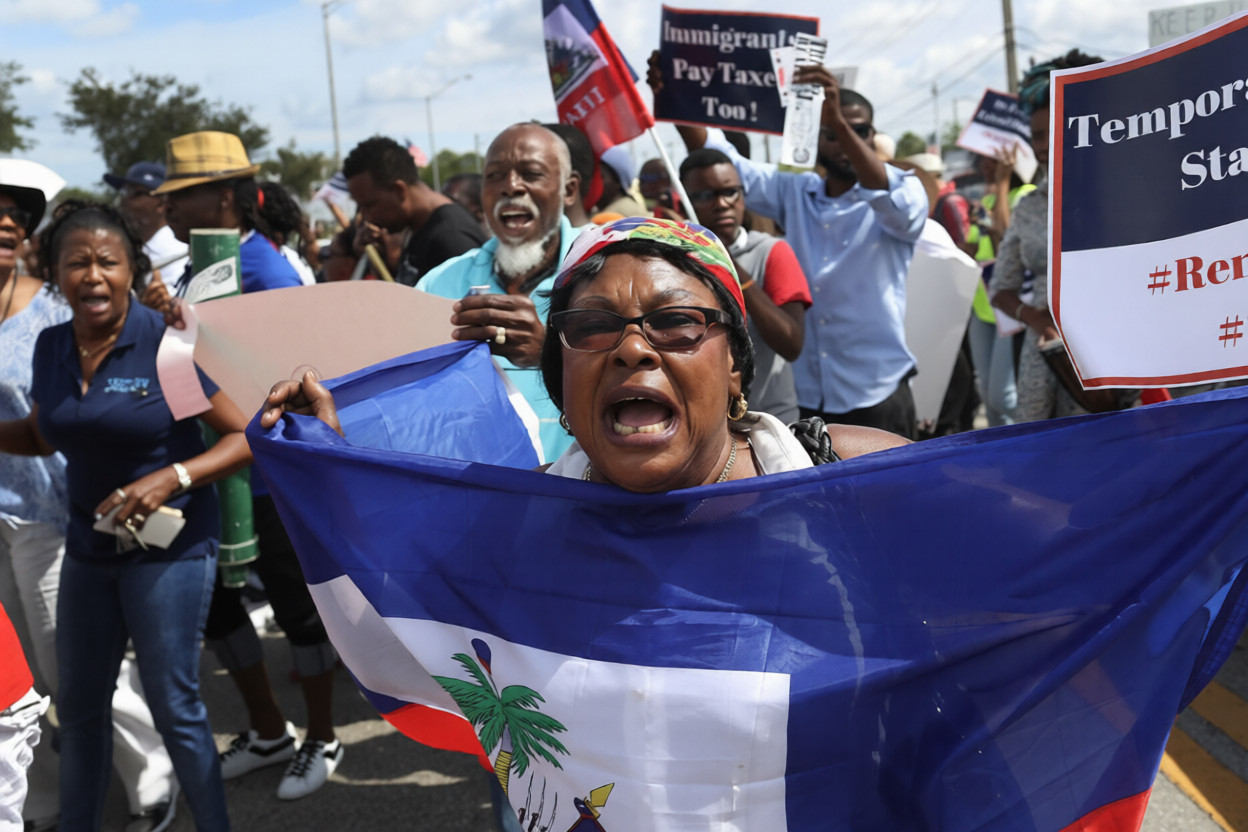
Hundreds of thousands of Haitians are facing the prospect of having to leave the United States on their own or being deported, with the revocation on Monday night of a temporary protection status that had allowed them since 2010 to live and work legally in the country.
Hundreds of thousands of Haitians are facing the prospect of having to leave the United States on their own or being deported, with the revocation on Monday night of a temporary protected status that had allowed them since 2010 to live and work legally in the country.
“You can’t move. You’re like a prisoner, even though you haven’t done anything wrong,” a Haitian healthcare worker who has benefited from this TPS status for many years told AFP.
The person she cares for, she adds, risks having a “broken heart.
“TPS protects its beneficiaries from deportation and gives them the right to work, but it doesn’t allow access to permanent residency or U.S. citizenship.
It is granted temporarily to immigrants whose safety is at risk in their country due to conflicts, natural disasters, or other “extraordinary” conditions.
Last month, the Supreme Court, with a conservative majority, allowed the Trump administration, which is carrying out a massive deportation policy, to take it away from the roughly 350,000 Haitians and 6,000 Syrians who benefit from it.
And on Wednesday, in Congress, a Republican senator blocked Democrats’ attempt to extend temporary protection for Haitian nationals.According to several immigrant advocacy organizations, Haitian beneficiaries of TPS represent about 200,000 workers in the United States, especially in the healthcare, construction, transportation, and hospitality sectors, who are worried about the consequences of having this status revoked.
According to Nancy Hagans, president of a nurses’ union in New York State (the New York State Nurses Association, or NYSNA), several thousand of her members will no longer be able to work legally starting at midnight.
Facing the prospect of detention by federal immigration services and then deportation, her organization advises them to “get their papers in order” and, “if they have money in the bank, to withdraw it,” she told AFP.”A Life Here”
“Some people own their homes. They’ve been here for 26, 27 years, they’ve built a life here,” reminds Ms. Hagans.
“What the government has just done is take away resources not only from hospitals, nursing homes, and the most disadvantaged communities, but also deprive our communities of an important source of economic activity,” she denounces.
For Lyne Lucien, an American-Haitian artist based in New York, “one of the hardest things about this decision is the uncertainty it creates.”
Members of the Haitian diaspora “worry that families will end up separated” and “wonder if returning to Haiti is safe or realistic given the current conditions,” she says.
The poorest country in the Americas has suffered for decades from natural disasters, like the 2010 earthquake, political instability, and corruption.The country hasn’t had any elections since 2016, and its last president, who was assassinated in 2021, hasn’t been replaced.
Since the beginning of 2024, Haiti has also been hit by a wave of violence carried out by gangs that control almost all of the capital, Port-au-Prince, and the main roads.
Since Donald Trump returned to the presidency in 2025, his administration has revoked TPS for migrants from about fifteen countries, including Venezuela, Nicaragua, Honduras, and Somalia, putting over a million immigrants at risk of deportation.
Some of these decisions are still being contested in court.