
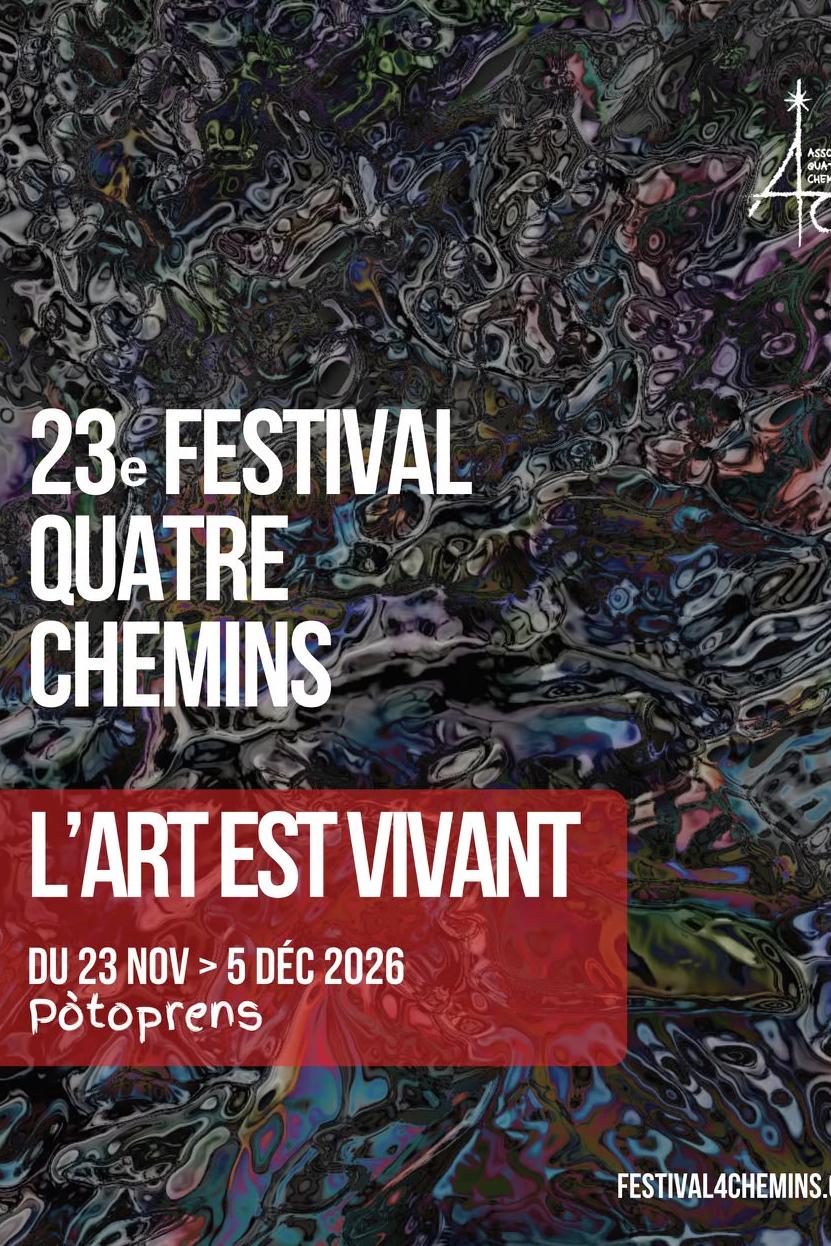
Through the work of Maksaens Denis chosen for the poster of the 23rd edition of the Quatre Chemins Festival, Jacques Adler Jean Pierre explores the relationships between image, memory, movement, and abstraction.
Through the work of Maksaens Denis chosen for the poster of the 23rd edition of the Quatre Chemins Festival, Jacques Adler Jean Pierre explores the connections between image, memory, movement, and abstraction. As an artist himself and a keen observer of Haitian creation, the author offers a sensitive look at Denis’ approach and the work of graphic designer Kensley Mervil, who brings new life to this work in public space. It’s a perspective that invites you to see contemporary Haitian art differently, without trying to impose a single meaning.
A work by Maksaens Denis at the heart of the poster for the 23rd Quatre Chemins Festival, taking place in Port-au-Prince from November 23 to December 5, 2026.
Art is alive.This statement, chosen as the guiding theme of the 23rd edition of the Quatre Chemins Festival, takes on a special resonance when you look at the work of Haitian artist Maksaens Denis and the way it was graphically reinterpreted by Kensley Mervil to create the festival poster.
Here, the image isn’t just something you look at. It seems to move, transform, and break away from its origin to become something else. It places us in that fragile space where photography meets video, where material meets abstraction, and where memory stops being an archive to become an experience.Maksaens Denis’ work is precisely marked by this desire to shift perspectives.
From video to abstraction: forgetting to create better
When asked to talk about the genesis of this work, the artist doesn’t try to artificially reconstruct its origin. On the contrary, he embraces forgetting as an integral part of the creative process.
Originally, he explains, there was a video. It was worked on using different software, subjected to various effects, and then paused on a single frame. But that frame itself was just a step.
Maksaens Denis continued his work all the way to abstraction, to the point of no longer remembering the original image.This process is particularly revealing of his approach: the work is not just about transforming an image, but gradually freeing it from its original identity.
The starting image disappears. It becomes matter. Then the matter becomes movement. And finally, the movement remains in a still image.
Perhaps this is where one of the mysterious strengths of this creation lies: it lets us see something whose memory even the artist himself has agreed to lose.
An image without a forced message
Maksaens Denis also refuses to lock this work into a single interpretation.He clarifies that there isn’t, strictly speaking, a theme or message that he intended to convey through this creation. This stance is important. It gives the work its space for freedom and the viewer their own territory for interpretation.
Yet, this lack of an explicit message doesn’t mean there’s a lack of depth.
Throughout his artistic journey, memory, spirituality, the injustices faced by the Haitian people, and the realities experienced by the LGBT community have played an important role. These are, he says, recurring concerns, questions he keeps coming back to.
So, even when a work doesn’t state anything directly, it can still carry the traces of the artist’s concerns.Maksaens Denis: Art as a Plural Language
Video, photography, music, performance: Maksaens Denis works in a universe where the boundaries between disciplines become porous.
For him, the image is never completely still. Even when it appears as a photograph or a graphic composition, it seems to retain the memory of the movement that created it.
This is exactly what makes his work particularly interesting in the context of the Quatre Chemins Festival, a place where performing arts, bodies, images, voices, and imaginations come together.The artwork chosen for the poster seems to carry within it a fruitful contradiction: it is still, yet it suggests movement; it is abstract, yet it seems to retain a trace of reality; it is silent, yet it opens up an intimate dialogue.
When the artwork becomes a poster
Graphic designer Kensley Mervil’s work adds another dimension to this piece.
By making Maksaens Denis’s creation a central element of the poster for the 23rd edition of the Quatre Chemins Festival, the designer isn’t just illustrating an event. He’s also taking part in a process of transformation.The work then moves from an artistic space to a public space. It leaves the realm of original creation to enter the streets, screens, social media, cultural spaces, and the public’s imagination.
Maksaens Denis creates an image that gradually moves away from its origin. Kensley Mervil then gives it a new graphic life.
Two artistic gestures meet: the artist’s, which deconstructs the image, and the graphic designer’s, which reconstructs it in a new visual environment.
The poster thus becomes more than just a communication tool. It becomes a new stage in the life of the work.
Look without trying to understand right away
So what should the viewer do in front of this image?
Maksaens Denis doesn’t give instructions.
He doesn’t ask the audience to immediately search for a hidden meaning. Instead, he invites them to get carried away by what he beautifully calls “the movement of the still image.”This expression almost alone sums up the experience being offered.
Look.
Stop.
Let yourself be touched by the shapes.
Accept not understanding everything.
And above all, let your own interpretation arise.
Because living art may not be the one that gives us answers, but the one that keeps producing questions long after we’ve stopped looking at it.A Work in Motion
In this creation by Maksaens Denis, taken up and put into dialogue by Kensley Mervil for the poster of the 23rd Four Paths Festival, the image thus becomes a territory of passage.
It moves from video to still image, from still image to abstraction, from abstraction to poster, and then from poster to the viewer’s gaze.
At each step, something is lost — the original image, its primary identity, perhaps even its memory — but something else appears.
Maybe this is what living art is all about: a work that never stays exactly where its creator placed it, because every gaze gives it a new existence.
And in front of this work, Maksaens Denis leaves us an essential freedom: to look without instructions, to feel without obligation, to interpret without boundaries.The image is still.
But in the eyes of the one who gazes at it, it keeps moving.
Jacques Adler Jean Pierre