
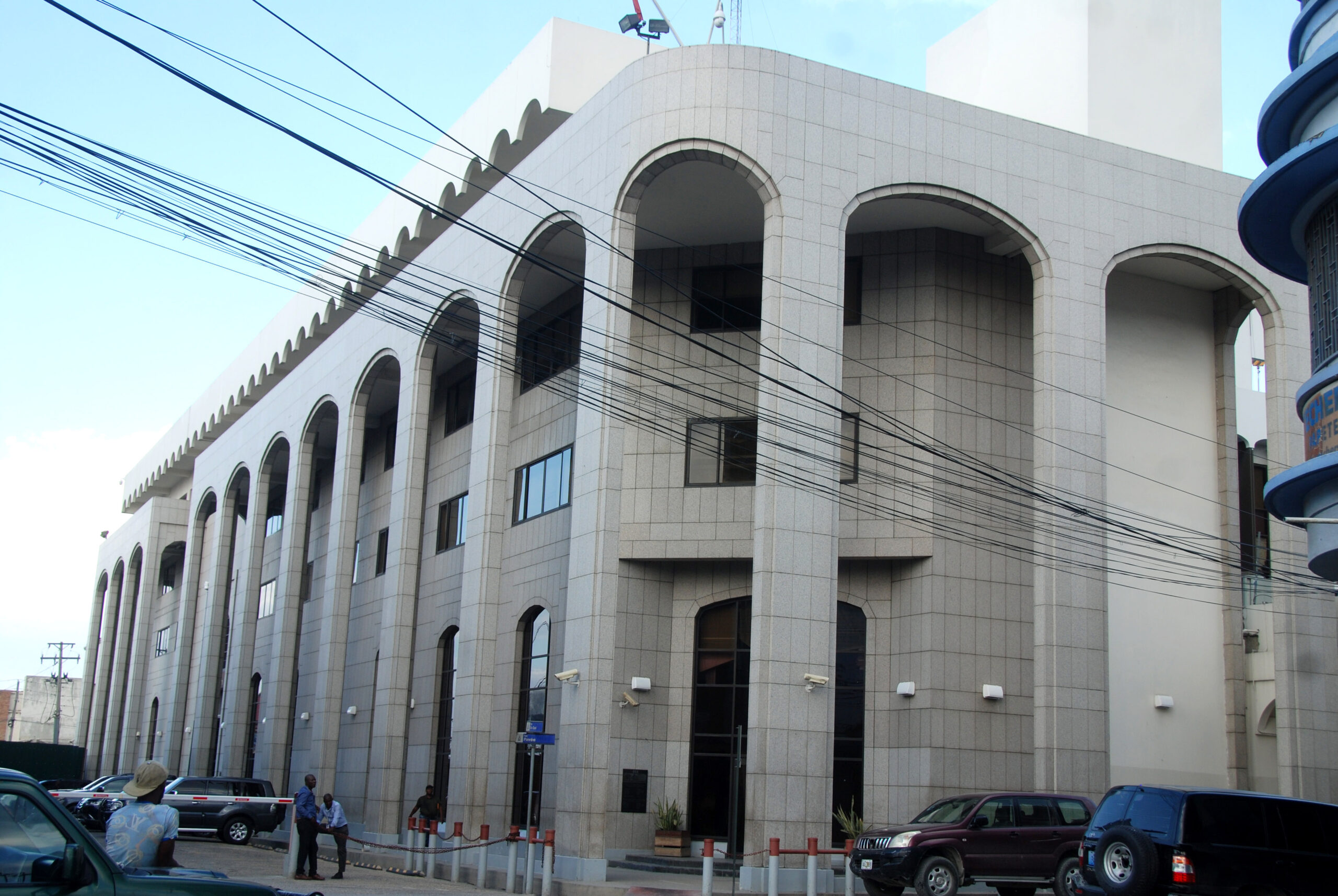
The Research Department in Economics and Finance at the Bank of the Republic of Haiti (BRH) published at the end of July 2026 a study entitled: ‘Banking System Stability and Stress Tests in Haiti: A Bayesian and Quantile Approach to Systemic Risks.’
At the end of July 2026, the Research Department in Economics and Finance of the Bank of the Republic of Haiti (BRH) published a study titled: ‘Banking System Stability and Stress Tests in Haiti: A Bayesian and Quantile Approach to Systemic Risks.’ The study, authored by economists Jean Marie Cayemitte and Jean Sobocoeur Chrispin, shows that the Haitian banking system has a relatively good capacity to absorb isolated shocks. However, this resilience remains fragile when several negative factors combine, especially during periods of political crisis. Using annual data covering the period 2000-2024, the study recommends strengthening capital buffers, more sophisticated monitoring of systemic risk, and better management of foreign exchange risk.The researchers’ goal is to figure out how much Haitian banks can handle different macroeconomic shocks, and also to see how these shocks affect the financial system depending on whether the economy is in a crisis, stable, or growing. To do this, they combine a Bayesian vector autoregressive model with a quantile regression approach. This method works really well for small economies with limited statistical data and helps get a clearer picture of how the financial system behaves in extreme situations.
The starting point of the analysis is a Haitian economy marked by high volatility. Between 2000 and 2024, average economic growth was only 0.87%, with fluctuations around this average ranging from -5.65% to 5.89%. On top of this macroeconomic instability, there is the recurring exposure to political crises and the country’s vulnerability to natural disasters. These factors make assessing the strength of the banking system especially important. According to the authors, classic economic models, which are based on linear relationships, may give an incomplete picture of vulnerabilities. The same economic shock can have very different effects depending on whether the country is in a period of recession, stability, or expansion.The study uses 25 annual observations, from 2000 to 2024, coming mainly from the BRH, the World Bank, and the international disaster database (EM-DAT). Using Bayesian methods allows researchers to better take into account the limitations of the small sample size.
Inflation and the exchange rate at the heart of vulnerabilities
Results from the Bayesian vector autoregressive model show that inflation is one of the main channels through which shocks are transmitted to the banking sector. It explains between 25% and 35% of the variance of several financial indicators depending on the time horizon. Non-performing loans are particularly sensitive to price changes. In the medium term, inflation’s contribution to changes in non-performing loans increases, while the contribution of factors specific to the banking sector decreases. The return on assets (ROA) is also affected by macroeconomic conditions, especially inflation and the exchange rate.The exchange rate also appears to be a major transmission channel. A depreciation of the currency leads to higher inflation and hurts banks’ profitability. Non-performing loans also increase, while capital buffers gradually shrink. This vulnerability is particularly worrying in an economy that heavily depends on imports. A depreciation of the gourde raises costs for businesses and households, weakens their ability to repay, and can, therefore, affect the quality of bank portfolios.One of the most interesting findings of the study is that the relationship between economic growth and bank profitability isn’t constant. During a severe crisis, the sensitivity of return on assets (ROA) to growth is only 0.05. It goes up to 0.08 in the median scenario and rises to 0.12 during periods of strong expansion. In other words, banks benefit more from growth when the economy is expanding than they manage to turn an uptick in activity into profitability when facing a crisis.
This difference is important for supervisory authorities. According to the authors, traditional linear models can underestimate the banking system’s vulnerabilities during times of crisis and, conversely, overestimate certain sensitivities during expansion phases. Stress tests therefore need to be adapted to the economic regime the country is in. The study also finds that the transmission of inflation to non-performing loans is stronger during tough times. The elasticity of non-performing loans to inflation reaches 0.15 in the quantile corresponding to severe crises. It gradually decreases to 0.08 during periods of expansion. In a crisis, the erosion of purchasing power and the financial difficulties of borrowers make the banking system much more sensitive to inflationary pressures.This observation leads the authors to recommend paying close attention to inflation when the economy is in a downturn. The same inflation rate shouldn’t necessarily trigger the same response from authorities depending on the economic context.Diaspora transfers play a stabilizing role. The study also highlights the importance of these transfers for the country’s financial stability. They help strengthen the banking system and account for a significant part of the changes in the capital ratio. Their contribution to this measure ranges from 8.9% to 9.8%, depending on the time frame considered. Transfers also support the dynamics of GDP and the exchange rate.
The quantile analysis reinforces this finding: the effect of transfers on the equity ratio goes from 0.15 in severe stress situations to 0.35 during expansion periods. The authors see this as an important stabilizing mechanism for the Haitian economy. This stabilizing role is especially clear in the natural disaster scenario. While GDP would contract by 8%, transfers would increase by $1.5 billion, helping to limit the impact of the shock on the banking system.Three scenarios to test the resilience of Haitian banks
To concretely measure the resilience of the banking system, researchers built three stress scenarios: a major political crisis, a major natural disaster, and an international financial crisis. These scenarios were calibrated based on the extreme quantiles of the model. The first scenario predicts a 5% contraction in GDP, a 15-point rise in inflation, and a 25% depreciation of the exchange rate. ROA would drop by 3 points, remittances would fall by 500 million US dollars, and non-performing loans would increase by 8 points.The second scenario assumes a natural disaster causing an 8% drop in GDP, an 8-point rise in inflation, and a 15% depreciation in the exchange rate. But it also includes an increase in transfers of 1.5 billion dollars. The third scenario, focused on an international financial crisis, combines a 5.2-point decline in ROA, a 15-point increase in non-performing loans and 12-point inflation, a 35% drop in the exchange rate, and an 800 million dollar decrease. The political crisis looks like the most worrying scenario.The results of the stress tests are particularly revealing. Under normal reference conditions, the probability of a systemic default is estimated at 8%, with expected losses of $3.6 million. The liquidity ratio reaches 78%. In the political crisis scenario, the capital ratio drops to 7.4%. However, it still remains above the regulatory threshold of 5%. But the probability of a systemic default climbs to 15.2%, an increase of 7.2 points compared to the normal scenario. Expected losses would reach $6.8 million, an increase of 89%. The capital shortfall needed to bring the ratio back to 8% would be $12.5 million. The political crisis thus appears to be the most worrying shock for the Haitian banking system. It combines several negative factors: contraction in activity, inflation, currency depreciation, and deterioration of asset quality.
The natural disaster scenario is marked by a bigger economic contraction than in the political scenario, but its effects on the banking sector are paradoxically less severe. The capital ratio stands at 8.1%, while the probability of default reaches 12.8%. Expected losses are estimated at $5.8 million and the capital shortfall at $3.2 million. Diaspora transfers play a key cushioning role here. The inflow of external resources following a natural disaster would help partially offset the negative effects of the economic shock.The international financial crisis shouldn’t be underestimated. The third scenario also leads to a significant deterioration in banking indicators. The drop in bank profitability and the rapid increase in non-performing loans would create a negative loop likely to weaken banks. The capital ratio would fall to 7.8%, the probability of default would reach 14.1%, and expected losses would be $6.3 million. The capital shortfall would be $8.7 million. Researchers thus establish a clear hierarchy of risks: political shocks are the main threat, followed by financial crises, and then natural disasters. This hierarchy remains stable across the different specifications tested by the authors.
Liquidity holds up better than solvency
There’s one fairly reassuring point that comes out of the simulations: the banking system still has a decent ability to withstand liquidity pressures. Even under stress, the liquidity coverage ratio (LCR) stays above the critical 100% threshold. It drops from 125% under normal conditions to 108% in a political crisis scenario, 115% after a natural disaster, and 110% in a financial crisis scenario. The net stable funding ratio (NSFR) also remains above 100% in all three scenarios. This relative resilience is mainly linked to the traditional structure of Haitian bank balance sheets and the dominance of retail deposits. That said, the authors point out that the drop in the LCR during a political crisis shows some vulnerability to confidence shocks.Analyzing by economic regime allows us to go further. In the severe stress scenario, the probability of default reaches 14.7%, and the system’s capital needs are estimated at $49.7 million. The coverage ratio then reaches 24.9% of the reference portfolio. In the median scenario, the probability of default is 9.9% and the capital needs are $33.5 million. During an expansion, the probability of default drops to 8.1% and the capital needs to $27.3 million. So the results show that the apparent strength of the banking system during normal times shouldn’t lead to underestimating the need for protection against extreme shocks.
The authors point out that, in order to keep the capital ratio above 8% in the most adverse policy scenario, banks would need an additional buffer of 1.6 points, bringing the ratio to 9.6%. Rebuilding equity after a severe shock could take three to four years in a moderate growth context, and up to five or six years during a stagnation period.
Based on these findings, the authors advocate for a gradual strengthening of the macroprudential framework. Haitian regulations have distinguished, since the enactment of Circular 88-1, between the leverage ratio and the risk-weighted capital adequacy ratio. The study notes that risk-weighted capital requirements were raised to 12%, with an additional conservation buffer bringing the requirement up to 14.5%.The researchers suggest keeping this overall solvency requirement at 14.5% and adding a 1% countercyclical buffer. In another part of the macroprudential analysis, they consider a range of 1% to 1.5% for this additional buffer, meant to help banks absorb losses during times of political stress. The idea is simple: banks should build up more capital during good times so they can use these reserves when the economy hits a crisis.The study also recommends modernizing early warning mechanisms. Authorities should, in particular, follow the likelihood of a systemic default more systematically and set intervention thresholds that take the economic context into account. The researchers specifically suggest institutionalizing a warning threshold when the probability of a systemic default reaches 12%. They also recommend closer monitoring of indicators related to political instability, especially during elections or periods of social tension. Exchange rate risk management should also be strengthened. The results show that a sharp depreciation of the gourde can quickly affect inflation, bank profitability, and asset quality.
However, the authors do not present their results as definitive. One of the main limitations of their work is the availability of data. The study is based on only 25 annual observations, which reduces the accuracy of the estimates, especially in extreme situations. Annual frequency can also hide certain dynamics that happen within the same year. For future research, the authors suggest using quarterly data more, developing Bayesian vector autoregressive and quantile models, and making comparisons with other economies in the region.
The analysis also looks at the banking system in an aggregated way. So, it doesn’t allow you to pinpoint differences in vulnerability between banks. The authors suggest eventually developing stress tests broken down by institution, integrating interbank networks to measure contagion risks, and better modeling liquidity risk. One of the main lessons from the study is that financial stability shouldn’t be seen as a given. It largely depends on the economic situation, political stability, and currency market conditions. According to the authors, the way forward is a more proactive approach: gradually strengthening capital, developing early warning indicators, improving foreign exchange risk management, and institutionalizing regular stress test exercises that take observed non-linearities into account.Beyond the banking sector, the study highlights a broader reality of the Haitian economy: financial stability remains closely linked to the country’s macroeconomic and institutional stability. Controlled inflation, a less vulnerable foreign exchange market, better forecasting ability, and institutions capable of anticipating shocks are all necessary conditions to strengthen the resilience of the banking system.
The study ultimately offers a roadmap that goes beyond just banking supervision. It calls for improving statistical systems, developing more sophisticated monitoring tools, and better coordinating monetary and macroprudential policies. According to the authors, methodological innovation can help authorities better protect the financial system, even in an environment with limited data and high volatility.