
|
Getting your Trinity Audio player ready...
|
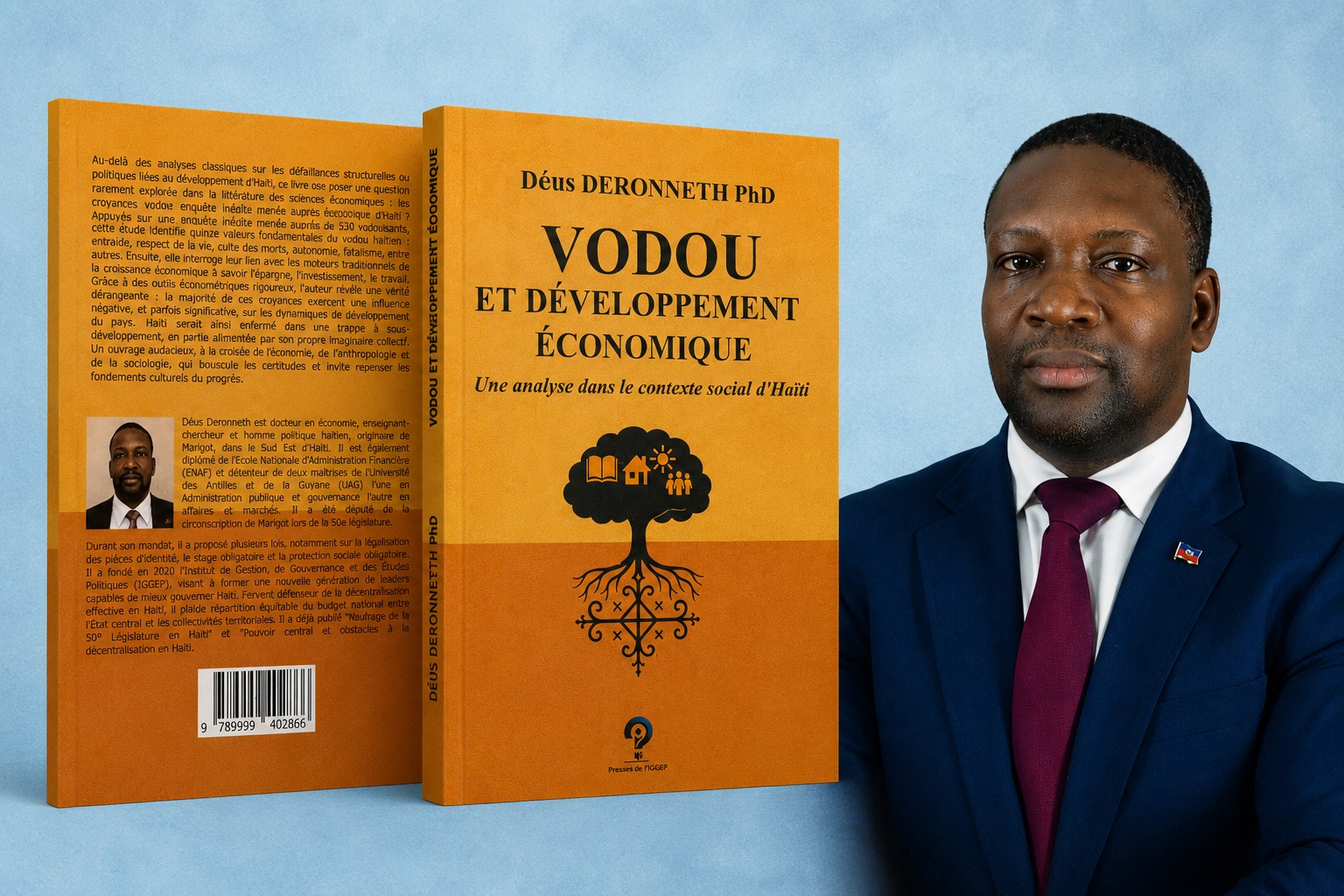
Former deputy and doctor of economics, Déus Deronneth puts Vodou to the test of econometrics. The results shake up certainties.
Published in 2025 by the IGGEP Press, “Vodou and Economic Development: An Analysis in the Social Context of Haiti” raises a question that Haitian economic literature had until now sidestepped: do Vodou beliefs influence the country’s growth? Its author, Déus Deronneth, addresses this question using econometric tools. A Doctor of Economics and a teacher-researcher, Deronneth is originally from Marigot, in the Southeast. A graduate of the National School of Financial Administration and holder of two master’s degrees from the University of the Antilles and Guyana—one in public administration and governance, the other in business and markets—he served as a deputy for his constituency during the 50th legislature. In 2020, he founded the Institute of Management, Governance, and Political Studies (IGGEP), whose Press is publishing this third work, derived from his doctoral thesis. He had previously authored “Sinking of the 50th Legislature in Haiti”.and ‘Central Power and Obstacles to Decentralization in Haiti.’
This 405-page book extends the work that questions the links between culture, religion, and economy — from Max Weber and his ‘The Protestant Ethic and the Spirit of Capitalism’ to the African authors Daniel Etounga-Manguelle and Axelle Kabou, who raised the question of cultural responsibility in underdevelopment. Deronneth applies this framework to the Haitian case through an approach that his predecessors had not taken: econometrics applied to an anthropological subject.