
|
Getting your Trinity Audio player ready...
|
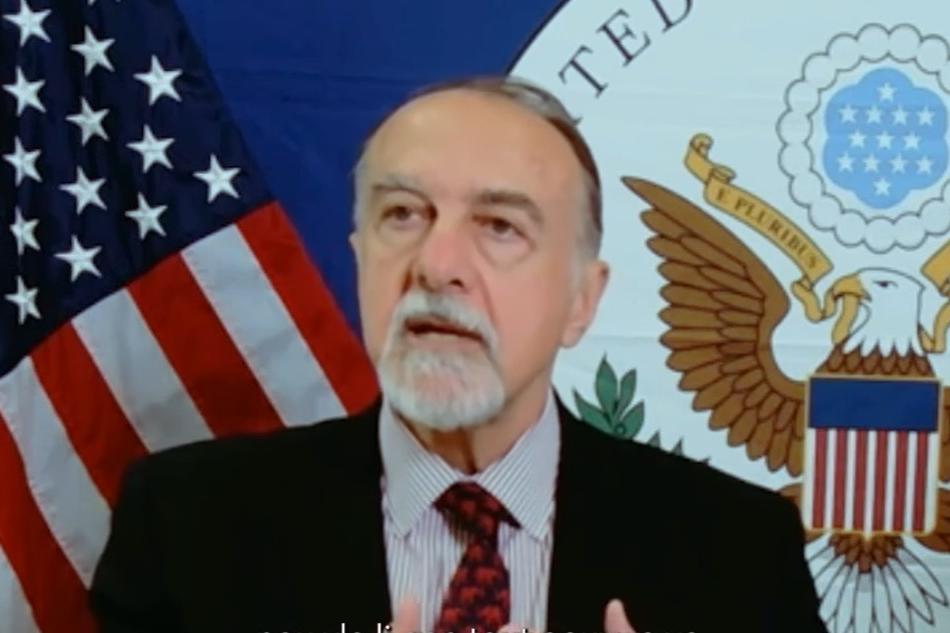
American chargé d’affaires Henry T. Wooster, whose main job is to help with the ‘stability of Haiti,’ said he was ‘proud’ of the accomplishments of his team and himself, noting that there is still ‘a lot to do because everyone wants more progress,’ in an exclusive interview with Le Nouvelliste after being appointed ambassador to Kenya by President Donald J. Trump.
“I’m proud of the achievements of my team and myself this June, which marks the start of my second year here,” said the American diplomat before listing the “accomplishments.” “We supported a peaceful transition in February. The United States obviously cannot claim full responsibility for the process. But we contributed, and I’m proud of that,” Henry T. Wooster shared. “I’m also proud of the new Security Council resolution and the mandate it set, as well as the long-awaited introduction of the Gang Crackdown Force (FRG). These are important steps that reflect the hard work of the whole team,” the American diplomat noted. “But of course, as you can imagine, there’s still a lot to do,” Wooster added, quick to highlight the desire of all partners to see more progress.”Everyone wants more progress. My government wants more, the members of the United Nations Security Council want more, and of course, the Haitians themselves want more. But the tricky part here is that a lot of people don’t really grasp what it takes to move a large coalition force across the world, put it together from contingents from different countries, equip it, organize it properly, and then deploy it on the ground,” said Henry T. Wooster, who mentioned the logistical challenges, unforeseen issues that you have to deal with, adjust to, and overcome.
Barriers to the deployment of the FRG’s 5,500 members: “What’s slowing down the process are logistical issues. And logistics is a complex field. It gets complicated for many reasons, including factors we didn’t necessarily anticipate during the initial planning, like the fighting that took place in the Strait of Hormuz. This had consequences on maritime transport, and a large part of the heavy equipment that needs to get here — including these massive armored vehicles — doesn’t travel by plane but by sea, by ship. So this has significantly slowed down the process. Which has caused us some difficulties. But it’s not insurmountable. It’s not that we can’t overcome it. We will manage,” assured Henry T. Wooster. “It’s simply a variable that didn’t exist when we started planning.”he continued, believing that “the FRG is an essential element to restore stability.” “You know it, and we know it: you can’t win, or achieve lasting stability, only through weapons. We are fully aware of that. But you also can’t ignore them, given what the gangs are doing — the violence, brutality, terrorism, the crime they inflict,” said Wooster, who emphasizes the effort to help strengthen the capabilities of the PNH. “We are also running another initiative in parallel, which we call P-4000. The ‘P’ stands for police, and ‘4000’ because we want to train and integrate 4,000 additional police officers in one year. This is the support we provide to the PNH. The goal is clear: to allow the Haitian state to remain what it needs to be — a sovereign state — and not be overwhelmed by the gangs,” Wooster explained, noting that his country is helping to create conditions for elections to take place in Haiti.The American diplomat said that given how long the process of confirming an ambassador in the Senate will take, he’ll still be in Haiti, right on top of the issues.