
|
Getting your Trinity Audio player ready...
|
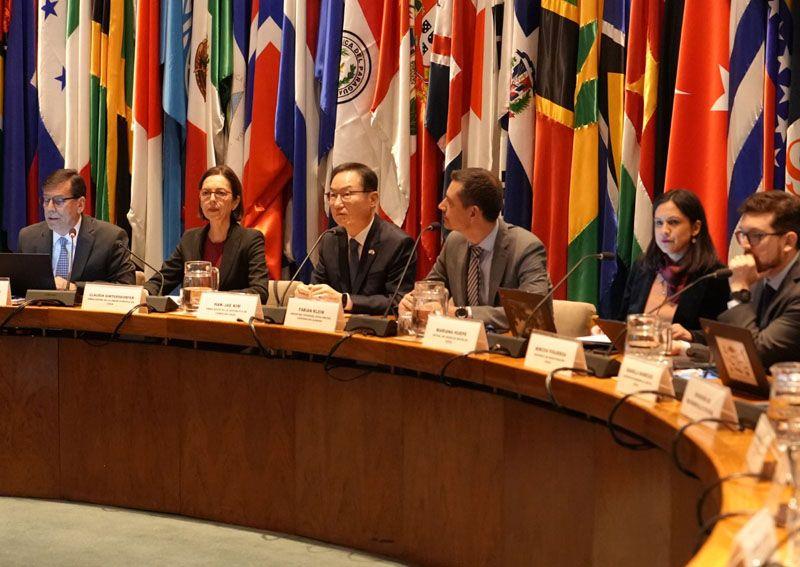
The opening of the sixth regional seminar of the United Nations regional organization on social development, which started on Tuesday, June 16, 2026, in Santiago, Chile, will bring together officials and experts until Thursday, June 18.
Latin America and the Caribbean need to make progress in digital inclusion and put it at the heart of their public policies. Indeed, without proper measures, the current rapid technological transformation could worsen existing inequalities and create new forms of social, professional, and territorial exclusion, said the Economic Commission for Latin America and the Caribbean (ECLAC) on Tuesday, June 16, 2026, during its sixth regional seminar on social development titled ‘Inequalities and Digital Inclusion: Challenges and Opportunities for Inclusive Social Development in Latin America and the Caribbean.’This annual seminar was kicked off today by José Manuel Salazar-Xirinachs, Executive Secretary of ECLAC (video); Claudia Gintersdorfer, European Union (EU) ambassador to Chile; Hak-Jae Kim, ambassador of the Republic of Korea to Chile; Fabian Klein, program advisor for German cooperation ECLAC-BMZ/GIZ; and Ximena Andión, Regional Director for Mexico and Central America at the Ford Foundation (virtual). Alberto Arenas de Mesa, director of ECLAC’s Social Development Division, led the discussions.
Digital transformation offers huge opportunities for Latin America and the Caribbean, a region stuck with three interlinked development barriers: low capacity for growth and transformation, high inequality, low social mobility and cohesion, and a third institutional weakness with ineffective governance,” said José Manuel Salazar-Xirinachs, Executive Secretary of ECLAC. The integration of new technologies, the development of artificial intelligence, and advances in the digital economy can help boost productivity, drive innovation, create new economic sectors, and expand access to essential services like education, health, social protection, and financial services, explained the senior UN official.These transformations, he added, can also create new job opportunities, strengthen the capacities of local populations, and increase the possibilities for economic growth and development in the region.
“However, these opportunities are not automatically or fairly distributed,” he emphasized. “Moving towards digital inclusion means acknowledging its social dimension and putting it at the heart of public policies. It’s not just a technology program, but also a program of rights and development,” stressed the top official of the regional United Nations organization.