
|
Getting your Trinity Audio player ready...
|
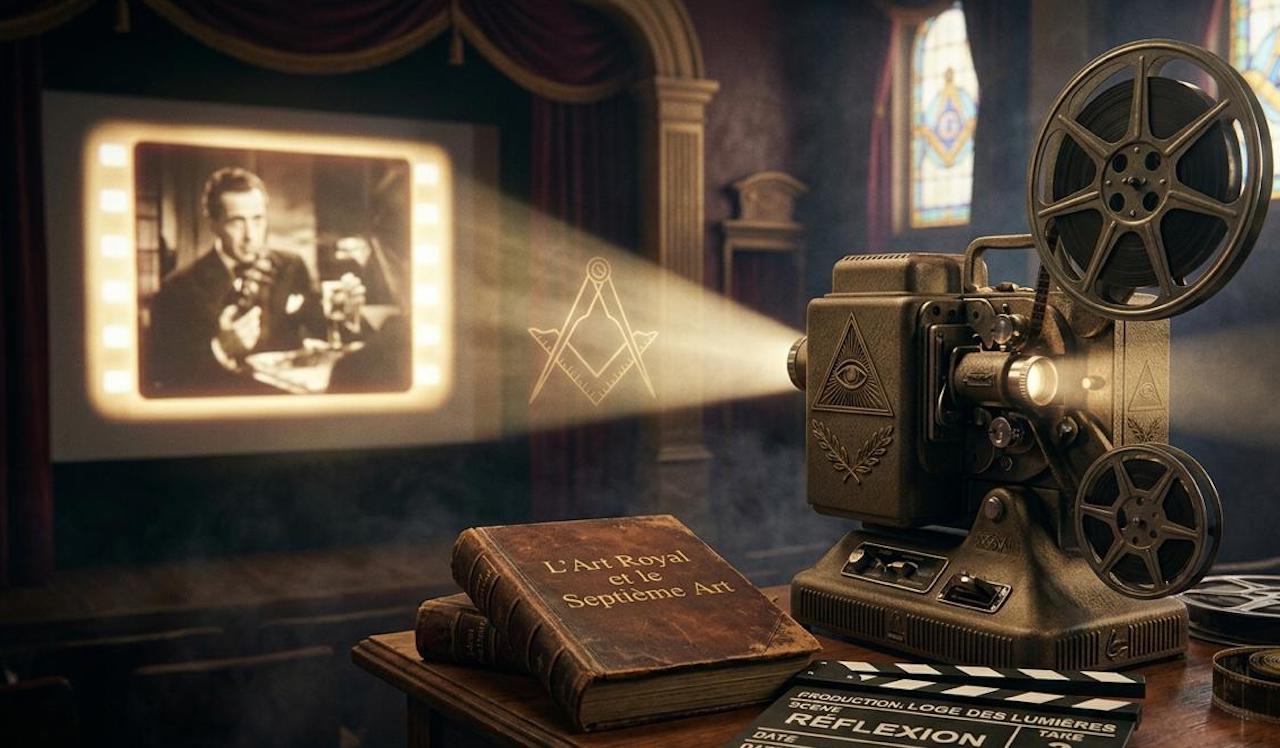
Freemasonry has made its way into filmmaking through a proliferation of clues and subtle coding aimed at those who know how to read the language of shapes.
Freemasonry has found its way into filmmaking through a proliferation of clues and a discreet coding aimed at those who know how to read the language of shapes. This is what film historian Fred Alan Wolf calls the ‘semiotics of secrecy.’ One of the most recurring symbols in world cinema is the checkerboard floor, an alternation of black and white tiles that decorate the floors of Masonic lodges and represent the duality of existence: good and evil, light and shadow, joy and pain, or the union of opposites in the harmony of the structure.
The mosaic paving or the duality of the world
In cinema, mosaic paving is rarely just a decorative coincidence, as it marks a spatial threshold or a metaphysical crisis in a journey or initiation. For example, in the first Beetlejuice (1988), directed by Tim Burton, the corridor of the afterlife is represented by a distorted checkerboard, visually signifying the transition from life to death, the border zone where landmarks vanish. Meanwhile, in Alfred Hitchcock’s brilliant filmography, the geometric checkerboard pattern follows broken lines (think of the dream sequence designed by Salvador Dalí for Spellbound, released in 1945) that map the labyrinth of the human mind. Hitchcock, a great master of anxiety, arranges his characters on the set as if they were pawns subject to the rules of an ironic and invisible Grand Architect.
The Omniscient Eye and the Luminous Delta
The Luminous Delta, or the Eye of Providence, set within a triangle, is without a doubt the symbol that sparks the most cinematic fantasies. Featured on the US one-dollar bill (a symbol reflecting Masonic ideals that the Founding Fathers of the United States were heavily influenced by), this eye has become in movies a symbol of supreme surveillance, but also of spiritual insight.In Metropolis (1927), directed by the brilliant Fritz Lang, which is both a timeless classic and the greatest science fiction film in cinema history; the Moloch machine devours the workers under the gaze of industrial dials that resemble giant eyes. Even though he was working within the context of German expressionism, Lang used the principles of Masonic order to build a monumental fable of urban, political, and esoteric dystopia that mixes class struggle and spatial segregation, industrialization and the multiplication of machines, the myth of the double and robotics, where reconciliation between the “brain” (the ruling elite) and the “hands” (the working class) can only happen through the “heart” (the mediator). This tripartition, just like this quest for social harmony through the geometrization of urban space, is directly in line with the tradition of 18th-century Masonic-inspired architectural utopias.The Explicit Revelation
Many films contain hidden traces, yet some works tackle Freemasonry head-on, turning the cinematic story into a true initiation journey or a critical portrayal of the Order. This is the case for the film The Man Who Would Be King (1975), adapted from Rudyard Kipling’s eponymous short story (Kipling himself was a fervent mason, initiated at the Hope and Perseverance lodge in Lahore) and directed by John Huston, which is perhaps the most brilliant cinematic analysis of Masonic symbols used as instruments of power and tragedy.In this movie, two former British soldiers and Freemasons, Daniel Dravot (Sean Connery) and Peachey Carnehan (Michael Caine), decide to conquer Kafiristan, an isolated region of Afghanistan. Once there, Dravot is mistaken for a god by the local priests because he wears a Masonic medal with the compass and square around his neck, and he discovers the same symbol engraved on the local temple’s throne, left there centuries earlier by Alexander the Great.In his film, Huston uses Freemasonry to explore ideas of brotherhood and pride. The Lodge is first shown as a universal support network (like in the opening scene where Carnehan recognizes Kipling through a subtle distress sign), and then as a system of wisdom corrupted by imperial ambition. Dravot forgets the lessons of the square (uprightness) and wraps himself in the arrogance of the compass (domination of space). His fall—spectacular, from a rope bridge that stretches like a bow—is the punishment for an initiate who took himself for the Grand Architect of the Universe. Huston’s staging has a twilight lyricism, suggesting that secrecy isn’t a weapon of power, but rather a mirror that shatters those unworthy of its clarity.