
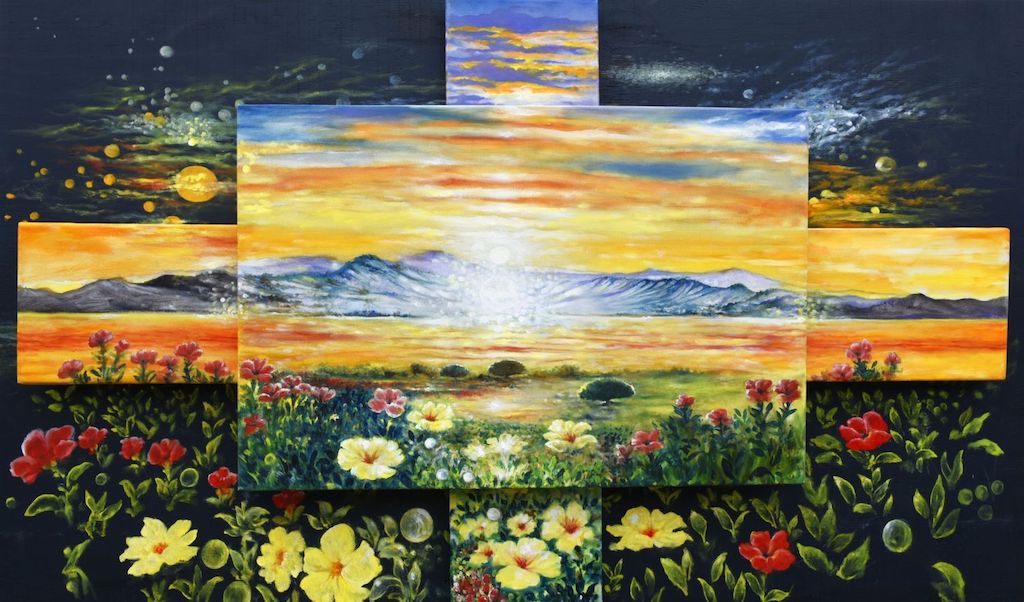
Haitian artist Enock Placide, who has been living in the United States for several decades, represented Haiti at the 2026 Venice Biennale with “Yelena’s Garden,” an installation that combines painting, physicality, spirituality, and reflections on time. In this interview with Le Nouvelliste, he talks about his work, his journey, and his vision of contemporary art.
Enoch Placide
Le Nouvelliste: How many works did you present this year at the Venice Biennale, and how were they received by the public and critics?
Enock Placide: At the 2026 Venice Biennale, I presented eleven works. Ten of them are brought together in a single art installation called ‘Yelena’s Garden,’ while the eleventh is a standalone piece depicting the Battle of Vertières, accompanied by a narrative recounting one of the most significant moments of that conflict. As part of this installation, I also included a library, a brief manifesto explaining my concept, and a video animation inspired by loop quantum gravity theory. My vision of the installation as a transformative and tangible art object is reflected in the notes recorded in the pavilion’s guestbook. These reactions match what I hoped to inspire, and even more. It’s not about personal satisfaction, but rather a confirmation of the validity of the scientific, artistic, and spiritual theories underlying the installation,and which are the result of many years of research.The presentation of this work as an artistic object of the fourth dimension is developed in my accompanying text entitled ‘Yelena’s Garden: Illusions of 4D Riemannian Sunset,’ which will soon be published on my website as a complement to a more in-depth mathematical study currently being prepared for academic review and possible publication.
Between the garden, the cosmos, and time
Le Nouvelliste: The garden, cosmic space, and stellar space seem to form three fundamental dimensions of your work, particularly in this painting, driven by the variations of the sunset, presented at the Biennale. How does this connection between flowers, stars, and solar temporality shape your artistic approach and imagination?Enock Placide: At first glance, the garden might seem like a three-dimensional artistic object. Yet, as you observe it and reflect on it, it reveals itself to be a true work in four dimensions, which, in my opinion, is an unprecedented achievement in the history of conceptual painting.
As you rightly noticed, I layered three distinct phases of a sunset into a single image. The result is a genuine four-dimensional artistic object. It’s no longer a fixed, static image on a two-dimensional surface requiring abstract interpretations from the viewer, but a dynamic landscape in constant flux.Moreover, the combination of terrestrial landscapes and cosmic representations serves as a metaphorical allusion to two seemingly contradictory perceptions of reality: being firmly grounded on Earth while traveling through space at the same time.
I imagine this paradoxical perspective as a four-dimensional cognitive experience, completely impossible in our everyday reality.
In modern art language, one could call it a surrealist work.
Le Nouvelliste: How would you define your work as an artist today, both in its broad strokes and in its deepest intentions?
Enock Placide: My vision and deepest intention can be summed up like this: to embody, in the Haitian pavilion at the 2026 Venice Biennale, a national heritage and a universal truth capable of transforming how we see the world.In physics, the grand quest of unified field theory is about finding a single framework to connect the infinitely large of cosmic gravity with the infinitely small of the quantum world.
My installation offers a metaphorical answer to this question by placing the human being at the center of the setup. Without observers, the elements of the installation remain separate geometric shapes. As soon as someone enters, their interactions distort and unify everything. They become the kinetic energy that creates a field linking the macrocosm and the microcosm.
As it says in Genesis, we are created in the image of the Creator, of the Infinite, of the beginning and the end. That’s also why, in Haitian spirituality and mythology, this installation represents the Milokan, which is the unification of all the lwa, depicted on the back of the different canvases that make up the work.Le Nouvelliste: Your pictorial world is strongly marked by color. How would you describe your relationship with color and its role in developing your artistic language?
Enock Placide: For a long time, it has been recognized that in painting, colors are the manifestation of light and that this visible light can be broken down into a chromatic spectrum.
For me, colors, because they are light, represent the very essence of life. Physics shows us that electromagnetism is a fundamental force of the universe and that light remains at the heart of life as we know it. It is the main source of energy for our planet and influences the behavior of almost all living organisms.From a Child with Polio to the Venice Biennale
Le Nouvelliste: The ‘time of origins’ often comes up in discussions about art. For you, how did it all begin?
Enock Placide: At the age of four, I contracted polio. Like many children of my generation facing the same situation, I was cared for by Sister John at Saint-Vincent School for Disabled Children in Port-au-Prince.
The school placed a strong emphasis on arts and crafts. From kindergarten, I was heavily exposed to drawing through coloring books. I still remember my mother proudly showing my drawings to the neighbors.
However, my artistic journey took on a more serious dimension when I joined St. Trinité primary school. At twelve, I dreamed of becoming one of the best artists of my time. My drawings had already caught the attention of Sister Ann Marie, who was then the principal.St. Trinité School also gave a key place to artistic education, whether it was music, theater, or visual arts. I was lucky to meet Jean-Claude Garoute, known as Tiga, one of the major figures in Haitian art history, there. Tiga became my friend, my mentor, and a source of spiritual inspiration until he passed away.
After elementary school, I continued my studies at Collège Saint-Pierre, where I received a classical education from the famous art teacher Néhemy Jean. By the age of seventeen, I had already mastered classical painting techniques while looking for a new way to express my ideas and concepts on canvas.
Later on, I went to the United States, where my studies shifted toward science and technical fields. I earned an associate degree in science and physics, followed by a bachelor’s in abstract mathematics.I remember that a teacher had encouraged me to pursue graduate studies. I told him that I already had enough knowledge in mathematics to devote myself to my true passion: contemporary conceptual painting.
My presence today at the Venice Biennale is the culmination of more than forty years of a rich and exciting artistic journey in the United States.
Le Nouvelliste: Over the years, your work has followed a steady path. Where can one see Enock Placide’s works today?Enock Placide: During my American career, many people acquired my works. Among the most notable public acquisitions is a painting titled “People in the Field,” purchased by the State of New York for the historical collection of Brooklyn Black College, kept at Medgar Evers College.
Another significant acquisition concerns my pioneering work in graphic animation created in 1983 for “Voyage of Dreams,” now housed at the Museum of Modern Art in New York as part of a prestigious traveling collection dedicated to film and video.
At the time, for security reasons, I had recorded this work under the pseudonym “Nemo” to protect my family from possible retaliation linked to the criticisms made in this documentary against the Duvalier regime. My identity has remained discreet until today.Le Nouvelliste: You live in the United States. How has this environment influenced your artistic path?
Enock Placide: My life as an artist in the United States has been marked by several memorable events: being selected in 1980 as one of the thirty-five most promising young artists living in New York by the New York Urban League, having a solo exhibition at the famous Bedford-Stuyvesant Restoration Skylight Gallery, and participating as a guest of honor and speaker at the Smithsonian National Museum of African American History and Culture during a discussion dedicated to the rebirth of Haitian art.