
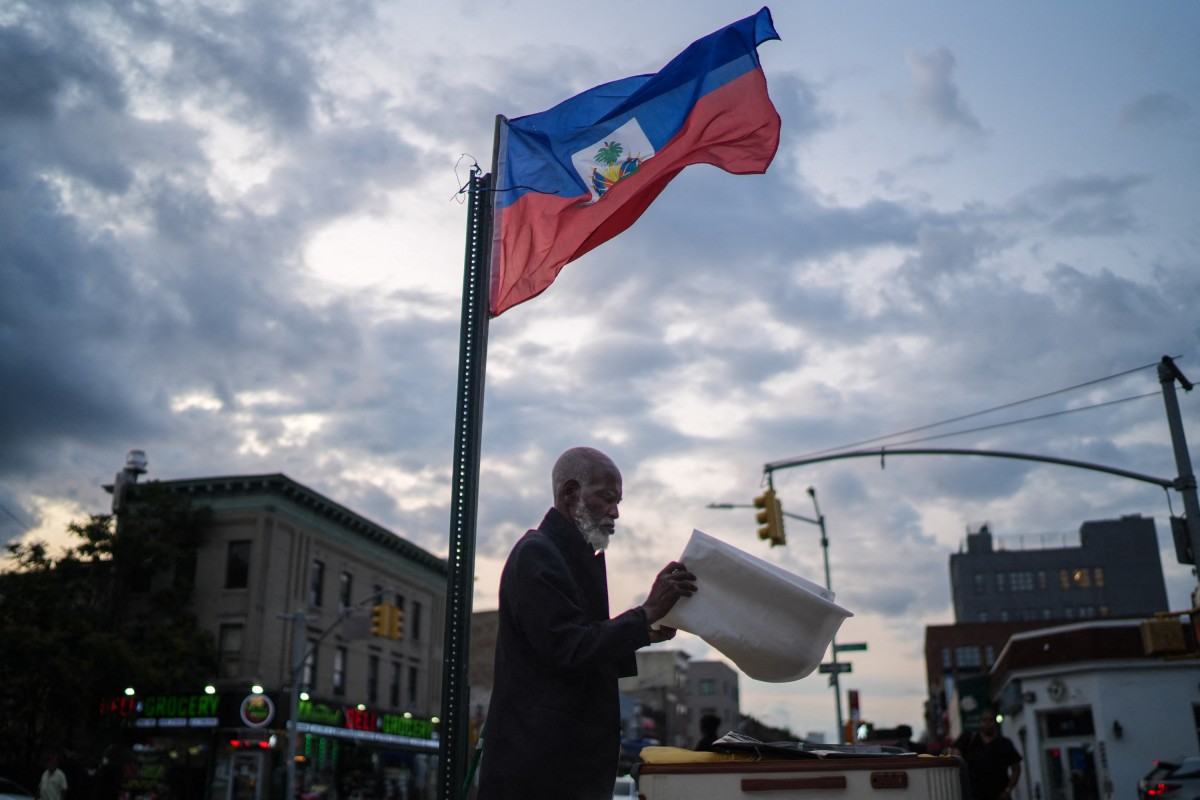
Cultural racism is hardening in the United States. Understanding American President Donald Trump’s excessive nervousness toward Haitian immigrants, called illegal in the United States, suggests a reexamination of the mental state of U.S. leaders in the 19th century.
Cultural racism is hardening in the United States
Understanding American President Donald Trump’s excessive nervousness toward Haitian immigrants, referred to as illegal in the U.S., suggests taking another look at the mental state of U.S. leaders in the 19th century. Located in West Africa, the present-day country of Liberia was founded in 1822 by an American colonial society – the American Colonization Society. American settlers began establishing themselves there as early as 1816, and the said Colonial Society officially came into being in 1817 with the ultimate goal of deporting free or freed African Americans to Liberia, who seemed undesirable to the white elites, who preferred to call it ‘voluntary emigration.’ But black slaves were kept in the cotton fields, at a time when the cotton industry was booming. Still within the framework of the colonization program, the U.S. leaders granted independence to the people of Liberia on July 26, 1847.whose capital is Monrovia, in honor of President James Monroe, the 5th President of the United States who served from March 4, 1817, to March 4, 1825. If the plan to massively relocate free black people had somewhat failed due to objections from all sides, it remains true that the self-interested initiative of the American authorities reflected a general aversion to the black race. And in our time, cultural racism has not faded in the United States of America, despite the obvious advances of modern science. So legislative texts don’t have as much power over cultural mentality as people think; color prejudice is stubborn.
Story for the author of this paper to express his real feeling of apprehension and uncertainty about the misfortune hanging over the heads of the 350,000 Haitians waiting to be deported from the United States to Haiti, according to the administrative measures adopted by the current American administration. While our island country is still struggling to recover from the internal scourges that have been plaguing and eroding it for decades of moral misery and material poverty—a double human and social burden. These things happening over our heads are the result of administrative laxity and the incompetence of the government, which has failed to make rational choices in the professional management of the state administration, taking into account the classes and social strata of the Haitian nation.Believing that racism in the United States has disappeared is foolish, because racism is part of the historical and sociological reality of modern American society; on the contrary, it is systemic and takes many forms. Haitian historian and writer Jean Demesvar Delorme (February 10, 1831 – December 25, 1901) warned us about the complex racism in the United States: “In that country,” he said, “civilization means money. It’s only about making money, no matter the cost. Any idea of justice and duty is subordinate to this main idea: having millions. One is appreciated, respected, considered, when one does not have black skin, of course, depending on the amount of money one has.” Delorme: La misère au sein de la richesse. Various reflections on Haiti (1873). Page 144.The thing is not about knowing whether the American state has entered an unusually hardening process in its relations with the Haitian state, nor about analyzing this multifaceted phenomenon in a black-and-white way: as if the Democratic Party is less racist than the Republican Party. In our view, they are two rivers that meet at a confluence: a river for the United States’ wars of aggression, so a river in flood, and a confluence for the big house of the American bourgeoisie. This observation also applies to all white countries: racism is no more present in the United States than it is in Europe, even though the Western press and media are constantly under the pressure of the ruling classes.
In capitalist and Christian Western societies, freedom of the press, freedom of expression, and freedom of opinion are a myth in Western culture, where the existential reality is cruelly hidden, as can be seen in public debates, on TV shows as well as on radio broadcasts.The major Western press served fascist-Nazi propaganda before, during, and after World War II, as the global proletariat remembers. The specter of communism haunted the capitalist bourgeoisie, as Karl Marx would say, and it had to be stopped by any means necessary without exception. Pope Pius XI, the head of the Catholic Church, was already stating that “Communism is intrinsically evil” according to the encyclical letter Divini Redemptoris “Divine Redeemer” published by the Holy Father on March 19, 1937. The papacy is infallible according to the Church’s magisterium; when the Pope speaks ex cathedra, it’s basically a free pass for capitalists to crush Soviet communism, of course with the powerful and deadly help of fascist-Nazis, whom they admired and collaborated with. Pope Pius XI was fascinated by the Nazi leader Adolf Hitler, whose courage and determination he praised.According to an article in the journal Persée, which cites the French ambassador to the Holy See, François Charles-Roux. Here’s an excerpt from the praise of Pius XI, whose real name was Ambrogio Damiano Achille Ratti: ‘I have changed my opinion about Hitler following the statements he made these days about communism. This is the first time, it must be said, that a government voice has spoken out against Bolshevism in such categorical terms and joined the Pope’s voice.’ Pierre Billet – Persée Journal: Cardinal Pacelli, Secretary of State of Pius XI (1996) Persée https://www.persee.fr
But then it is incumbent on the State of Haiti to assume its responsibilities as a State on the moral, civil, political and economic levels, in order to avoid a recurrence of the racist treatment inflicted on our compatriots. For exogenous causes are generally dependent on endogenous causes; we must not delude ourselves or be alarmed when the historical Caucasian calls us a “nigga” or a “dirty negro”, but we must harmonize ourselves with what was done in 1804, the solemn proclamation of the Independence of Haiti which was the best response we gave to the unhealthy rhetoric and barbarism of the colonial empires of the time. It is up to the Haitian elites to conform to the lessons of history, to design strategic plans for sustainable development based on our national agriculture, a vast field in which we have, from a historical point of view, a legendary experience. In the past and by our workforce We were able to feed the gathered Western bourgeoisie. Even if it was under the constant pressure of French European colonists, whose foreign trade was responsible for the dizzying rise of the French colonial Empire’s economy thanks to the forced labor imposed on our forefathers and ancestors. At that time, the colonial regime was exempt from labor wage costs; the slavery of Black people was a powerful engine of accumulation for the global capitalist economy.We really do need to restart the experiment ourselves, for ourselves, for our children and grandchildren. Experience shows that, ever since the discovery of agriculture, people, no matter who they are, first focus on working the land to meet their basic needs and ensure their material survival, before turning to intellectual, cultural, and spiritual activities. Eating, having shelter, and clothing ourselves are essential to human life. To err is human, but we also have to learn from our mistakes and faults. So, let the nation’s ruling classes make the right decisions that will shape our lives and those of our children. That’s our proof.

