
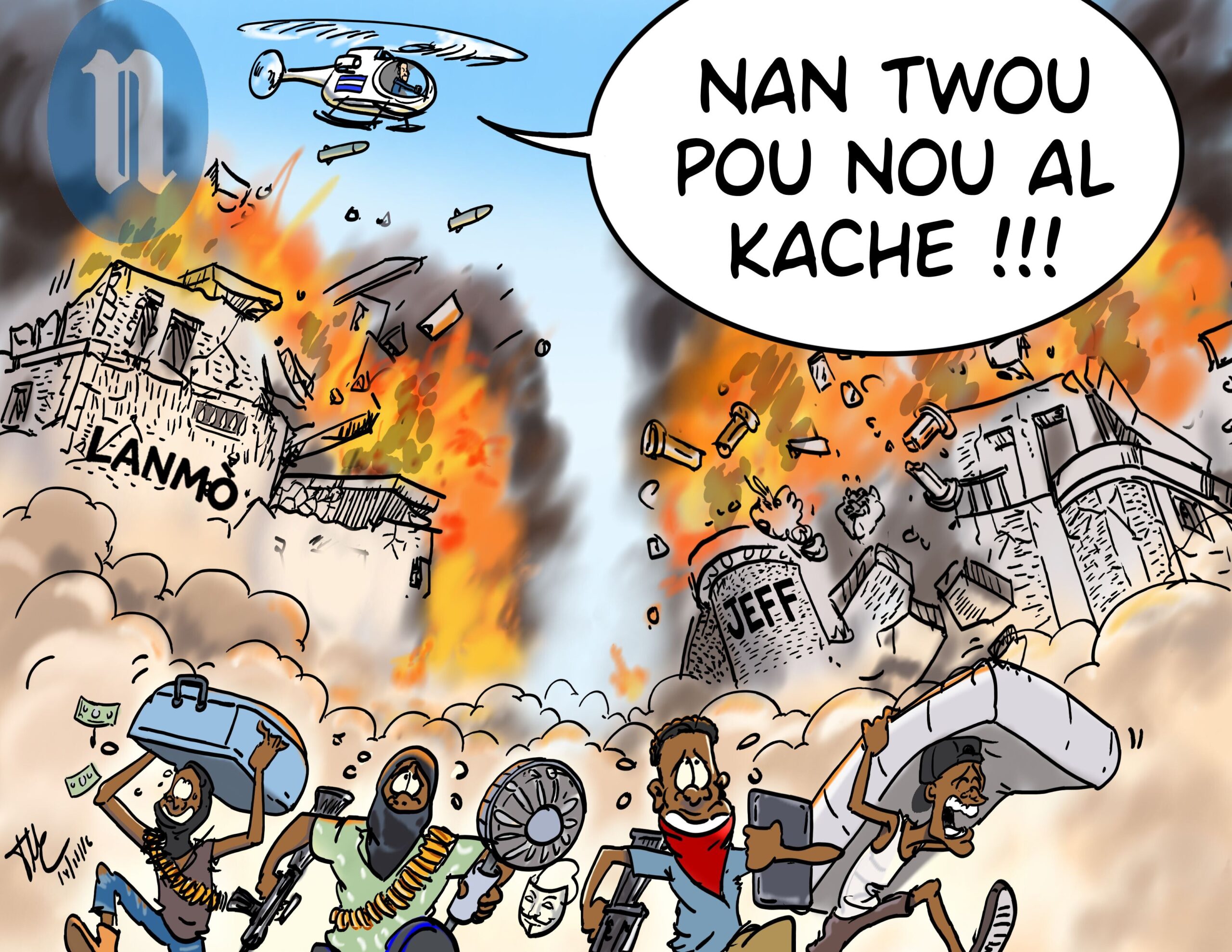
A month after the disappearance of four Salvadoran soldiers at Santo 17, on October 18, 2026, El Salvador significantly increased its military presence in Haiti and has since built up some goodwill.
A month after the disappearance of four Salvadoran soldiers in Santo 17 on October 18, 2026, El Salvador significantly strengthened its military presence in Haiti and has since built some goodwill. After more than 5 years of hardship, Haitians are hoping to see the light at the end of the tunnel and view Nayib Bukele, the president of El Salvador, as an unexpected ally.It all started on Sunday, October 18, 2026, when four Salvadoran soldiers, members of the Gang Suppression Force (FRG), went missing in Santo 17, in the Cul-de-Sac plain, following an attack attributed to armed criminal groups. According to explanations provided by the Salvadoran army, the four men, aviation technicians, were returning to their base in an armored vehicle when they fell into an ambush. They had gone shopping at a bad spot.
The attackers threw Molotov cocktails at their armored vehicle. The soldiers, according to a statement from the Salvadoran army released 24 hours later, had managed to get out before losing contact with their command.The FRG’s reaction was immediate. Helicopters and armored vehicles were sent to the area to try to find the soldiers. Clashes broke out between the forces involved and gang members, while several ground and air approaches were attempted. Operations continued in the following days, including the use of explosive drones.
The disappearance of the soldiers sparked a response from Salvadoran President Nayib Bukele. On October 21, in a message posted in Haitian Creole on X, the leader announced an operation aimed at finding his compatriots and issued an ultimatum to the armed groups.“Today we launched a military operation to help them. We have only one goal: to bring our four fellow citizens home, safe and sound,” said the Salvadoran head of state, warning the gangs that the attacks carried out so far were nothing compared to what awaited them if they didn’t release the soldiers.
As of October 22, more than a hundred Salvadoran soldiers had arrived in Port-au-Prince. Other contingents followed, bringing the number of deployed troops to over 2,000 in just a few days. The Salvadoran authorities presented this mobilization as an operation aimed at finding the four missing technicians.On October 28, following a phone call between Nayib Bukele and Haitian Prime Minister Alix Didier Fils-Aimé, the two governments announced their intention to strengthen operational cooperation in the fight against gangs.
In response to questions raised by the scale of the Salvadoran deployment, Prime Minister Alix Didier Fils-Aimé held a press briefing on November 3, 2026, to clarify his government’s position. The head of government emphasized that the foreign forces present in the country were meant to support Haitian institutions and not replace them. He also reaffirmed that the Haitian state still holds the responsibility for leading the country’s security efforts.Salvadoran operations quickly went beyond the Santo area. The military carried out interventions in several neighborhoods controlled by criminal groups, notably in Croix-des-Bouquets, downtown Port-au-Prince, and in the Village-de-Dieu areas.
However, this Salvadoran offensive has raised some concerns within the U.S. administration. On November 8, Secretary of State Marco Rubio emphasized the need for better coordination between the Salvadoran forces and the FRG to avoid accidental clashes between the two forces. Le Nouvelliste learned that Prime Minister Alix Didier Fils-Aimé set up a “Joint Information Center (JIC)” among all the forces on the ground to address this coordination issue.On November 10, the day after concerns were expressed by Washington, Nayib Bukele released a video showing airstrikes against the residence of Wilson Joseph, aka “Lanmò San Jou,” leader of the “400 Mawozo” gang, in Croix-des-Bouquets. According to a government source contacted by Le Nouvelliste, the residence was destroyed. These rocket strikes, carried out from helicopters, stepped up the fight against criminal groups following the appearance of explosive drones.
Two days later, on November 12, a joint operation involving the PNH, the Haitian Armed Forces (FAd’H), the Task Force, and Salvadoran special forces managed to regain control of Sylvio-Cator Stadium in downtown Port-au-Prince.The presence of Salvadoran soldiers in this area has also changed the security situation around the Salomon market and the Léogâne gate. Witnesses specifically noted the absence of certain armed men who used to extort passersby near the Salomon market.
The Salvadoran operations have generated visible excitement among part of the Haitian population. On Tuesday, November 17, thousands of demonstrators marched in several areas of the Port-au-Prince metropolitan region, in Cap-Haïtien, Jacmel, and Jérémie.
On Tuesday, November 17, in a carnival-like atmosphere, processions were seen in downtown, Delmas, Pétion-Ville, and Kenscoff. Armed with signs, banners, and tree branches, the demonstrators shouted slogans in support of the Salvadoran leader.Support demonstrations continued on Wednesday, November 18, 2026, in Les Cayes, Gonaïves, and Port-au-Prince.
This popular mobilization coincided with a new phase in relations between Haiti and El Salvador. On November 17, the Council of Ministers, meeting at the Villa d’Accueil under the presidency of Prime Minister Alix Didier Fils-Aimé, approved a cooperation agreement between the two countries.
According to a statement from the Prime Minister’s office, this decision marks a new step in strengthening bilateral relations, particularly in response to the security challenges Haiti is facing. However, Haitian authorities have not yet released the detailed provisions of this agreement, including those relating to the duration of deployment, operational procedures, and coordination of the forces on the ground.Since the arrival of Salvadoran forces in Haiti, the Haitian National Police (PNH), the Task Force, and the Gang Suppression Unit (FRG) seem to have found a renewed sense of motivation. Both forces are stepping up their actions, especially in the metropolitan area of Port-au-Prince, with operations aimed at pushing gangs out of their strongholds. The FRG launched an offensive against criminals in Gros Morne and Cité Soleil. The PNH and the Task Force carried out an operation that led to the death of gang leader Mathias Saintil and are conducting offensives in Village de Dieu.

