
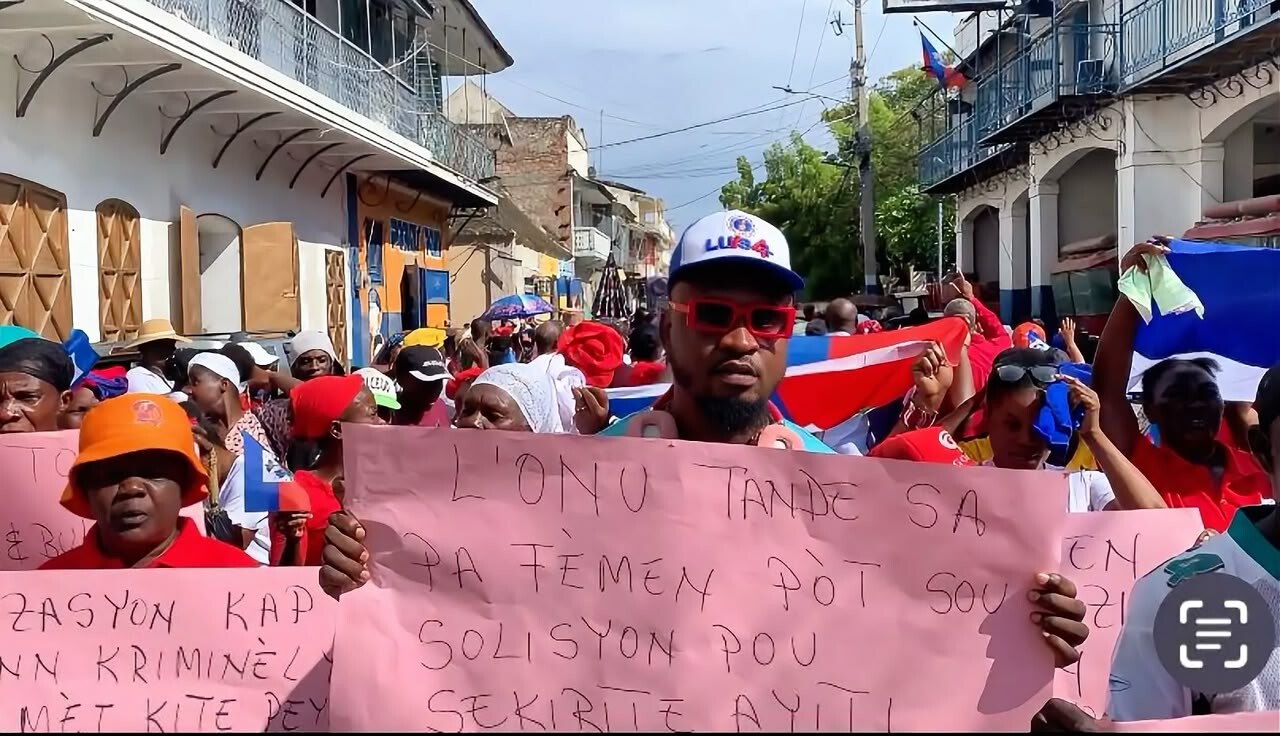
At the initiative of the Coalition of Protestant Churches of the North, several hundred people protested on Tuesday, November 17, 2026, in the streets of Cap-Haïtien to show their support for Salvadoran President Nayib Bukele, whose announced commitment to fighting armed gangs in Haiti has raised high hopes.
At the initiative of the Coalition of Protestant Churches of the North, several hundred people demonstrated on Tuesday, November 17, 2026, in the streets of Cap-Haitien to show their support for Salvadoran President Nayib Bukele, whose announced commitment to fighting armed gangs in Haiti has raised many hopes. This mobilization, which brought together believers from different religious communities as well as political activists, also led to sharp criticisms of the Haitian authorities.
Carrying signs with various demands, the demonstrators walked through several streets of the country’s second city, calling in particular for the restoration of security, the improvement of living conditions for the population, and changes in national governance.One of the coalition leaders, Pastor Mathieu Raphaël, condemned what he calls ‘suit-wearing bandits,’ referring to some political figures he holds responsible for the worsening national situation. He also expressed his gratitude to God and U.S. President Donald Trump for the support given to Haiti through El Salvador’s involvement in international security efforts.
According to the religious leader, the Haitian population cannot continue living under the constant threat of armed groups, while insecurity disrupts economic activities, hinders people’s movement, and further weakens families’ living conditions.Demanding real social and economic security for all Haitians, Pastor Mathieu Raphaël called for citizen mobilization against gang violence. He believes that President Nayib Bukele’s efforts deserve recognition, especially in a context where part of the population expresses fatigue over the ongoing insecurity.
Also speaking, the vice-coordinator of the Coalition of Protestant Churches of the North, Reverend Rubin Saint-Martin, painted a worrying picture of the country’s social, political, and educational situation.He notably criticized the difficulties faced by the Haitian educational system, mentioning the recurring teacher protests, who are demanding that authorities keep their commitments. According to him, this situation directly harms the students, who are regularly deprived of classes and sometimes forced to protest to claim their right to education.
Reverend Saint-Martin also spoke out against impunity and bad governance. He condemned the behavior of certain former leaders accused of squandering public resources, who, according to him, continue to pursue political ambitions without facing any legal consequences.Drawing on the biblical book of Proverbs, chapter 14, verse 34, which says, ‘Righteousness exalts a nation, but sin is a disgrace to any people,’ the religious leader emphasized the need to put justice, responsibility, and respect for public commitments back at the heart of national life.
He also condemned what he sees as organized insecurity, while calling on the international community to respect the Haitian people’s right to freely choose their leaders.
‘Stop choosing for the Haitian people. We are mature enough to decide our own future,’ he said.Speaking about the Battle of Vertières on November 18, 1803, whose 223rd anniversary Haiti will mark on Wednesday, Reverend Saint-Martin recalled the sacrifices made by ancestors to win freedom. He believed that this independence should also be reflected in the country’s ability to independently define its diplomatic relations and choose its international partners.
Criticizing the influence that foreign actors have had on Haitian affairs for several decades, he called for international cooperation based on mutual respect, rather than the imposition of political choices.The coalition’s deputy coordinator also thanked Salvadoran President Nayib Bukele for his commitment to Haiti. According to him, it is in the most difficult times that a country’s true partners are revealed. He expressed a wish to see the relations between Haiti and El Salvador grow stronger in a spirit of solidarity and cooperation.
The demonstration started at the Samarie roundabout, at the eastern entrance of Cap-Haïtien. After passing through several streets in the city center, the procession ended its route at the end of 5th Street, on Cap-Haïtien Boulevard.
The mobilization concluded without any reported incidents, under the supervision of a security team deployed by the National Police of Haiti.

