
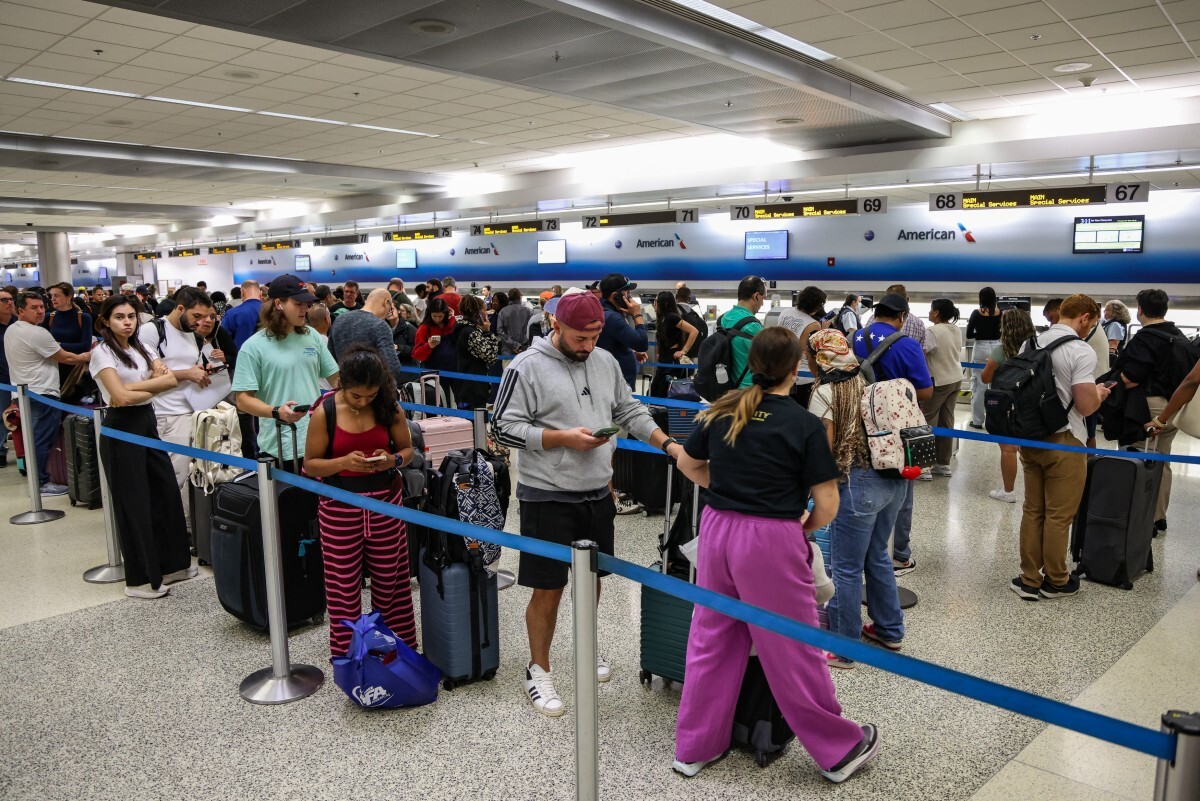
Airspace reopened in the United States on Friday night, but chaos is still reigning in airports, after all flights in the country were suspended for several hours, causing nearly 6 cancellations.
Airspace reopened in the United States on Friday night, but chaos still reigns at airports, after all departures in the country were suspended for several hours, causing nearly 6,000 flights to be canceled and affecting hundreds of thousands of passengers.
The event is extremely rare: the last nationwide flight bans were in January 2023 due to a computer outage, and on September 11, 2001, when the attacks in New York and Washington had paralyzed the country.With that history in mind, many feared an act of malice. But there is ‘no cyberattack,’ nor ‘any link’ to the major outage that hit Microsoft on Thursday, assured Homeland Security Secretary Markwayne Mullin—without completely ruling out sabotage.
Authorities grounded all planes as a precaution due to communication problems caused by ‘old equipment,’ explained Transportation Secretary Sean Duffy.
Communications and radar were working only ‘intermittently’ in several air traffic control centers, and air traffic controllers ‘could not (…) immediately see where the planes were,’ he explained.The airspace is now open again, but “it will take us some time to get back to full capacity,” he announced.
Traffic is expected to return to normal “as we approach the peak travel period for Thanksgiving,” in two weeks, when millions of Americans will be traveling to reunite with family.
Series of delays
The incident threw airports across the country into chaos and uncertainty for hours. Thousands of passengers had their flights canceled or rescheduled.
“I’m really frustrated,” confided Tiara Johnson to AFP, a New Yorker stuck at LaGuardia Airport.
Her flight to Orlando, Florida, where she was supposed to attend a concert, kept getting delayed.
“At first it was supposed to leave at 7:55 PM. Then it changed to 8:30 PM, 9:30 PM. Now it’s 10:30 PM. So we don’t know when it will leave,” she sighs.
At Washington’s Ronald Reagan Airport, Elisabeth Kessebeh was patiently waiting, dreaming of her final destination, Puerto Rico.
“They’re not sure if we’re leaving today, so I guess we’re just on hold,” she says.
In Las Vegas, Harry Reid Airport is packed with passengers lining up in long queues at counters trying to get rental cars.”We were already on our flight ready to leave when we were told to get off,” grumbles Susan Sardina, determined to find an alternative way to get back to Orange County, California, about half a day’s drive from Las Vegas.
Outdated equipment
Air traffic problems in the United States are nothing new, both in terms of infrastructure and labor shortages, issues that have been worsened by the Covid-19 pandemic.
This incident comes just a day after the White House asked Congress for an additional $30.1 billion in funding to modernize the U.S. air traffic control system.On Friday night, Mr. Duffy took the opportunity to stress the need for system upgrades, some of whose equipment dates back to the 1960s and sometimes runs on copper lines or floppy disks.
“I’m going to say this a million times: Congress needs to give the president the resources he needs to get this bill done,” he said.
“The president asked for $30 billion. I want $50 billion,” he added. “With a brand-new, state-of-the-art system, you won’t have these breakdowns.”Two communication outages affected flights at Newark, one of the three major airports serving New York, in the spring of 2025, due to a telecommunications cut at the control center managing incoming flights, located in Philadelphia, about 100 miles south.
And in September 2026, hundreds of flights were canceled on the East Coast because of an accidental break in a telecommunications line.


1 comment
Excellent
Excellent