
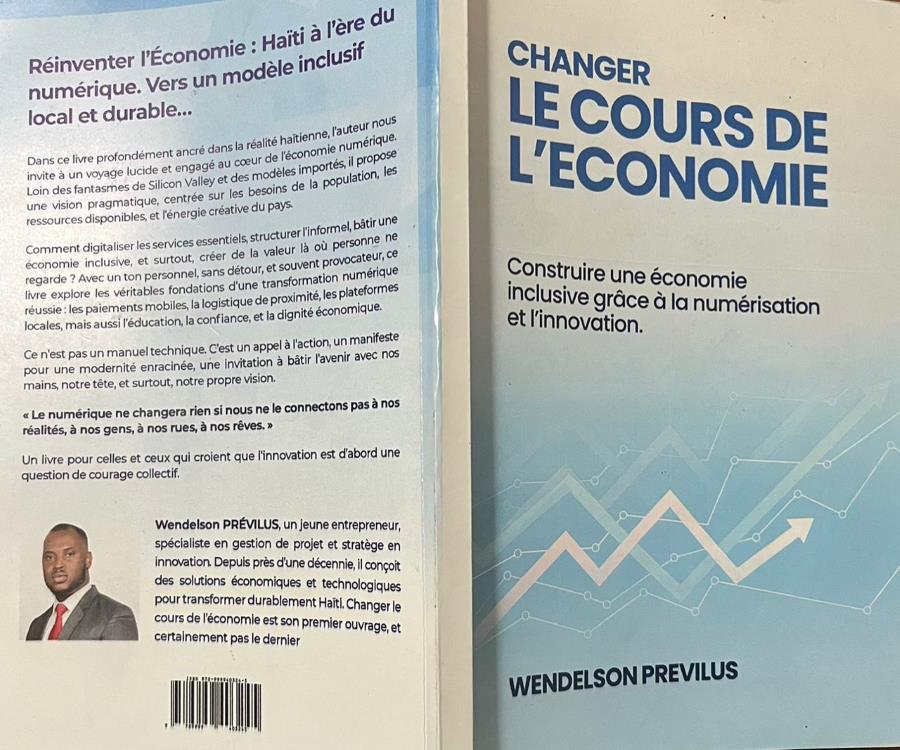
The economic imbroglio, characterized by massive informality, financial exclusion, market fragmentation, concentration of wealth and economic power, and the external dependence that has prevailed in Haiti for ages, conditions the average Haitian to live at the pace of urgency: the urgency to eat, to escape insecurity, to find a job, to care for a loved one, to sustain.The economic tangle, characterized by massive informality, financial exclusion, market fragmentation, the concentration of wealth and economic power, and the external dependence that has prevailed in Haiti for ages, conditions the average Haitian to live at the pace of urgency: the urgency to eat, to escape insecurity, to find a job, to take care of a loved one, to sustain. Thus in Haiti, living amounts to a perpetual struggle for survival. This is how Wendelson Prévilus expresses himself in the introduction of his book entitled ‘Changing the Course of the Economy: Building an Inclusive Economy Through Digitalization and Innovation.’As paradoxical as it may seem, this impasse that the country is going through can, according to the author, become a point of awakening. For, he says further on, when everything seems blocked, when traditional routes lead nowhere, another path must emerge. This book was born from this conviction: we are at a crossroads. We can continue a trajectory of survival, pretending to manage a system on its last breath, or dare to chart a trajectory of prosperity by relying on collective intelligence, on technology, on youth, on the boldness of those who have not given up.”
The trajectory of prosperity that the young entrepreneur talks about does not rely on mineral resources, nor on external aid, nor even on large infrastructures. It relies on something simpler, but more powerful: our capacity to connect, innovate, and digitalize.“The digital economy is not a luxury reserved for rich countries; it can become a shortcut. It can transform our challenges into opportunities: by connecting the country to global markets; by reducing transaction costs; by including those left out of the system; and by creating new jobs adapted to our realities,” he continued.
According to the assessment made by the author on the current state of the Haitian economy, the country struggles to produce enough, to export, to innovate, and to create wealth in an equitable and sustainable way. More than 70% of the active population is engaged in the informal economy, which becomes both an immediate survival solution and a long-term structural trap.GDP per capita remains one of the lowest on the continent. Currency flows are more fueled by diaspora remittances than by exports or investments. Access to credit is almost non-existent for the majority of citizens, as only 35% of them have an active bank account.
The spotlight that the author Wendelson Prévilus places on the current functioning of the Haitian economy leads him to admit that this inherited model from the past is characterized by: an excessive dependence on the informal sector; an absence of real industrialization; an elitist banking system that excludes the majority; and a state that is scarcely present in rural areas.This model, which can no longer meet the needs of a young, connected, ambitious but frustrated population, no longer works. Therefore, it becomes urgent to recognize the economic deadlock in which the country finds itself and to consider the urgency of a new path. This other path will not be decreed from above; it will emerge from a change of paradigm, from a different way of seeing the economy.
It should no longer be perceived as a rigid machine, but rather as a living ecosystem, made up of exchanges, collaboration, and creativity. And it is through this change of perspective that the project management specialist and innovation strategist, Wendelson Prévilus, envisions the digital economy as the essential avenue for Haiti’s economic renewal.For him, digital technology today represents the best opportunity available to Haitians to reconfigure the national economy. Why? Because, he says, digital technology: