
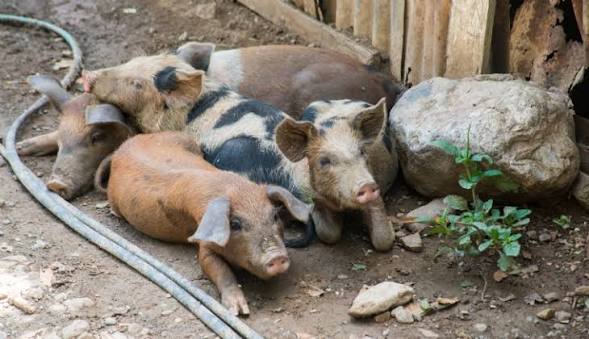
Just a few years ago, a visit to the Don Pedro area in Monte Adentro, Santiago, would allow you to meet dozens of small farmers and family butcher shops supplying the surrounding communities.
Just a few years ago, a visit to the Don Pedro area in Monte Adentro, Santiago, would let you meet dozens of small farmers and family butcher shops supplying the surrounding communities. Today, things look completely different. Many pig farms are empty, and those who stick with it say that pig farming has become a daily battle against African swine fever (ASF), rising imports, and high production costs.This situation reflects a reality that emerged after an article was published in Listín Diario, where specialists and producers questioned the management of African swine fever (ASF) in the country and warned about the decline in national production. In Don Pedro, these figures really hit home.
José, whom everyone calls ‘Mañaño’ and who is in charge of the farm, laments the disappearance of the local pig-raising tradition.Less than half of the producers who were around before are still present. “African swine fever and imports have ruined many small and medium farmers,” he said during a visit to one of the farms still in operation.
His comments echo the points made by veterinarian and pig disease specialist Francisco Trincado, who in an interview with Listín Diario warned that African swine fever (ASF) continues to affect national production and that the increase in imports has reduced the participation of local producers in the market, especially small and medium-sized farmers.
For Dr. Francisco Trincado, in Don Pedro, the numbers and warnings about the drop in national production are reflected in empty pens and farmers who have given up an activity that for decades supported hundreds of families.In this context, Mañaño explained that every pig from these farms intended for sale must first undergo a health check at the farmer’s expense.
“We take blood from these animals. This sample is sent to Santo Domingo to make sure they’re not sick, and if everything is fine, a permit is issued.” “That’s how you can sell them,” he explained.
From the inside
Visiting a farm helps to understand why so many producers have abandoned this sector. Raising a pig for several months requires a constant investment in food, medicine, infrastructure, and labor, with no guarantee of making back that investment if there’s an outbreak.Animals go through different feeding phases, with concentrates called Phase 1, Phase 2, and Growth, each designed for a specific developmental stage. Each 45 kg bag of feed costs between 1,500 and 2,000 Dominican pesos and, depending on the number of animals, can be consumed in less than a week.
“It’s been going on for three or four months.” “After that, anything the animal continues to eat is practically wasted,” he commented.
He also noted that another factor affecting farm profitability is the drop in pork prices, which he attributes to increased imports.As he explained, a few months ago, the price of a kilogram of live pigs was about 135 RD$, whereas it is currently around 120 RD$, a drop that, although it seems small, represents a considerable difference for those who have to bear the high costs of feed, medicine, and farm maintenance.
“That’s one of the reasons why many producers have disappeared,” he concluded.
The transformation of the sector was also evident among traders in the region consulted by Listín Diario; several butchers agreed that pig farming has drastically decreased in recent years.”There are no more farms or farmers within a five-kilometer radius,” said one of them, describing how a community that had been known for pig farming for decades now has only a few producers struggling to survive.