
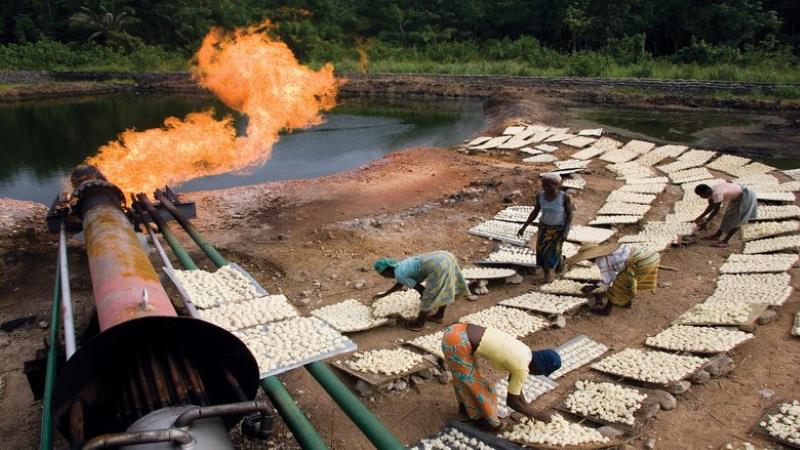
Safe access to energy is essential for economic growth and job creation
Global volumes of flared gas have increased for the third year in a row, reaching 167 billion cubic meters in 2025, which is roughly the equivalent of about 54 billion dollars of gas burned for nothing. While many countries, especially poorer ones, are facing energy shortages, capturing this gas released during oil extraction could boost energy security, generate electricity, support economic activity, and create jobs, all while cutting emissions.The annual Global Gas Flaring Tracker report, released today by the World Bank Group, shows that the volumes of gas flared in 2025 are almost equivalent to Africa’s total annual gas consumption and higher than the annual volumes of liquefied natural gas passing through the Persian Gulf. Nine countries — Russia, Iran, Iraq, Venezuela, Mexico, Libya, Algeria, Nigeria, and the United States — are responsible for more than four-fifths of the world’s gas flaring, even though they account for about half of global oil production.At a time when many countries are struggling to improve access to reliable and affordable energy, the cost of continuing flaring for economic development is simply too high, says Demetrios Papathanasiou, Director of the World Bank Group’s Energy Sector. The gas that is currently being flared could be captured and used to power industries and businesses, create jobs, and strengthen energy security.
Many countries import gas at high prices while flaring large amounts of gas at their oil fields. Ending this practice globally would require an estimated investment of 70 to 100 billion dollars, which is less than twice the annual value of the gas currently being wasted. Countries facing high import costs and energy shortages could thus benefit from better energy access, new gas revenues, and lower energy bills. Yet, even though the tools needed to stop routine flaring are well known, the practice continues. The obstacles aren’t technical, but structural: inadequate regulation, a lack of capital, limited market infrastructure, and the absence of priority given to reducing flaring, both by operators and public authorities.Where effective policies and regulations meet targeted investments and strong leadership, flaring practices go down. Governments and operators who act decisively get results. Kazakhstan, for example, has cut its flared gas volumes by 87% since 2012, including a 16% drop in just 2025.“The technologies, policies, regulations, and financing mechanisms needed to capture and use gas from flares already exist. What’s missing in too many countries is the leadership, the prioritization of this issue, and the governance required to put these solutions into practice in a way that opens access to markets and infrastructure,” explains Zubin Bamji, head of the Global Flaring Reduction Partnership and Methane (GFMR) at the World Bank. “The cost of doing nothing will amount to billions of dollars in lost revenue and energy insecurity for millions of people.”
About the GFMR
The Global Partnership for Reducing Flared Gas and Methane (GFMR) at the World Bank Group works to speed up progress by providing catalytic funding in the form of grants, technical assistance, advisory services on regulatory reforms, and support for measurement, reporting, and verification systems. The GFMR collaborates with governments and public operators to identify projects, mobilize commercial financing, and strengthen the institutional capacities needed for sustainable long-term reductions.