
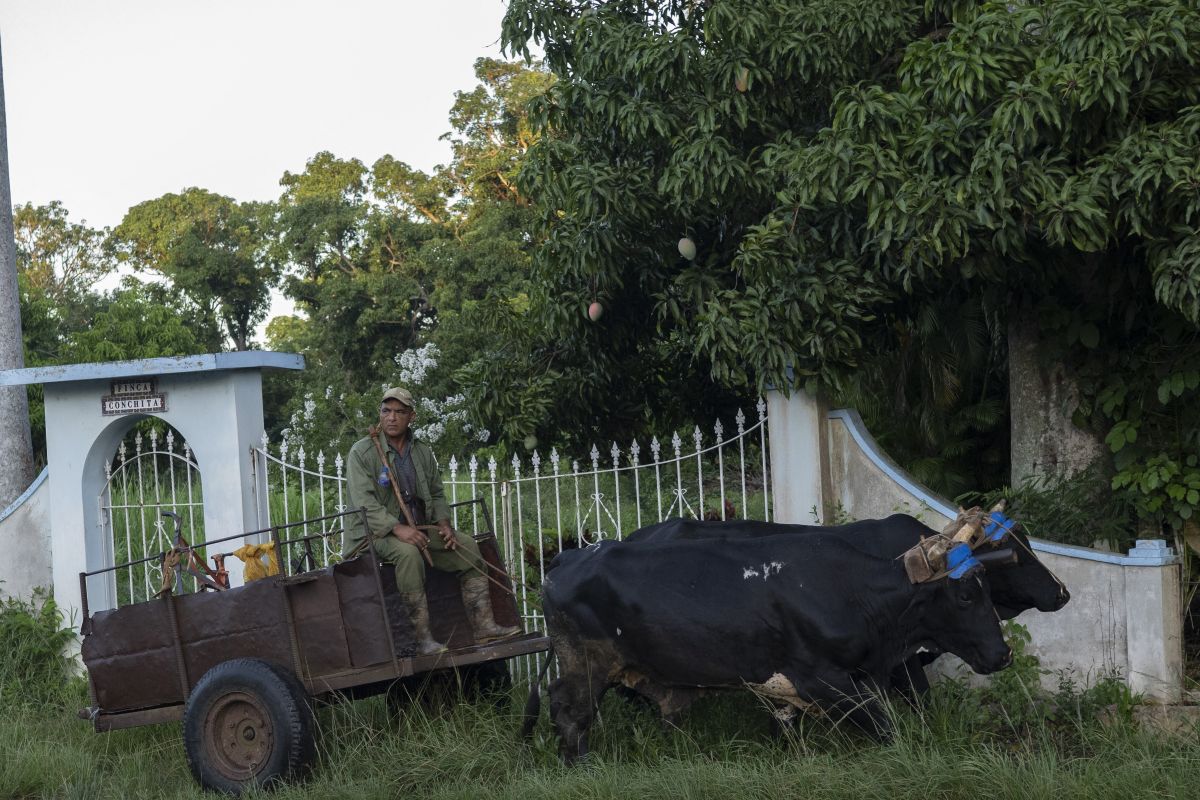
By Clare BYRNE Alexander Quesada was offered a tractor for setting up a model farm in Cuba, but today he is forced to use oxen for his plow, at a time when a serious energy crisis, worsened by the American blockade, is paralyzing food production.
By Clare BYRNE
Alexander Quesada was offered a tractor for setting up a model farm in Cuba, but today he is forced to use oxen for his plow, at a time when a serious energy crisis, made worse by the U.S. blockade, is paralyzing food production.
The ups and downs of “Finca Burgambilia,” the farmer’s organic farm in Caimito, west of Havana, named after the bougainvillea bushes that decorate its entrance, reflect the state of relations between Cuba and the United States over the past few decades.
This 52-year-old farmer looks back nostalgically on what he calls the ‘Obama years,’ ten years ago, when a historic diplomatic thaw between Havana and Washington helped trigger an influx of tourists and money.
As American visitors poured off cruise ships into the Cuban capital, restaurateurs even went out to his farm to get a range of vegetables, including arugula, which was almost unknown on the island.
The income generated by restaurant demand became a cash cow for this eight-hectare farm, allowing Alexander Quesada to invest in new projects, like producing organic honey.”We used to sell a kilo of arugula and with that, we might subsidize 100 kilos of lettuce, which allowed us to maintain a balance and keep growing,” explains this father of two.
But ever since Donald Trump imposed a fuel blockade on Cuba at the end of January, choking an already fragile tourism sector, he’s been struggling to stay afloat. This measure worsened the energy crisis, leaving homes and businesses without power for dozens of hours at a time.
The red tractor he received from the Mexican government as a reward for his high yields still sits in the shed. And oxen are now working the fields.Arugula has disappeared, replaced by cheap root vegetables like cassava and sweet potatoes, which people can buy but on which Alexander Quesada makes almost no profit. “We are at a standstill, and rather in decline,” he admits.
“Our land”
The province of Artemisa, where the farm is located, is Havana’s breadbasket. This green landscape was covered with sugarcane until the 1990s and the collapse of the Soviet bloc, the main buyer of Cuban sugar.As sugar revenues disappeared, the government wanted to put an end to monoculture by distributing land to small farmers and small livestock breeders.
Today, peasants are reducing their production or stopping planting altogether due to a lack of subsidized fertilizers, seeds, fuel, and electricity for their irrigation pumps.
The “Special Period,” the crisis of the 1990s, “was tough but nothing like today,” laments Raul Castillo Rodriguez, a 52-year-old farm worker in Burgambilia.
At a fruit and vegetable market in Havana, José Joaquin Rodriguez, 29, whose family has been farming land south of the capital for three generations, blames the authorities for crushing any initiative.”To get a plot of land, you run into obstacles at the municipal, provincial, state, and even Ministry of Agriculture levels,” complains this farmer who came to sell his produce.
Cuba imports almost all the food its population consumes. But since the government no longer has enough foreign currency to buy goods abroad and resell them at heavily subsidized prices, malnutrition is being felt.
Under pressure, the government unveiled a massive liberal reform program in June, promising a radical shift from decades of centralized economy.
In agriculture, the land will remain state-owned, but farmers will have the right to cultivate much larger areas, will be allowed to start businesses, import and export directly, and price controls will be lifted.Like most Cubans, farmers welcomed these reforms positively, though without expecting any real improvement as long as the U.S. embargo and sanctions remain in place.
José Joaquin Rodriguez is, however, worried about the risk of inequalities between those who actually work the land and potential private investors who could reap the benefits of the transition.
“We, ordinary citizens, poor people, (…) can’t afford to import a container of fertilizer,” he says. “Now, anyone can come, import it, and become the king of the land, of our land.”