
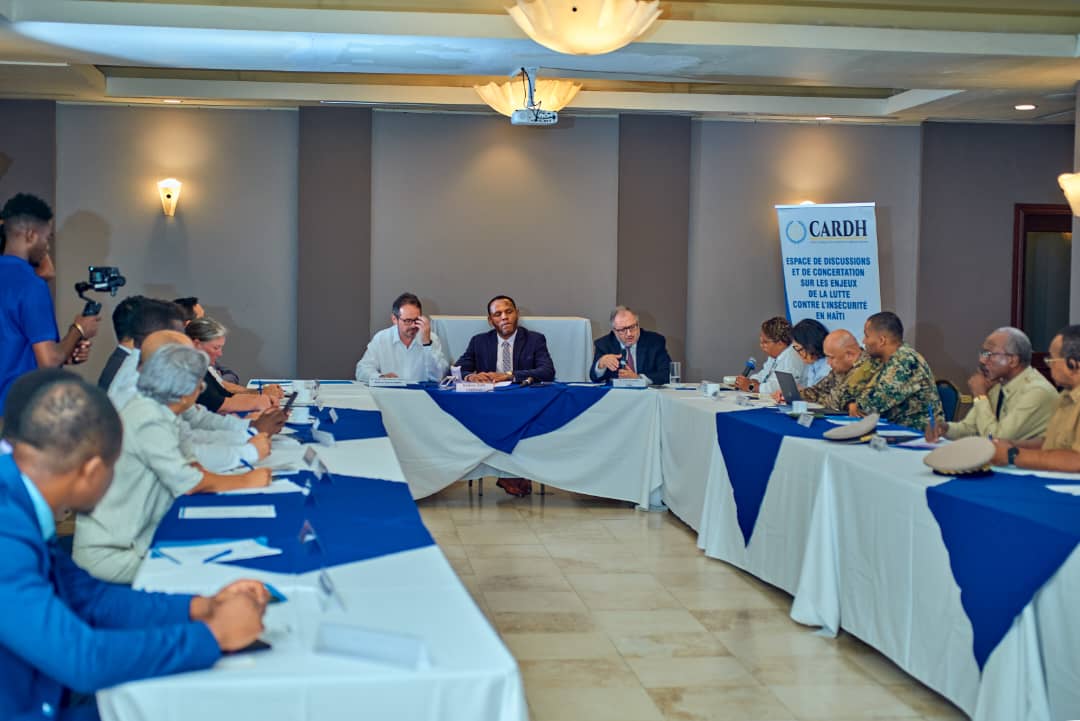
The Center for Human Rights Analysis and Research (CARDH) brought together, during a special session of the Sectoral Security Table (SST), key players in the security chain, representatives from the international community, and civil society organizations around the theme: ‘Assessment of the security process since the transition from the Multinational Security Support Mission (MMSS) to the Gang Suppression Force (GSF).’
The Center for Human Rights Analysis and Research (CARDH) brought together, during a special session of the Sectoral Security Table (SST), key players in the security chain, representatives from the international community, and civil society organizations around the theme: ‘Assessment of the security process since the transition from the Multinational Security Support Mission (MMSS) to the Gang Suppression Force (GSF).’This meeting aimed to take stock of the actions carried out since the entry into force of UN Security Council Resolution 2793, which established the Gang Suppression Force (FRG) to replace the MMAS. It was also meant to give civil society institutions a chance to express their concerns and find common ground on security issues.Opening the discussions, the executive director of CARDH, Mr. Gédéon Jean, went over the objectives assigned to the FRG by resolution 2793 adopted on September 30, 2025. He reminded everyone that this force is responsible for carrying out targeted operations against gangs, securing the country’s strategic infrastructures, and strengthening the operational capacities of the Haitian National Police (PNH) and the Haitian Armed Forces (FAD’H). Almost a year after its authorization, he invited the participants to assess the results achieved, the difficulties encountered, and the future prospects.
Representing the commander-in-chief of the Haitian Armed Forces, Colonel Edwin Florexil acknowledged the contribution of the FAD’H to consolidating positions regained by the PNH, particularly in the Téléco area in Kenscoff and in protecting several strategic infrastructures. However, he noted that intelligence shortcomings are one of the main obstacles to the effectiveness of security operations.
Speaking on behalf of the PNH’s general director, Inspector General Jacques Joël Orival highlighted the significant logistical challenges faced by the police force. These difficulties, worsened by the international context, have notably led to the suspension of certain operations, like in Martissant. Nonetheless, he pointed out several advances made by the police, including the reclaiming of control over the National Palace and its surroundings.On his side, the representative of the West Chamber of Commerce and Industry (CCIH), Michael Paul, praised CARDH’s initiative while expressing the private sector’s concerns. He regretted that several prevention and disarmament programs are being paralyzed by insecurity and asked for more details on the FRG deployment schedule. Mr. Paul also wondered about the coordination mechanisms put in place to limit collateral damage during operations and drew the PNH’s attention to the rise in kidnappings, especially in the Delmas district.
For his part, filmmaker Arnold Antonin emphasized the lack of a real national security plan and an integrated command structure, concerns that had already been raised in previous sectoral table meetings.The head of the Civil Society Initiative, Rosny Desroches, highlighted the need to strengthen the prison system to prevent mass escapes when people arrested by the FRG are handed over to Haitian authorities. He also called for more transparency regarding any potential project to build and manage new prisons with a foreign firm. Additionally, Mr. Desroches urged that the planning of future electoral operations be closely linked with security operations, using indicators to assess the conditions for a secure vote.
Speaking on the occasion, the head of BINUH, Carlos Gabriel Ruiz-Massieu, described the transition from MMAS to FRG as a “major development” in international support for security in Haiti.According to Mr. Ruiz-Massieu, the new force benefits from a strengthened mandate from the Security Council as well as support from the United Nations Mission Support Office in Haiti (BINUH), providing a stronger institutional framework, better predictability, enhanced accountability mechanisms, and increased logistical support.
The head of BINUH also reminded that resolution 2814, adopted in January 2026, redefined BINUH’s mandate, which is now more focused on political support, good offices, disarmament, justice reform, and human rights monitoring, rather than direct support for PNH operations.Carlos Ruiz-Massieu finally pointed out that the operationalization of the FRG comes with new coordination mechanisms between the BINUH, BANUH, the FRG, Haitian authorities, and international partners. He said that UN member states largely support this transition and want to speed up the force’s deployment as well as the gradual expansion of its operations.
The Special Representative of the Secretary-General noted that ‘the necessary framework is now in place’ and called on all partners to turn this new momentum into concrete and lasting results, so that the security progress achieved translates into a tangible improvement in the living conditions of the Haitian population.Among the people present were the Canadian ambassador André François Giroux, accompanied by officials from Canadian cooperation and the RCMP, the Mexican ambassador José de Jesús Cisneros Chávez, the first secretary at the French embassy Bertrand Ollivier, as well as the head of the political section at the U.S. embassy, Merghan Higgins.