
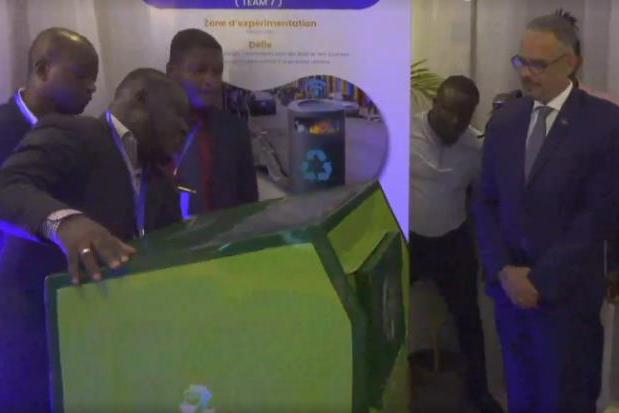
Exhibited at the Karibe Convention Center during the second edition of the FRD/BRH Scientific Days on Thursday, July 23 and Friday, July 24, 2026, the prototype of a smart trash can demonstrates the success of the first phase of the FATRTAX project (Fatra associated with responsible technology based on intelligence) carried out by the ‘Team Seven’ group.
Displayed at the Karibe Convention Center during the second edition of the FRD/BRH Scientific Days on Thursday, July 23 and Friday, July 24, 2026, the prototype of a smart trash can shows the success of the first phase of the FATRTAX project (Fatra associated with responsible technology supported by intelligence) carried out by the group “Team Seven.” As part of a panel at this second edition, Olson Boisguené gave explanations about the smart trash can and the second phase of his project.“It’s a connected trash can, equipped with solar panels, a GPS system, and software. It has a SIM card and installed sensors,” said Olson Boisguené, pointing out that the GPS allows locating the trash can. Thanks to the sensors in the smart trash can, it sends an alert when it’s full. There are other alerts too, like if the trash can is tilted by protesters or when there are acts of vandalism, according to Mr. Boisguené. “It’s a talking trash can,” he added. The collector will have an app that lets them receive information sent by the trash can.
This smart trash can isn’t equipped with a sensor to sort waste. It will accept all types of trash: organic, plastic, etc. ‘We’re not ready yet for a trash can that sorts. Many people know nothing about sorting. It would have been enough to put sensors in for the sorting function, but the reality in Haiti requires much more,’ said Mr. Boisguené, revealing that he conducted a study to find out what type of trash can fits the Haitian reality.From this study, the team working with Olson Boisguené found that people throw garbage on the streets because they can’t find trash bins or other options along their way.
“What bothers people is constantly seeing trash right in front of them,” Olson Boisguené said. “People hate it more than anything. That’s why we went for strong, connected trash bins that can take all kinds of waste and also notify collectors, who could be the city halls, the National Solid Waste Management Service (SNGRS), the Ministry of the Environment, etc. We also know that some people, like me, are allergic to the bad smells that come from garbage.”During his speech, Olson Boisguené used the concept of technological sovereignty. He explained that only the sensors are imported for the creation of the smart trash can. “It’s Haitian engineers who create the design. The structure, that is, the framework, is made by Haitian ironworkers. The software is developed in Haiti—in short, the programming is done in Haiti. We don’t want to copy European models,” said Boisguené, suggesting that the smart trash can could use SIM cards from operators in other countries.
For the second phase of the project, Mr. Boisguené mentioned that there will be simulations. First, there will be an initial simulation with five smart trash cans in a city. Then, there will be a hundred smart trash cans sending data for another simulation exercise, explained the representative of Team Seven.