
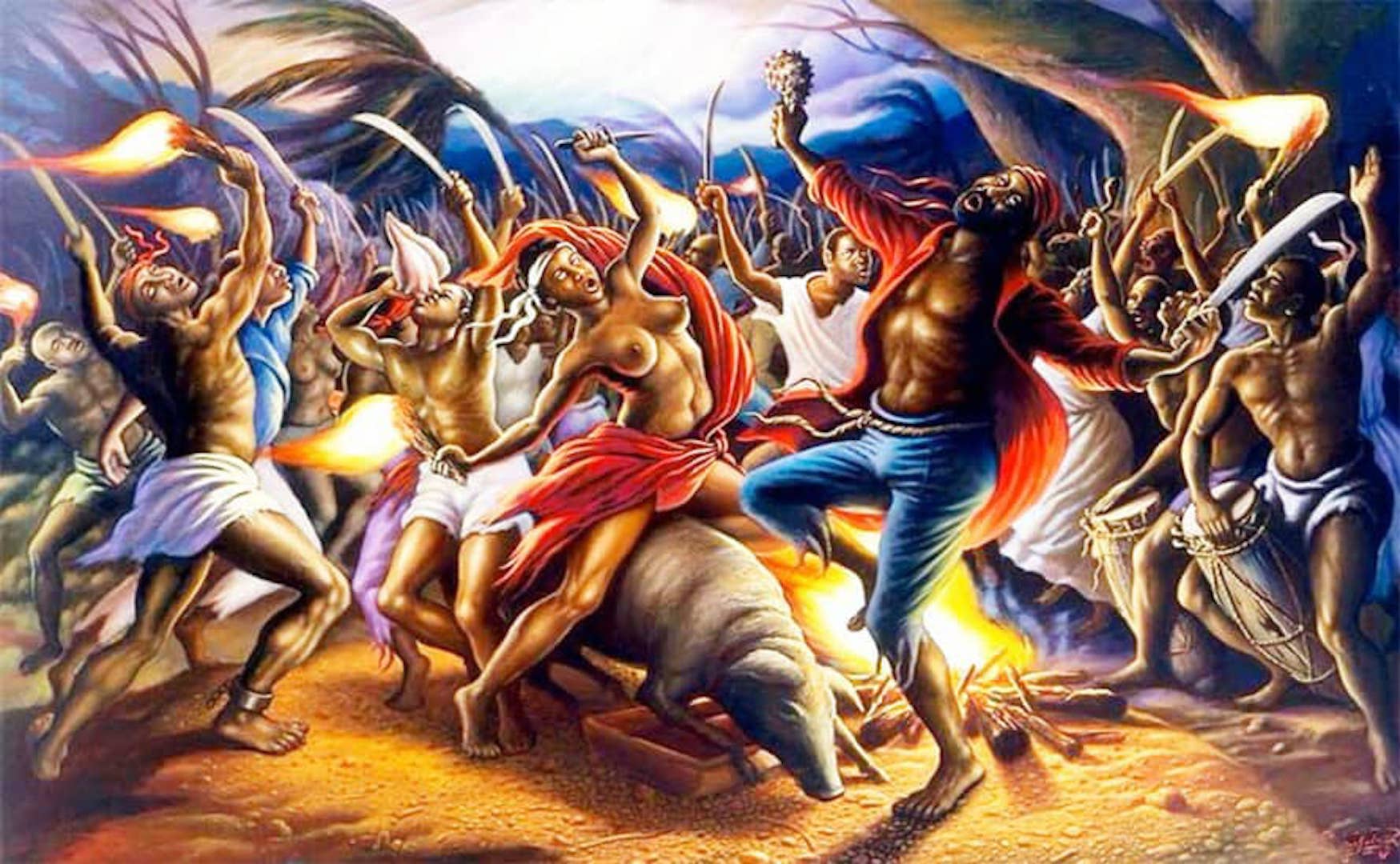
How do you spark a collective movement and coordinate action around a project without prior agreement among the different leaders to draw up a plan or project document? Operating in a repressive system that legally allowed no form of association on the part of the oppressed, the main leaders eventually ended up meeting in a secluded spot called Bois Caïman, on the Le Normand de Mézy plantation, during the night of August 13 to 14, 1791.
How can you spark a collective movement and coordinate unified action around a project without prior agreement among the different leaders to draft a plan or project document?
Operating in a repressive system that legally allowed no form of association for the oppressed, the main leaders eventually ended up meeting in a secluded spot called Bois Caïman, at the Le Normand de Mézy estate on the night of August 13 to 14, 1791. From this perspective, Bois Caïman was a preparatory meeting among some influential slave leaders, estimated to be more than 200.As in most meetings, this one began with a prayer, with a ritual that galvanized this concentration of energy, itself radicalized by the desire and thirst for freedom after three centuries of slavery, and influenced by the political contexts of France and Saint-Domingue, hereafter Haiti.
The vodou religious ritual had the effect of electrifying the participants at this Bois Caïman meeting and creating the emotional shock of solidarity needed, that unity, that enthusiasm which reached the collective psyche. Quickly, the strategies for the general uprising were developed, the instructions and roles well defined and understood.
Boukman presided over the political-religious ceremony and led the initiatory gathering. During his Words addressed to the Grand Master, he practically launched the manifesto of the Haitian revolution by haranguing:“God who makes the sun, who lights us up above, who lifts the sea, who makes the thunder roar, who is the God you hear, hidden in the clouds, there he looks at us, he sees everything the white people do, the white God asks for crimes, but the God here who is so good orders us vengeance. He will lead us. He gives us assistance, and we don’t want goodness. Throw away the picture of the white god, who thirsts for water in our eyes, listen to the freedom that is in all our hearts.”
“Freedom! Freedom! Freedom!” Cries from the heart of human beings reduced to forced slavery for three hundred years; the Bois Caïman revolution was the trigger that led, thirteen years later, to the Independence of Haiti.Fierce enemies on their own lands but brothers of race sharing the horrors of slavery, Africans from different tribes and even different civilizations overcame their history of wars and divisions, went beyond their cultural differences to carve out freedom. It was at Bois Caïman that this explosion, this unity, took place, on the night from Saturday to Sunday, August 13 to 14, 1791. Meetings were usually not allowed by the system; however, Saturday night was generally calenda night (a night of dancing, drumming, singing in a corner of the dwelling) and Sunday was market day (an official gathering and all the commotion). Perfect camouflage!It was the first time that beings reduced to the status of furniture demanded and, thirteen years later, on January 1, 1804, won their right to exist. Unlike other well-known anti-slavery movements like those of Moses and Spartacus, which failed, Bois Caïman succeeded and has since awakened Black consciousness: our essence as a drifting people. (Tribute to Carl Labossière – Carlito).
The Bois Caïman revolution was certainly a revolt of oppressed slaves in the most prosperous French colony, Saint-Domingue. However, the Bois Caïman revolution belongs to universal history, as it was the only successful uprising of oppressed slaves, marking a significant turning point in human history.THE REVOLUTION
It was the first time in human history that human beings reduced to such a state of dullness rose up victoriously, awakened Black consciousness, and practically established the philosophy of liberation movements. Bois Caïman can thus be invoked anywhere there is a struggle for freedom, the right to exist, justice, dignity, and so many other concepts, including building a more equal humanity.
The Bois Caïman revolution had, as a universal corollary, the goal of eliminating prejudices based on the unscientific idea of racial superiority and overturning the world economic order that relied on the sale and trade of human beings. As such, the Bois Caïman revolution fundamentally expresses the oppressed’s rejection of their oppressors, the right to freedom, the right to life, the equality of all men, the creation of a new civilization, and so much more, and so many other fairer and more humane perspectives.Thus, Bois Caïman marked a turning point in world history. However, the Haitian elites, supported by the Catholic, Protestant, and other churches, and aided by history writers trained in the colonial school, have continually erected barriers aimed at downplaying and trivializing the Bois Caïman gathering and revolution. As a result, the essence of the people, their history, myths, in short all of their origins and many other factors that crown the cultural and spiritual dimensions, as well as the natural and necessary riches of the young nation, have just as much been minimized and trivialized.Moreover, the slave-owning colonial powers of Europe and the Americas, as well as some African states like Dahomey, Ghana, Mali, Nigeria, etc., were forced to reevaluate their economies, which were then based on the trade of ‘ebony wood or the slave trade.’
Despite this, the writers of human history have chosen not to give the Caïman Wood revolution the recognition it deserves. This omission needs to be reviewed and corrected, because the history of humanity cannot be written based on superficial whims and harmful colonial socio-economic interests.May Bois Caïman be the detonator once again! – The detonator in our meditations and reflections. Let’s work towards a program of HAITIAN RENAISSANCE to reconcile the nation with itself. It’s time to have a better understanding and practice of our country and ourselves, for a brand-new Haiti.
THE GENERAL UPRISING
At Bois Caïman, the strategies for the general uprising had been put in place, the instructions given, and the roles clearly defined. Jean-François Papillon was to take command of the movement, Georges Biassou became his second-in-command. Boukman Dutty and Jeannot Bullet would trigger the insurrection.Following Boukman’s instructions, he set fire prematurely to the Chabaud plantation two days after the Bois Caïman gathering, on August 16. He was arrested, tortured, and then executed after making certain revelations.
The date was set for August 22, 1791! As planned, around ten o’clock at night, Boukman attacked the workshops of the Turpin, Flaville, Clément, Noé, and Gallifet plantations in Acul du Nord, then moved on to Limbé. In no time, the slaves, armed with sticks, machetes, picks, axes, knives, etc., turned these places into massive infernos, whose flames hurled unimaginable material and human debris toward the city of Cap.During that red night from August 22 to 23, Jeannot was supposed to swoop down on Cap with his group. When he got nearby, “the white people of this town, seeing themselves surrounded by eight thousand slaves and believing that people of color were behind this uprising, attacked them in the streets and massacred a large number of them.” (Thomas Madiou) Jeannot had to retreat; the French army arrived to stop his advance. At the same time, near Ouanaminthe, the mulatto Candi was rising up with his peers, especially those who had been condemned in absentia in the case of Ogé and Chavannes last February (1791).After more than 300 years in inhumane slavery, the radicalization was such that two members of the Colonial Assembly, Odelucq and Daverhoult, who did not want to return to Cap via the Spanish part in the northeast, tried to enter through the Northern Plain. “Caught at the Gallifet camp, they were sawed between two planks.” (Beaubrun Ardouin)
Pauléus Sannon describes the scene like this: “Night and day blended under the low, black, flaming sky… The Northern Plain, Petite-Anse, Quartier-Morin, and Limonade had disappeared… The flames reached Grande-Rivière, Sainte-Suzanne, Dondon, Marmelade on one side; Plaisance and Port-Margot on the other. After three weeks, they stopped on their own, for lack of fuel.”The general uprising of the slaves in Saint-Domingue, on the night of August 22–23, 1791, which stemmed from the mobilization at Bois Caïman on August 14, prompted the National Convention of France to abolish slavery first on February 4, 1794 (16 Pluviôse Year II) and not in April 1848. The uprising marked the beginning of a long radicalized revolt that would lead to the indigenous victory at Vertières on November 18, 1803, and to Haiti’s Independence on January 1, 1804, in the name of Liberty and Equality – a major first in human history!
Even today, however, Haiti is kept in quarantine by Western and economic powers for having victoriously broken its chains. The toll of this racist dehumanization, moreover, looks like this after more than three centuries: (1492 – 1630) Genocide of the peaceful Taíno in their homeland of Ayiti by the Spanish, lasting 138 years; (1630 – 1804) Slavery and torture of all kinds by the French, enslavement, trai…Dehumanizations are increasing, being redefined, accommodated, and passing hands between Germans, Levantines, Canadians, Americans, etc., and they continue along with Haiti’s endemic racism and international isolation 235 years later; basically around 547 years of inflicted suffering. So when does the tunnel end?
And to quote Lula – Luiz Inacio Lula da Silva, during a summit between Brazil and CARICOM in 2025: “Haiti cannot be punished forever for being the 1st Independent Black Republic in the Americas.”