
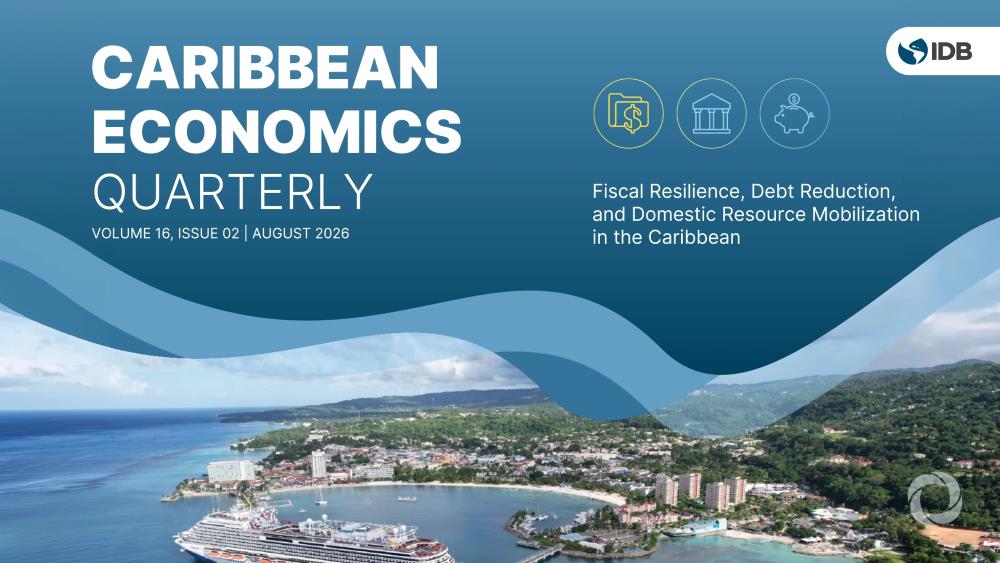
The Caribbean Economics Quarterly (CEQ) points out that public finance and tax reforms support faster, more resilient, and more sustainable long-term growth.
The Caribbean Economics Quarterly (CEQ) points out that public finance and tax reforms support faster, more resilient, and more sustainable long-term growth.
Even with persistently high global interest rates and volatile energy markets, Caribbean economies have made notable progress in budget consolidation and debt reduction, according to a new report from the Inter-American Development Bank (IDB).This new issue of the Caribbean Economics Quarterly (CEQ), titled “Fiscal Resilience, Debt Reduction, and Domestic Resource Mobilization in the Caribbean,” looks at the budgetary and debt paths of six member countries from the Caribbean Department of the IDB: the Bahamas, Barbados, Guyana, Jamaica, Suriname, and Trinidad and Tobago. It finds that half of these countries managed to bring their debt-to-GDP ratios below pre-pandemic levels, showing the effectiveness of strong fiscal management and credible institutional frameworks.
However, the CEQ warns that the regional fiscal environment remains tough due to tightening global financial conditions, rather than a deterioration in investors’ perception of the Caribbean.”Over the past ten years, Caribbean countries have managed to face a series of global shocks of extraordinary complexity with remarkable political discipline,” said Anton Edmunds, Director General of the IDB for the Caribbean.
“The data shows that a substantial reduction in debt is possible when governments maintain credible budget frameworks. Looking ahead, the priority must be to set up more productive, fair, and resilient revenue systems, capable of financing both debt reduction and essential investments, especially in disaster risk management,” he added.One of the main findings of the report is that the region is collecting less revenue than needed for sustainable development and disaster resilience. In 2023, tax revenues in the Caribbean averaged 21% of GDP, which is lower than the Latin American average (22%) and the OECD average (34%).
The CEQ highlights several priority transnational reforms aimed at closing this gap, including modernizing tax administration through digital technologies, streamlining tax incentives and exemptions, and strengthening stable revenue sources like property taxes. For oil and gas producers, the report emphasizes the importance of strict tax rules and sovereign wealth funds to mitigate revenue volatility and preserve wealth for future generations.The full report of the Caribbean Economics Quarterly is available on the IDB website.
The Caribbean Economics Quarterly publication series is a reliable resource for policymakers, academics, and businesses. Previous editions are available here.