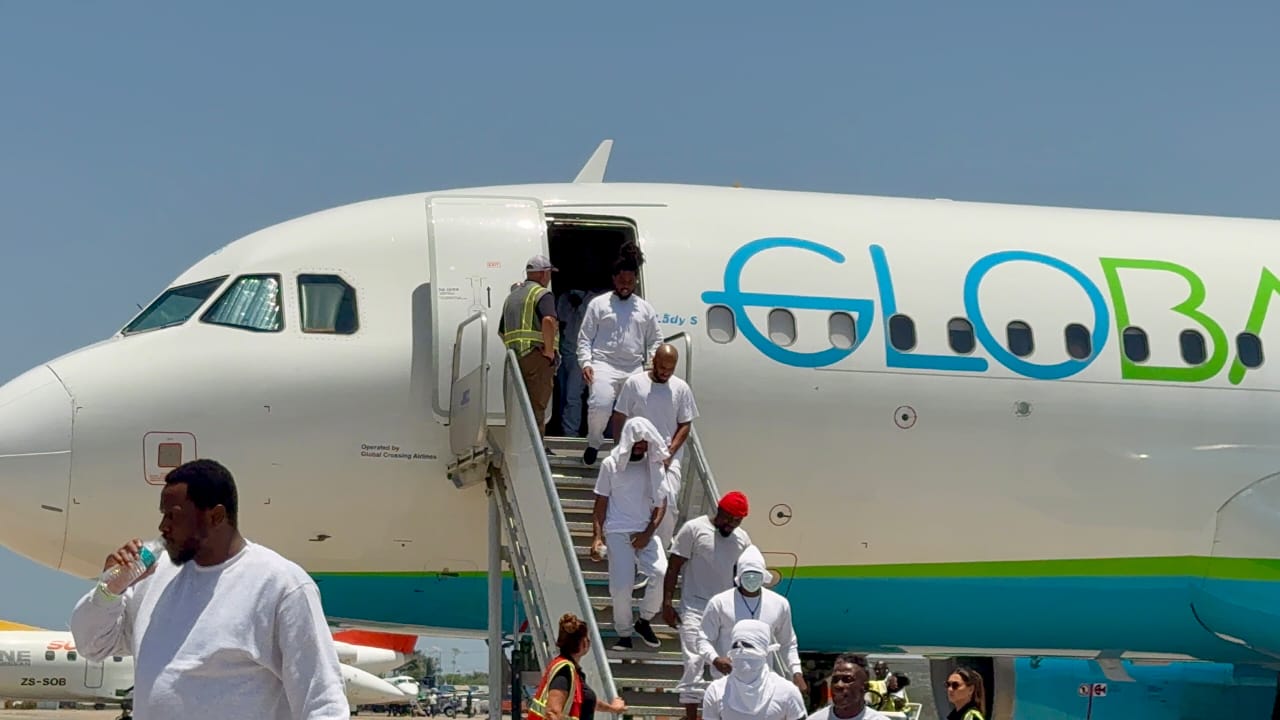
A new group of 161 Haitian migrants expelled from the United States arrived this Thursday, August 20, 2026, at Cap-Haïtien International Airport.
A new group of 161 Haitian migrants expelled from the United States arrived this Thursday, August 20, 2026, at Cap-Haïtien International Airport. Among them were women and children accompanying their parents. Upon getting off the plane, they were taken care of by the National Office of Migration (ONM).At the airport to welcome them, the ONM’s general coordinator, Jean Négot Bonheur Delva, said that the profiles of the returnees were varied. Some had benefited from migration programs under the Biden administration, others had held resident status or had temporary protection that had expired. The group also included, according to him, people who had served prison sentences in the United States.
Some cases also highlight the complexity of these expulsions. According to the general coordinator of the ONM, several repatriated people were not born in Haiti, but rather in Chile or the Dominican Republic.
“Many were not even born in Haiti. Some were born in Chile, others in the Dominican Republic, but because their father or mother is Haitian, they were sent to Haiti,” explained Jean Négot Bonheur Delva.
The general coordinator stressed that the ONM does not get involved in the American decision to expel these people. “We are not the ones requesting their return. It’s a decision made by the United States,” he said.Once they arrived in Cap-Haïtien, the repatriated people received food, drinks, and basic necessity kits. The ONM says it wants to ensure their return to their home regions in conditions that respect their dignity.
“Our mission is to welcome migrants with respect and dignity, and then to support them so they can get back home,” emphasized Jean Négot Bonheur Delva.
According to the official, Prime Minister Alix Didier Fils-Aimé gave instructions to make sure this support continues until the repatriates reach their destinations. People going to the Grand Sud should be accompanied during their journey, while those heading to the Grand Nord and the West department should receive 10,000 gourdes to help with transportation.One of the situations the ONM will have to deal with involves a migrant who says he doesn’t know any of his family members in Haiti. Born in the Dominican Republic, he reportedly said that his parents still live there. Jean Négot Bonheur Delva assures that his institution will take steps to help him find his relatives, in Haiti or the Dominican Republic. Beyond the institutional assistance, the group’s arrival was marked by accounts of frustration and distress. Several returnees denounced the conditions in which they say they were detained and expelled.
One of them says he left Haiti at just five years old before moving to the United States, where he lived in New York. After a legal case that, according to him, resulted in a 19-year prison sentence, he was eventually deported back to Haiti. He says he comes from Arcahaie, in the West department, while also saying he no longer knows any family members in the country.
“I’m not afraid to go back to my country. I’ll try to help it in my own way,” he said, while denouncing the treatment he claims to have faced before his deportation. He specifically claims that some migrants were given injections before boarding, a claim that could not be independently verified.For this repatriate, his return should now allow him to put to use the experience he gained during his years abroad. He especially advocates for a revival of national production and for more economic exchanges to help Haiti reduce its dependence on the outside world.Another migrant, also affected by his deportation, issued a warning to Haitians considering traveling to the United States irregularly. “Haiti is a land of freedom that our ancestors fought for,” he said, before encouraging his fellow countrymen not to take irregular migration routes.
He says he was arrested while leaving school and believes that Haitian migrants face major challenges defending their rights when stopped. “Psychologically, we are not at peace,” he shared.