
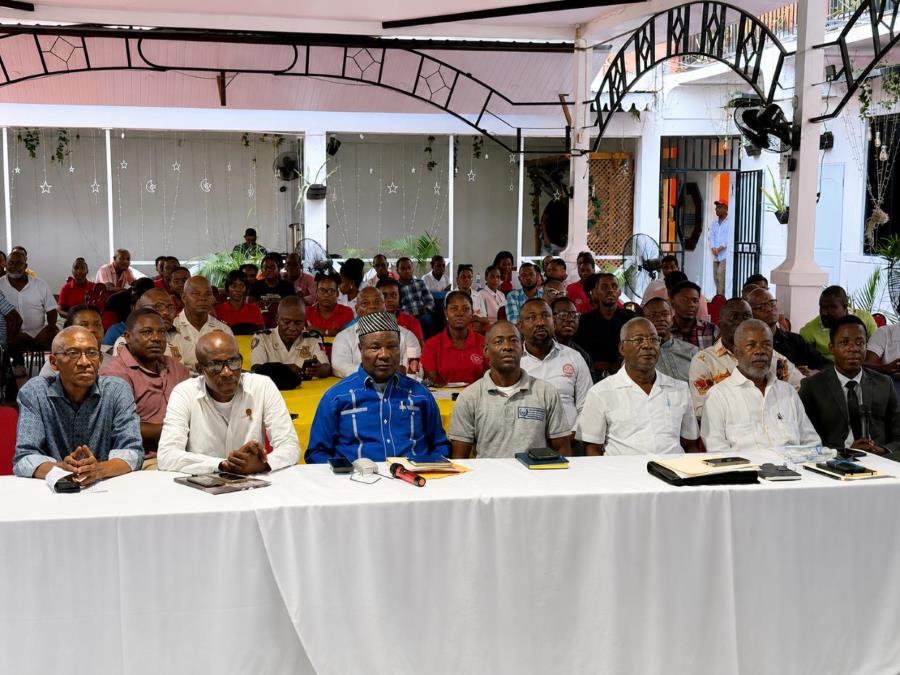
The third and final day of the Cap-Haitien City Conference, organized by the Center for Education and Social Interventions (CEIS), was marked this Thursday, August 13, by several presentations focusing in particular on transportation, urban mobility, metropolitan development, digital technology, and the relationship between the city and its port.
The third and final day of the Cap-Haïtien City Conference, organized by the Center for Education and Social Interventions (CEIS), was marked on Thursday, August 13, by several sessions focused especially on transportation, urban mobility, metropolitan development, digital technology, and the relationship between the city and its port. The events took place at the Retrouvailles Cultural Complex in Carénage.
Centered around the general theme “Cap-Haïtien between security and environmental crises, population explosion, regional development prospects, and citizen participation,” the three-day conference brought together professionals, academics, institutional leaders, and civil society actors to discuss the main challenges facing the country’s second-largest city.The day of August 13 started with civil engineer Hérold Pérard speaking about ‘Transport across the city of Cap-Haïtien: towards a new urban centrality.’ Sociologist and anthropologist Theuriet Direny then focused on urban mobility and public transportation, followed by an address from economist Kesner Pharel, CEO of Groupe Croissance, dedicated to the challenges and prospects of the greater metropolitan area of Cap-Haïtien.
The discussions continued in the afternoon with Kenrick Demesvar, coordinator and holder of the UNESCO Chair in History and Heritage at the State University of Haiti, looking at the role of Cap-Haïtien in the era of the cybernetic and digital revolution.One of the main presentations on the last day was given by the CEO of the National Port Authority (NPA), Jean Evens Charles, who discussed “The complex relationships between cities and ports,” emphasizing the need to build a new alliance between the port, the municipality, and other development players in Cap-Haitien.
According to the NPA’s CEO, the city’s development has historically been inseparable from its port infrastructure. “Cap-Haitien is the country’s second-largest urban center and the main economic hub of the northern region,” he reminded, noting that the performance of the port and the city are closely linked.Jean Evens Charles, however, pointed out several constraints that weaken this relationship. He specifically mentioned the scarcity of available space, the land and environmental pressure on the coastline, the occupancy of certain areas near port facilities, as well as the congestion caused by heavy vehicle traffic.
On top of these difficulties is the gradual silting of port infrastructure, fed in particular by sediments and waste carried into the basin by the city’s ravines. A situation that, according to him, requires a response that goes beyond the capacities of the port administration alone. “It’s a problem the port can’t solve on its own, since its origin lies upstream, in the city itself,” he emphasized.The head of the APN thus advocated for a governance approach shared between the municipality and the port. He reminded that a memorandum of understanding between the APN and the Cap-Haïtien City Hall was signed on October 24, 2024. This cooperation should particularly focus on transport and traffic, coastal planning and management, security and safety, as well as the roads serving the port facilities.
With this in mind, the APN plans several projects spread over the short, medium, and long term. For the next twelve months, Jean Evens Charles notably suggests setting up a committee in charge of updating the Port-City Hall agreement and creating a permanent platform for territorial dialogue bringing together public institutions, port operators, universities, the private sector, community organizations, and youth.
In the medium term, the port authority plans to continue modernizing its facilities, including the docks, handling equipment, and cargo tracking systems. The CEO of the APN also called for a project to dredge the access channel and the turning basin, under the high patronage of the Prime Minister, to combat silting and ensure the continuity of this work despite administrative changes.
The plan also includes strengthening environmental actions and better coordination with waste management and urban development programs. In the longer term, the APN wants to make the blue economy a driver of development in the far North, focusing in particular on maritime transport, sustainable fishing, cruise tourism, water sports, and training for maritime professions.The development of human capital is actually one of the eight projects presented by Jean Evens Charles. The stated goal is to further develop partnerships between the APN, universities, and vocational training centers in order to strengthen skills in logistics, port engineering, maritime transport, and security.
Beyond the infrastructure, the director general emphasized the economic benefits of the port for Cap-Haïtien and the entire northern region, through direct and indirect jobs, investments, and opportunities for export and tourism development.In conclusion, Jean Evens Charles called for a collective mobilization around this new vision of the relationship between the port and its urban environment. “The port and the city of Cap-Haïtien share the same territory, the same history, and I truly believe they also share the same future,” he said, hoping that the port infrastructure would become more of a lever for sustainable territorial development.The various talks and discussion sessions on this last day wrapped up three days of thinking about the future of Cap-Haïtien. Through topics like mobility, metropolitan planning, digital transformation, and cooperation between the city and its port, the participants mainly highlighted the need for better coordination between public institutions, local authorities, the private sector, universities, and civil society to sustainably address the city’s challenges.