
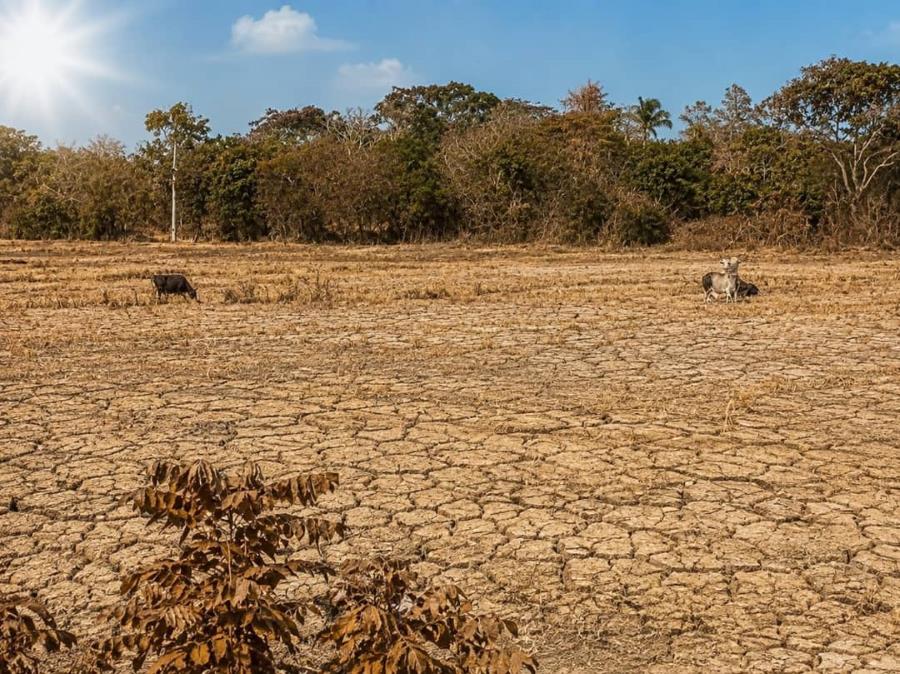
For over five months, a major drought has been affecting the Northeast department.
For more than five months, a severe drought has been affecting the Northeast department. Farmers, planters, and livestock breeders are struggling to keep their activities going, directly impacting their incomes as the school year, set to start on September 7, approaches. In several areas visited by Le Nouvelliste on Thursday, August 20, including Terrier-Rouge, Grand-Bassin, Fort-Liberté, Ferrier, and Ouanaminthe, the effects of the lack of rain are especially noticeable.Producers in Distress
Dried-up plantations, nearly dry rivers, emaciated animals, and dusty soil: the signs of drought are clear in several towns in the department. In Savane-au-Lait, in the Ouanaminthe municipality, and in Paulette, in Terrier-Rouge, some rivers have almost disappeared, while others are seeing a significant drop in their flow. This situation makes everyday life even harder for families who rely on farming and livestock to get by.”I worked in agriculture and livestock farming. Although on a small scale, I made profits that allowed me to meet my family’s needs. But since the end of April, due to the drought and lack of rain, I have practically lost everything,” says Lucien Marcelin, a farmer from Terrier-Rouge, to Nouvelliste. Like him, several producers interviewed say they have seen their crops drop significantly, while family expenses are rising with the upcoming school term.
The drought is making daily life even harder for families who rely on farming and livestock to get by.
In Grand-Bassin, concerns are also high. Alex Joseph, head of the Cigais farm, is calling on authorities to step in to help farmers in the Dolval and Danda communal sections. “This drought situation is critical in the Grand-Bassin communal sections. Farmers are running out of resources. Authorities at the central government level need to act to prevent the worst. I’m making a call to the DDNE of MARNDR,” he says, pointing out that agriculture is the main source of income for many families in the area.The PAPAIR project is making progress in the Northeast
In this challenging context, the Program for Supporting Agricultural and Fishing Productivity and Improving Rural Market Access Infrastructure (PAPAIR) continues to roll out in the department. According to the departmental director of Agriculture, agronomist Odibert Cothière, the project is currently moving forward with several ongoing interventions. Rural roads are notably being built in the municipalities of Ferrier and Sainte-Suzanne, while work related to the construction of glacis and cisterns is also being carried out.The PAPAIR includes several components, such as improving rural infrastructure and building farm roads to make it easier to access production areas and transport products to markets. The program also aims to support farmers through technical assistance and the adoption of suitable agricultural technologies, with the goal of increasing productivity, income, and food security. Funded notably by the Inter-American Development Bank (IDB) and the Global Agriculture and Food Security Program (GAFSP), the project also pays special attention to climate change adaptation as well as the involvement of women and young people.
In Mérande, in the Ferrier commune, access to water is still a worrying issue. The construction of a canal meant to connect the river in this area to the Massacre River in the Dominican Republic, to help irrigate the land, still isn’t finished. Farmers in the Maribaroux plain are therefore still facing the effects of the water crisis that has been hitting the area for several months.A long-awaited project, but its impact is still hardly noticeable
Despite the progress announced by the departmental Agriculture office, several farmers interviewed by Le Nouvelliste say they still haven’t felt the concrete impact of PAPAIR on their production. For some, the immediate challenges related to water shortages, access to inputs, and limited production resources remain largely unchanged. Kunius Prospère, a community leader active in syrup production, explains that farmer organizations are still meeting to look for short-term solutions and better adapt to the effects of the drought.The situation thus poses a double challenge for agricultural authorities: continuing the major announced investments under the PAPAIR while providing urgent support to producers facing drought. In a department where a large part of the rural population depends directly on farming and livestock, the success of these interventions will be crucial to strengthen farm resilience and prevent a further decline in production. For planters in the Northeast, the key now is to see the announced projects quickly lead to tangible improvements in the fields and in their living conditions.
Valéry Félix
fvalery751@gmail.com
X: @Valeryfelix7