
The United Nations Regional Commission predicts regional economic growth of 2.2% in 2026 and 2.5% in 2027 and highlights the need to boost productivity and growth to reduce informality through productive formalization strategies.
The United Nations Regional Commission forecasts regional economic growth of 2.2% in 2026 and 2.5% in 2027, highlighting the need to boost productivity and growth to reduce informality through productive formalization strategies.
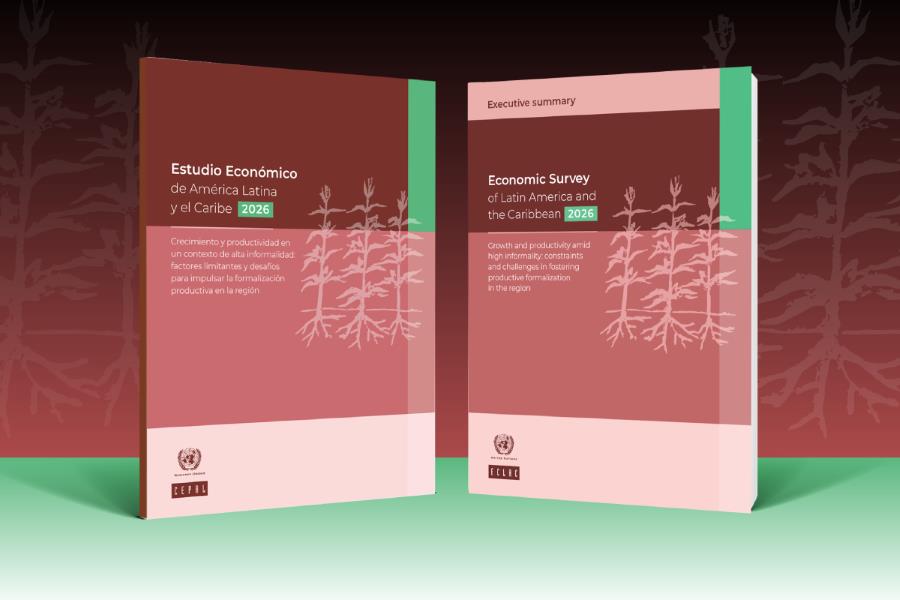
(Santiago, August 20, 2026) The Economic Commission for Latin America and the Caribbean (ECLAC) today released a new edition of its annual report, “Economic Study of Latin America and the Caribbean 2026: Growth and Productivity in a Context of High Informality: Constraints and Challenges Related to Promoting Productive Formalization in the Region.”The report says that the regional economy is expected to grow by 2.2% in 2026, after expanding by 2.4% in 2025, and could see a partial recovery reaching 2.5% in 2027. If these forecasts hold, Latin America and the Caribbean would have sustained five years of average growth around 2.3%, which isn’t enough to ensure a lasting increase in per capita income, close development gaps, or significantly expand political space.The report also points out that an unfavorable international context – marked by a slowdown in global growth, increased geopolitical tensions, financial volatility, and pressures on energy markets – partly explains the expected slowdown in 2026. It also notes, however, that the main barrier to regional growth is structural: low levels of investment, slowing formal job creation, and a large and persistent informal labor sector.
“The region has made significant progress in terms of macroeconomic stability, but this stability needs to become the foundation for stronger and higher-quality growth. To break out of the trap of low growth, it is essential to increase investment and productivity while moving toward productive formalization that strengthens the production capacities of individuals and businesses, expands social protection, and creates more quality formal jobs,” said ECLAC Executive Secretary José Manuel Salazar-Xirinachs.Slow growth in a new geopolitical era
In 2025, the region showed resilience in a reshaped international context marked by increased uncertainty. Regional GDP grew by 2.4%; inflation continued to move towards central bank targets, employment kept growing, though more slowly, and real wages kept recovering. At the same time, the current account balance remained at a moderate level of 1.2% of regional GDP, and net capital flows helped build up international reserves.A slowdown in the global economy is expected in 2026, with growth at 2.9%, the lowest rate since 2022. Geopolitical rivalries and disruptions in energy supplies have pushed up the prices of oil, fertilizers, and transportation, while the continuation of relatively high international interest rates and a stronger dollar could make financing conditions tougher for emerging economies.At the regional level, ECLAC forecasts growth of 2.2% in 2026 and 2.5% in 2027 for Latin America and the Caribbean, with significant differences across sub-regions. South America is expected to see growth of 2.5% in both 2026 and 2027. Growth in Central America is expected to be 1.6% in 2026 and 2.8% in 2027. This result is influenced by the expected contraction in Cuba and Haiti. If these two economies are excluded, the sub-regional average would be 4.0% in 2026 and 4.2% in 2027. Growth in the Caribbean is expected to reach 5.6% in 2026 and 7.9% in 2027, driven by steady growth in Guyana; if this country is not included, the sub-regional average would be 1.1% in 2026 and 2.2% in 2027.
Inflation should stay under control, even if reaching the target takes a bit longer. The recent inflation shock was mainly focused on energy and fertilizers, with less of an effect on food products compared to previous times. However, rising energy costs could delay further cuts in interest rates. In this context, ECLAC emphasizes the importance of maintaining the credibility of monetary policy and actively using macroprudential tools to reduce financial risks.Regarding employment, the number of people employed increased by 1.6% in 2025, which is about 4.3 million jobs, but the pace of job creation slowed for the third year in a row. The unemployment rate dropped to 5.3%, and informal work continued to decline, even though it still accounts for nearly half of the workforce. Early indicators for 2026 point to a more moderate expansion of employment and show that maintaining these improvements will increasingly depend on investment growth, productivity, and economic growth.
In terms of budgeting, stabilizing gross public debt at around 52% of GDP in Latin America hasn’t been enough to restore fiscal room to maneuver. Low growth, high financing costs, and rising interest payments limit the resources available to increase public investment, social protection, and speed up productive transformation. In the Caribbean, gross public debt was about 73% of GDP in 2025, which also reinforced the same obstacles to more productive, inclusive, and sustainable development.
Informality weakens the growth capacity needed to boost productivity.
The second part of the 2026 Economic Study looks at informality not just as an employment or social protection issue, but also as a structural constraint that limits economies’ ability to turn growth into lasting gains in productivity, investment, and quality jobs. At the same time, informality is a result of low growth and one of the mechanisms that keep the low-growth trap going.
Historical data show that the biggest progress in formalization happened between 2000 and 2013, a recent period marked by strong economic growth, high investment rates, productivity gains, and an expansion of formal salaried employment. This process has slowed down since 2014, alongside a slowdown in investments and stagnant productivity. Currently, nearly half of the people employed in the region still work.The analysis presented in the report shows that growth increases productivity in both the formal and informal sectors, but its effects are stronger, faster, and more lasting in the formal sector. Formal businesses are better able to take advantage of economies of scale, integrate innovation, access financing, and build production capacity. Therefore, the greater the weight of informality, the less capacity growth has to generate lasting productivity improvements.
Productive formalization: an integrated strategy to grow more and betterIn light of this analysis, ECLAC suggests developing strategies to boost productive formalization in the region. This concept refers to a process where increased formalization goes hand in hand with strengthening the productive capacities of individuals and businesses, improving productivity, and driving a productive transformation that can support more dynamic and inclusive growth. This approach goes beyond regulatory reforms or isolated administrative incentives and requires consistency and complementarity between labor, fiscal, financial, and productive development policies.The report identified four complementary areas of action:
Labor policies: develop job creation, training, and professional integration programs; reduce gender inequalities; better align labor policies with social policies; and strengthen the care economy and the use of digital tools to make access easier and ensure sustainability in the formal sector.
Fiscal policies: move towards social protection financing systems that reduce barriers to formalization; establish progressive and flexible paths to formalization; and use digitalization and administrative interoperability to simplify compliance and strengthen oversight.Financial policies: strengthen the role of the development bank as a tool for productive integration; design mechanisms that take into account the diversity of businesses; and expand guarantee systems to reduce credit segmentation.
Productive development policies: strengthen and expand integrated support programs for businesses, with a focus on technological outreach; targeted interventions in specific territories; promote forward-looking, multi-stakeholder governance, as well as productive integration and the strengthening of information, monitoring, evaluation, and learning systems.ECLAC concludes that reducing the informal sector is a necessary condition for boosting the region’s growth potential and escaping the low-growth trap. Productive formalization would help improve job quality, expand social protection, and reduce inequality, while also strengthening economies’ ability to turn growth into sustainable progress in productivity, widening the scope of public policies, and consolidating the productive transformation processes that maintain high growth rates in the long term.