
|
Getting your Trinity Audio player ready...
|
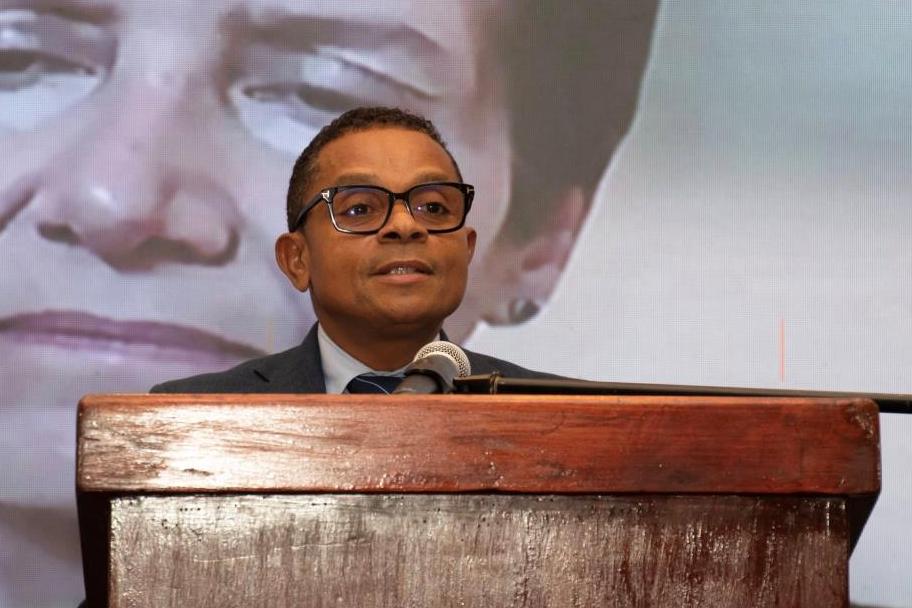
“The energy transition in Haiti” was at the heart of discussions during this week’s IDB (Inter-American Development Bank) Reflection Wednesday. Taking part in this space for discussion, Minister Joseph Almathe Pierre-Louis, head of the Ministry of Public Works, Transport and Communication (MTPTC), spoke to the audience about the meaning of the energy transition for Haiti. “In Haiti, the energy transition should be seen as a lever for economic and social transformation,” said the top official of the MTPTC.
“The energy transition in Haiti should not be seen as just a simple replacement transition but as a real development transition. In industrialized countries, the energy transition mainly consists of replacing fossil fuels with renewable energy sources. For Haiti, the challenge is more fundamental,” said Minister Joseph Almathe Pierre-Louis, explaining that the energy transition is primarily about providing modern, reliable, affordable, and sustainable energy to every citizen, every school, every hospital, every business, and every farm.For Haiti, the energy transition is already underway, according to Minister Joseph Almathe Pierre-Louis. He presented several projects related to the energy transition: the construction of the 13.4-megawatt solar plant in Caracol in the Northeast, the 4-megawatt solar project in Jacmel in the Southeast, and several modern mini-grids providing electricity to municipal sections that had never had power before. ‘The energy transition train has already left the station, but there is still a lot to do,’ the minister admitted.For Minister Joseph Almathe Pierre-Louis, the energy transition is not an option, it’s a necessity since over 60% of the Haitian population doesn’t have access to electricity. It’s also a key condition for economic recovery. The energy transition will help reduce dependence on petroleum products. “This kind of dependence weakens the national economy, increases vulnerability to external shocks, and lowers the country’s ability to provide affordable electricity,” the minister said.The IDB representative in Haiti, Corinne Cathala, sees the energy transition as a strategic, development, competitiveness, and resilience issue. “Haiti is among the least electrified countries in the region. Less than 40% of its population have access to electricity. This reality is a barrier to economic development, job creation, and improving living conditions,” Ms. Cathala lamented.However, the IDB representative in Haiti acknowledges that the country has significant assets to successfully make this energy transition. Its potential in renewable energy — solar, hydro, and wind — offers, according to her, many opportunities to build a resilient energy system that is less dependent on imported oil.Today, the challenge for Haiti, according to Corinne Cathala, is to create conditions that will speed up the energy transition or ensure that it benefits the entire population.
The IDB reaffirms its commitment to the energy sector in support of Haiti. It is carrying out several major investments. As an example, Ms. Cathala mentioned the energy transformation of the Caracol Industrial Park, and the additional $30 million in financing in 2019 to accelerate the energy development of the Caracol Industrial Park to boost its competitiveness.