
|
Getting your Trinity Audio player ready...
|
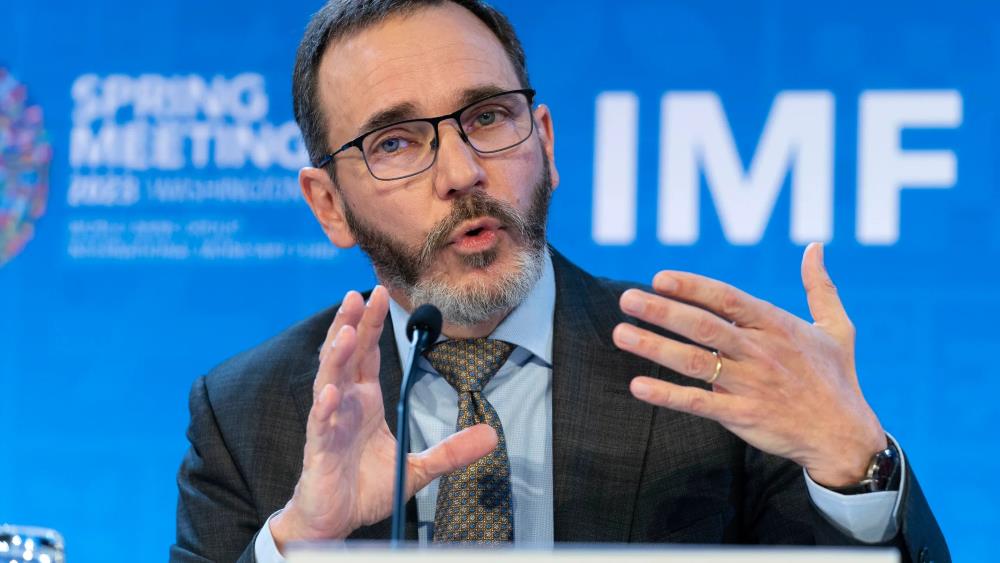
By Erwan LUCAS and Asad HASHIM The global economy has certainly faced a series of major crises since the Covid-19 pandemic, but “globalization is not dead,” even though it has evolved in recent years, said IMF Chief Economist Pierre-Olivier Gourinchas on Friday in an interview with AFP
.By Erwan LUCAS and Asad HASHIM
The global economy has certainly faced a series of major crises since the Covid-19 pandemic, but “globalization is not dead,” even if it has changed in recent years, said IMF Chief Economist Pierre-Olivier Gourinchas in an interview with AFP on Friday.
The International Monetary Fund (IMF) is set to soon release an updated version of its annual World Economic Outlook (WEO) report, without its chief economist, who is set to leave the institution on June 30 after four and a half years to join the American university Berkeley.
“Globalization is not dead,” he said, “but it has transformed and entered a new phase.”
“What we’re seeing is a desire to reduce bilateral trade between China and the United States,” he noted.
“This has allowed other players to get involved in supply chains, like Mexico or Vietnam. There’s a certain level of adaptation that has helped keep global trade at a very high level,” Mr. Gourinchas explained.
Of course, some countries “are looking to be less dependent on global trade,” he admitted, citing the United States first and foremost, “but I don’t think that’s a sustainable solution.”
In general, a country “can’t develop its industry just for itself; it has to be able to rely on a bigger market” if it wants to survive.
At the same time, trade agreements have multiplied, like those “of the European Union with Mercosur or India, which help strengthen trade in these specific areas.”
However, these markets have shrunk, according to Pierre-Olivier Gourinchas, particularly because of the scale of China’s industrial exports in the global economy.
“It’s not certain that a country like India could follow China’s development model,” based on product exports, “I don’t think they have the room to do it,” given the market shares held by Beijing.A strong but slowing economy
The continuation of these global trade exchanges, which have not collapsed, partly explains the global economy’s ability to respond to the various crises of recent years, particularly thanks to “the adaptation of private sector actors, who quickly repositioned their inventories or production” to cope with new constraints.
“What’s striking about the trade tensions” caused by tariff moves from Donald Trump, for example, “is that we initially saw a trade boom, with companies pre-positioning their products in anticipation of tariffs,” Mr. Gourinchas pointed out.A phenomenon that repeated itself with the outbreak of war in Iran by the United States and Israel, where “the private sector’s ability to respond to disruptions in the energy market has been quite remarkable.”
“The strength of the global economy is striking, despite significant headwinds in recent years, which at the same time have created opportunities for some emerging economies,” he continued.
A sign of this strength, while “in the 1980s, the rise in Federal Reserve rates led to a growth in debt in Latin American countries. That hasn’t been the case for any emerging country this time,” despite a rapid rate hike by the Fed four years ago, “a few countries had difficulties, but we didn’t see anything systemic,” reminded the Fund’s chief economist.Despite this resilience, growth has been weaker since 2020 than in previous decades, a long-term slowdown that even led the World Bank to talk about a ‘lost decade’ for the 2020s.
‘We see a slowdown in average growth over the past 25 years, and it’s a cause for concern because it’s something more structural,’ not just linked to the succession of current crises affecting the economy, confirmed Pierre-Olivier Gourinchas.
With a risk, especially for countries trying to develop, ‘of getting caught in the middle-income trap,’ without having the chance to cross the final hurdle.