
Security council, natural resources, artificial intelligence.
Security Council, natural resources, artificial intelligence. At the podium of the General Assembly, several leaders from French-speaking Africa have expressed the same frustration in recent days. That of an international order that, more than 80 years after the creation of the UN, continues, in their view, to distribute power, wealth, and the right to set the rules unevenly.
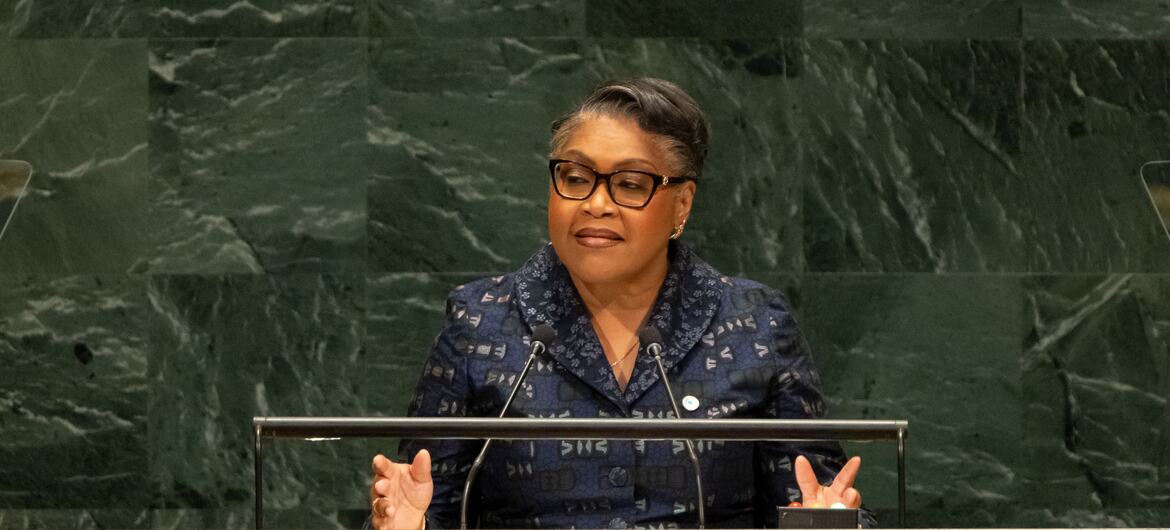
“The world of 1945 is gone,” summarized Congolese Prime Minister Judith Suminwa Tuluka. Digital revolution, energy transition, climate disruption: the balances have changed, she argued, but the institutions responsible for managing them remain “too often a reflection of an order that no longer exists.” For Kinshasa, the problem also lies in the application of international law. “There really cannot be lasting trust when the strength of our proclaimed principles varies depending on the people, the crises, or the circumstances.”Judith Suminwa Tuluka, the PM of the Democratic Republic of Congo, at the general debate of the 81st session of the Assembly
From Senegal to Niger, and including Côte d’Ivoire, this distrust of a system seen as not representative enough came up in many of the speeches by African leaders in New York. But while they agree on the diagnosis, the solutions clearly differ.Reforming the system or breaking free from it
Niger delivered one of the harshest critiques of the week. Its Prime Minister, Ali Lamine Zeine, condemned what he sees as the image of Africa as a continent “doomed” to rely on international aid while “its wealth is being taken or held hostage for the benefit of other agendas.” He accused France of trying to keep his country under its control, described terrorism in the Sahel as a form of “recolonization,” and criticized international institutions that, in his view, have become “tools of a world order where some peoples matter and others just survive.”Mali has developed a similar critique. Its foreign minister, Abdoulaye Diop, criticized the “selective application” of international law, the policy of “double standards,” and the logics of “hegemony” and “domination.” Bamako especially continues to link part of the Sahel security crisis to NATO’s intervention in Libya in 2011.
But neither Mali nor Niger is advocating isolation. Their split is more about the frameworks for cooperation and the choice of partners. The two countries, along with Burkina Faso, have made the Sahel States Confederation (AES) the tool for this reorientation. Mali says it is open to working with any partners who respect its sovereignty, territorial integrity, and “our strategic choices, including our choice of partners.”The President of Senegal, Bassirou Diomaye Faye, during the general debate of the 81st session of the UN General Assembly.
“We have no orders to take in this regard,” emphasized Mr. Diop.
Senegal is relying on existing regional and multilateral frameworks. Bassirou Diomaye Faye acknowledges a “crisis of confidence” in international institutions, but the president calls for a UN that is “stronger, more representative, and more effective.” In the fight against terrorism, he intends to work with the Economic Community of West African States (ECOWAS), the African Union, and the United Nations. “The Sahel must not be abandoned to its sad fate,” he warned.So the divergence is less about the need to cooperate than about the conditions of that cooperation. Dakar continues to rely on ECOWAS, the African Union, and the UN; Bamako and Niamey now plan to organize it mainly around the AES and partners they choose in the name of their sovereignty.Mastering resources, influencing the rules
However, this claim of sovereignty doesn’t stop at diplomatic and security issues. It also shows up in economic discussions, with a recurring concern: no longer limiting the continent to the role of supplier of raw materials.
Equatorial Guinea has advocated for cooperation that allows African countries to process their own resources, develop their value chains, and acquire the technologies needed for industrialization. “A more productive and industrialized Africa is a stronger partner to the benefit of all,” said its vice president, Teodoro Nguema Obiang Mangue.

