
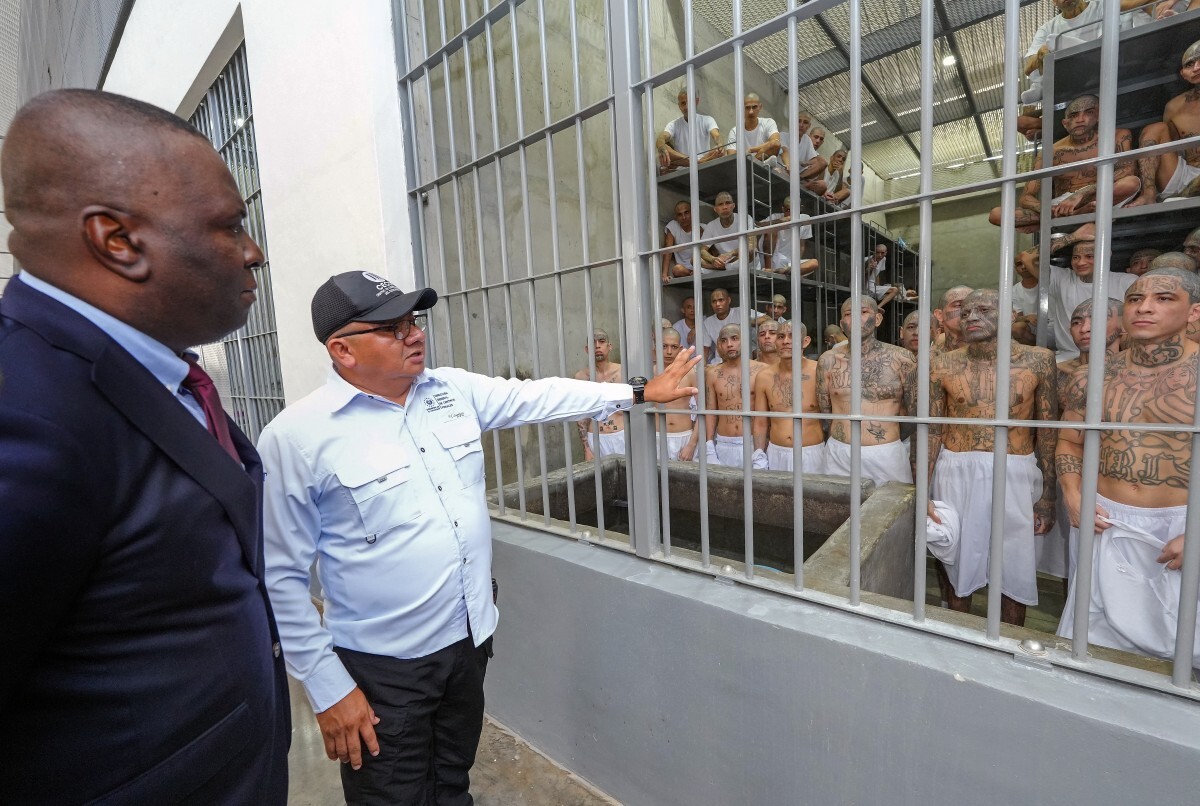
Prison model, adaptation of Haitian laws, training of judges from judicial poles, and the upcoming construction of a modern prison: these are the lessons Haiti learned from El Salvador.
The Minister of Justice and Public Security, Me Patrick Pélissier, announced new cooperation opportunities with El Salvador in the fight against armed gangs. Mandated by Prime Minister Alix Didier Fils-Aimé, he went on a mission to this Central American country on November 16 and 17, during an international conference on the State and democracy.
At a press conference held this Friday, November 20, in the diplomatic lounge, Me Pélissier shared the main outcomes of his trip.Beyond his participation in this international meeting, the minister’s mission was to meet with several Salvadoran officials to explore ways to strengthen bilateral cooperation on security. The Minister of Justice specifically met with Salvadoran Vice President Félix Ulloa, as well as with the Salvadoran Minister of Justice. They discussed strategies to combat criminal organizations, how judicial institutions operate, and the use of new technologies in security operations.At the end of his talks with his Salvadoran counterpart, Me Patrick Pélissier discussed three areas of cooperation. The first involves sharing experiences with the actors of Haiti’s judicial centers, with a view to better structuring the judicial handling of gang-related cases. The second focuses on strengthening the skills of police officers in charge of investigations, particularly in techniques for investigating criminal organizations and their networks. The third aspect, more symbolic, concerns the possible organization of a friendly match between Haiti and El Salvador at the Sylvio Cator Stadium in Port-au-Prince. The minister hopes to make it a ‘match for peace,’ symbolizing the historical ties between the two peoples.The trip also allowed the Haitian minister to visit two Salvadoran prison facilities. The first, built in seven months, has a capacity for 40,000 inmates and currently houses about 21,000 gang members. According to explanations given by Patrick Pélissier, the prisoners were specifically identified based on tattoos linked to their membership in criminal organizations. They are serving long sentences and do not get visits.
The second facility is dedicated to the detention and reintegration of people convicted of other crimes. The minister describes it as a large vocational training center with about twenty classrooms. Inmates there learn plumbing, mechanics, sewing, agriculture, and computer repair. They also help maintain and repair security vehicles, prepare their meals, and take part in farming activities. Work is therefore a key part of the reintegration system. Inmates can earn a reduction in their prison time depending on their participation in these work activities.”We have a lot to learn,” admitted Patrick Pélissier, noting that improving the functioning of Haitian courts is a key task to make justice more effective against organized crime.On the diplomatic front, the minister also mentioned a particularly striking gesture from the Salvadoran vice president. At the end of the conference, in front of more than 6,000 participants, Félix Ulloa reportedly spent about ten minutes talking about Haiti and its role in the history of peoples’ emancipation. The vice president notably recalled the Haitian revolution and the support given by Alexandre Pétion to Simon Bolivar in the liberation struggles in Latin America. According to the minister’s report, the vice president felt that Latin America had a historical debt to Haiti, calling on the countries in the region to support the Haitian people. He stated that El Salvador intends to play its part in this commitment.The Minister of Justice and Public Security, Me Patrick Pélissier, also praised El Salvador’s development efforts, a country once deeply affected by violence. He particularly highlighted its economic ambitions, the efforts made to improve the living conditions of its population, and the growth of tourism, with four million visitors recorded in 2025, according to the figures he presented.
Minister Pélissier also announced progress in the project to build three penitentiary facilities in Haiti. An agreement has been reached with a company specializing in prison construction, which is expected to start the process for the construction of one of the facilities, in partnership with a Haitian company. Prime Minister Alix Didier Fils-Aimé is said to have already given instructions for the project to be submitted to the competent authorities to speed up its implementation.

