
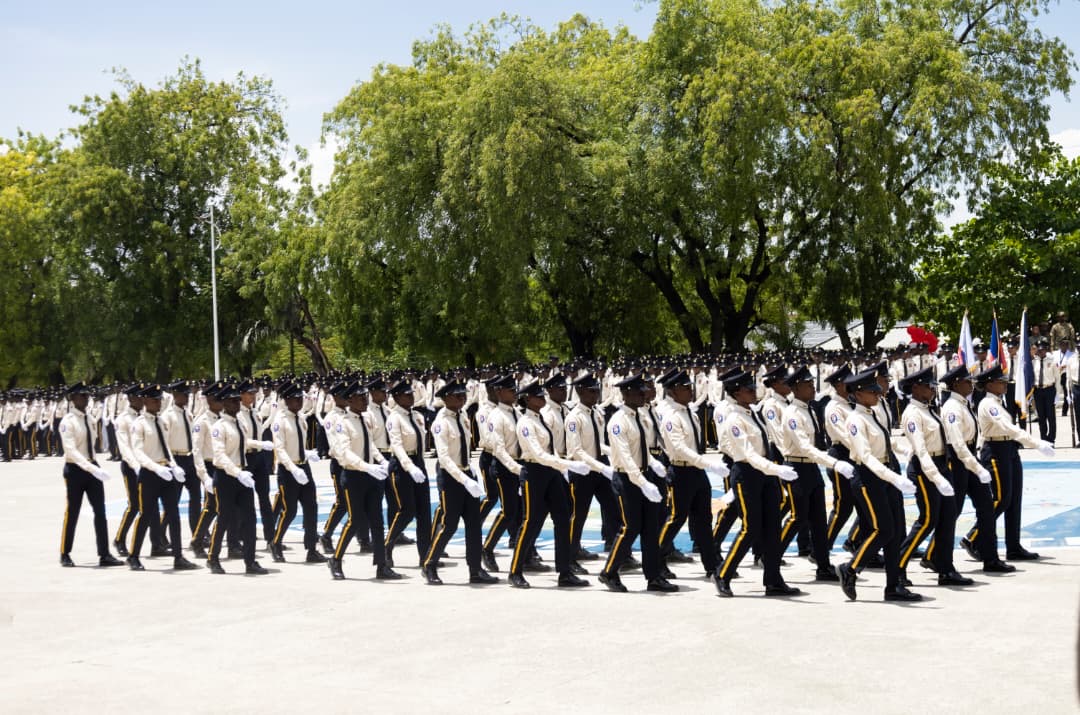
The Fils-Aimé government plans to train 27,000 police officers and soldiers over three years.
The Fils-Aimé government plans to train 27,000 police officers and military personnel over three years. The plan is to have 15,000 military members and 12,000 police officers, Le Nouvelliste has learned. ‘…We are putting in place a program to train 15,000 new soldiers over the next three years,’ said Prime Minister Alix Didier Fils-Aimé during his speech at the UN General Assembly in New York on Friday, September 25, 2026.”We chose to strengthen the operational capabilities of our national security forces. We’re recruiting. We’re training. We’re reinforcing. Through the P4000 Program, we’re continuing the training of 4,000 police officers. More than 2,000 have already been trained. A new cohort is expected to graduate from the Police Academy next November. At the same time, over 1,500 new soldiers have already been trained, and we’re putting in place a program to train 15,000 new soldiers over the next three years. We’ve also increased the investment budget for our two security forces. Today, our goal isn’t just to respond to the crisis. It’s to build the capacities that will allow Haiti to fully and sustainably handle its own security in the future,” explained Prime Minister Alix Didier Fils-Aimé.
“We chose to strengthen the operational capabilities of our national security forces. We’re recruiting. We’re training. We’re reinforcing. Through the P4000 Program, we’re continuing the training of 4,000 police officers. More than 2,000 have already been trained. A new cohort is expected to graduate from the Police Academy next November. At the same time, over 1,500 new soldiers have already been trained, and we’re putting in place a program to train 15,000 new soldiers over the next three years. We’ve also increased the investment budget for our two security forces. Today, our goal isn’t just to respond to the crisis. It’s to build the capacities that will allow Haiti to fully and sustainably handle its own security in the future,” explained Prime Minister Alix Didier Fils-Aimé.“At the same time, the government has launched an ambitious program to strengthen the Haitian Armed Forces. This year alone, 1,500 additional soldiers have already been recruited. We are also working on a project to increase the FAD’H to 15,000 more soldiers over three years, bringing in 5,000 soldiers each year,” he also confirmed.
“These programs aren’t just about increasing numbers. They are part of a vision for professionalization, training, equipment, and modernization of our defense and security forces. The goal is to provide Haiti with a National Police and Armed Forces with enough capability to carry out their core missions, protect the population, and contribute to the country’s long-term stability,” he explained.“In the same spirit, a new military doctrine is currently being developed. It aims to adapt the organization, missions, preparation, and intervention methods of the Haitian Armed Forces to the security reality our country is facing. This doctrine will have to take into account contemporary threats, issues of national territory protection, monitoring of land and maritime areas, as well as the need for better coordination among the various national security institutions,” said Mario Andresol, emphasizing that “the Haitian government intends to carry out its actions with a view to strengthening national security institutions, so that our country can have the human, material, and operational resources necessary to prevent the resurgence of such crises. In this perspective, strengthening the personnel of the Haitian National Police is a priority,” he added.Brief overview of the situation and security challenges
‘As of today, the security challenges are mainly focused in three of the ten departments of the Republic, covering fifty municipalities. Among these, twenty-nine, or about 58%, are currently controlled by our national security forces, while twenty-one others are still facing, to varying degrees, the presence of armed groups and ongoing security issues,’ said the Minister of Defense.“This situation calls for a determined national response, but it should not overshadow the efforts made or the progress achieved in restoring the authority of the State. The government is indeed pursuing a strategy of gradually securing affected territories, consolidating areas brought back under national control, and strengthening the capacities of the Haitian Armed Forces and the Haitian National Police,” Andresol explained.
“Through improving the operational preparedness, mobility, and response capabilities of our forces, we are working to create the conditions needed to protect the population, restore public institutions, and resume essential activities for national life,” he said during his speech.“These advances still need to be strengthened in an environment where the threat isn’t just internal. The illegal cross-border flow of firearms, ammunition, and drugs helps to boost the capabilities of armed groups, feed criminal networks, and weaken Haiti’s stability. The supply and funding channels for these activities go beyond national borders, which makes a collective approach to security essential,” said the Defense Minister.“Sharing land and sea borders with neighboring states gives cross-border cooperation strategic importance. We need to strengthen the exchange of information and intelligence, improve monitoring and control capabilities of border and maritime areas, and develop closer operational coordination to combat illegal trafficking that fuels insecurity. Protecting Haiti’s stability therefore also involves regional cooperation capable of acting on the supply sources of criminal networks,” said Defense Minister Mario Andresol.The government must promptly vote on the 2026-2027 budget decree. According to the Prime Minister’s framework letter: ‘Budget policy will also need to take into account the constraints related to current spending, including those arising from the recruitment and integration of new cohorts within the National Police of Haiti and the Haitian Armed Forces. At the same time, security-related investments, particularly those aimed at strengthening the capacity to fight gangs and terrorists, will need to be planned in a rigorous way, with a clear identification of needs, costs, funding sources, and the implementation schedule,’ according to this framework letter.

