
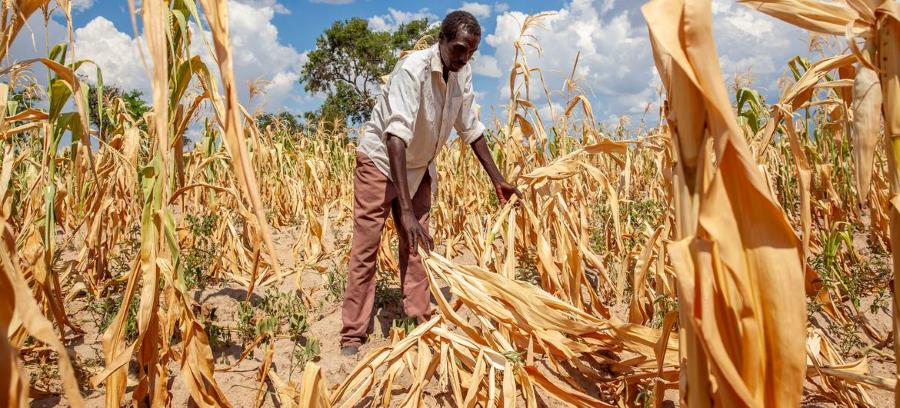
Heat waves, droughts, heavy downpours, and other extreme weather events are expected to increase worldwide in the coming months as the El Niño phenomenon strengthens in the Pacific, the World Meteorological Organization (WMO) warned on Friday.
Heat waves, droughts, heavy downpours, and other extreme weather events are expected to increase worldwide in the coming months as the El Niño phenomenon strengthens in the Pacific, the World Meteorological Organization (WMO) warned on Friday.
As heat records are falling one by one already in many parts of the world, a new player enters the climate equation. After several years dominated by La Niña, the El Niño phenomenon is now established in the tropical Pacific and is expected to quickly gain strength.
El Niño is a natural climate phenomenon caused by an abnormal warming of the surface waters of the equatorial Pacific. For meteorologists, its return doesn’t just mark a change in the oceanic cycle: it increases the risk of extreme weather events far beyond the Pacific”El Niño will also give an extra boost to global temperatures,” warned Alvaro Silva, a WMO scientist, on Friday during a press briefing in Geneva. “We know that during El Niño years, global temperatures usually reach record levels.”.The UN agency’s assessment is clear. Its latest seasonal climate bulletin forecasts, with a ‘high level of confidence,’ a rapid intensification of the phenomenon between July and September. Forecast models agree: surface waters in the central and eastern equatorial Pacific will continue to warm significantly, with seasonal anomalies exceeding 2°C in several areas. It’s this buildup of heat that disrupts major atmospheric currents and reshuffles weather patterns across the globe.
A Planet Already Under Stress
This announcement comes as summer is just beginning in the Northern Hemisphere and several regions are already experiencing exceptional temperatures.
“We are in the first week of July, at the start of what is traditionally the hottest month of the year. Yet, as early as June, we have already seen record temperatures in many parts of Europe. For example, Germany recorded a new national record of 41.7 °C last weekend,” said Clare Nullis, spokesperson for the WMO.In the United States, the UN agency also reports a ‘prolonged and dangerous’ heat wave in the central and eastern parts of the country, which is expected to continue through the American Independence Day weekend, according to the U.S. National Weather Service.
For scientists, El Niño alone doesn’t create these extreme events. But it acts as an amplifier of a climate already deeply warmed by human greenhouse gas emissions.
‘The strength of El Niño is important because it increases the likelihood of extreme weather and climate events in different regions of the world… on top of the long-term climate change caused by human activities,’ stressed Alvaro Silva.Very uneven impacts depending on the region
The expected consequences vary greatly across continents. The WMO predicts drier-than-normal conditions in Central America, the Caribbean, and some parts of North and South America. Rainfall deficits are also likely in parts of Indonesia and Southeast Asia during the peak of the monsoon season.
On the other hand, East Africa could see above-normal rainfall between September and December, with a higher risk of flooding. This situation could be further influenced by another climate factor, the Indian Ocean dipole, whose development is considered possible in the coming months.Meteorologists, however, remind us that no region is affected uniformly. The effects of El Niño vary depending on its intensity, duration, the time of year, and its interaction with other climate mechanisms. Even during so-called ‘neutral’ periods, extreme weather events can occur.
A window of action that is closing
In light of these prospects, the WMO says it has launched an ‘unprecedented’ mobilization with national meteorological services and regional climate centers to help governments anticipate the risks.”We still have a window to prepare and take early action. But this window is closing in some regions,” warned Alvaro Silva. In countries threatened by drought, the challenge is especially about ensuring enough water reserves for agriculture, energy production, and other essential sectors.El Niño appears on average every two to seven years and usually lasts between nine and 12 months. It typically reaches its peak intensity between November and February, while its effects on the global average temperature are often felt most strongly the following year.
With global warming now setting an ever-higher level of heat, El Niño could, in the coming months, push the planet even further toward its limits.