
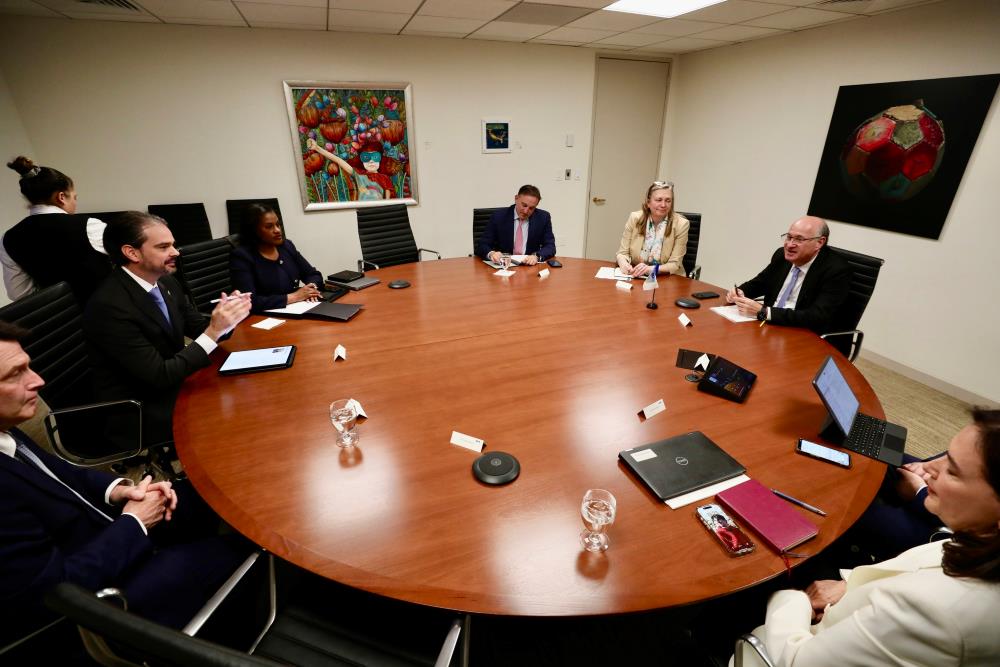
At the Regional Summit on Security and Justice in Brazil, the Inter-American Development Bank (IDB) and Interpol, the world’s largest international police network, announced a collaboration within the Rapid Response Working Group of the Alliance for Security, Justice, and Development.
At the Regional Summit on Security and Justice in Brazil, the Inter-American Development Bank (IDB) and Interpol, the world’s largest international police network, announced a collaboration within the Rapid Response Task Force of the Alliance for Security, Justice, and Development. This collaboration aims to provide specialized support to countries facing security and judicial challenges in Latin America and the Caribbean.This important step marks a new phase in regional cooperation and strengthening operational capacity. An initial pilot project will be launched in Brazil to assess its reproducibility in other contexts across the region. The partnership between Interpol and the Alliance Rapid Response Task Force will give participating countries access to international expertise, operational knowledge, and stronger cooperation networks to tackle increasingly complex security challenges. An initial technical assistance of $100,000 will be available for this first phase.“It is essential to promote responsiveness to serve our countries when they need it most. This collaboration with Interpol, through the Rapid Response Operational Task Force, is crucial for strengthening security in Latin America and the Caribbean. Fighting organized crime requires cooperation, stronger institutions, and a shared commitment to action. We are implementing concrete solutions to the security challenges the region faces,” said Ilan Goldfajn, president of the IDB Group.
“We know that the task force model works; INTERPOL recently adopted a similar approach. We look forward to working closely with our BID partners to identify INTERPOL resources that could further strengthen the Alliance’s Rapid Response Task Force and thus improve security in Latin America and the Caribbean,” said Valdecy Urquiza, Secretary General of INTERPOL.
The Rapid Response Task Force is already operational in Peru, Jamaica, Guatemala, and Brazil. In Peru, technical assistance helped guide discussions that led to the development of the country’s 2026 National Security Plan. In Jamaica, the Task Force supported efforts to strengthen the operational continuity of police forces in the face of natural disasters. In Guatemala, technical cooperation is helping advance cross-border security policiesInterpol’s increased participation in the Rapid Reaction Task Force will further strengthen the Alliance’s international cooperation network, which already has 14 partners.
A memorandum of understanding aimed at boosting cooperation with the Korean National Police Agency (KNPA) will further expand this network.
Together, these partnerships will turn the Rapid Reaction Task Force into a mechanism that brings together international expertise, swift technical assistance, and regional cooperation within a single framework. This mechanism will help Alliance member countries strengthen their security and justice institutions and fight organized crime more effectively.The Alliance for Security, Justice, and Development
Launched in 2024, the Alliance for Security, Justice, and Development brings together 23 member countries and 14 strategic partners to boost regional cooperation against organized crime. The Islamic Development Bank handles its technical secretariat. Through initiatives like the Rapid Response Task Force, the Alliance gives countries quick access to specialized technical expertise to tackle urgent security and justice challenges.INTERPOL
Interpol’s mission is to enable the police forces of its 196 member countries to work together to fight transnational crime and build a safer world. It manages global databases containing police information on criminals and crime, and provides operational and forensic support, analysis services, and training. These policing capabilities are deployed worldwide and support four international programs: financial crime and corruption; counter-terrorism; cybercrime; and organized and emerging crime.