
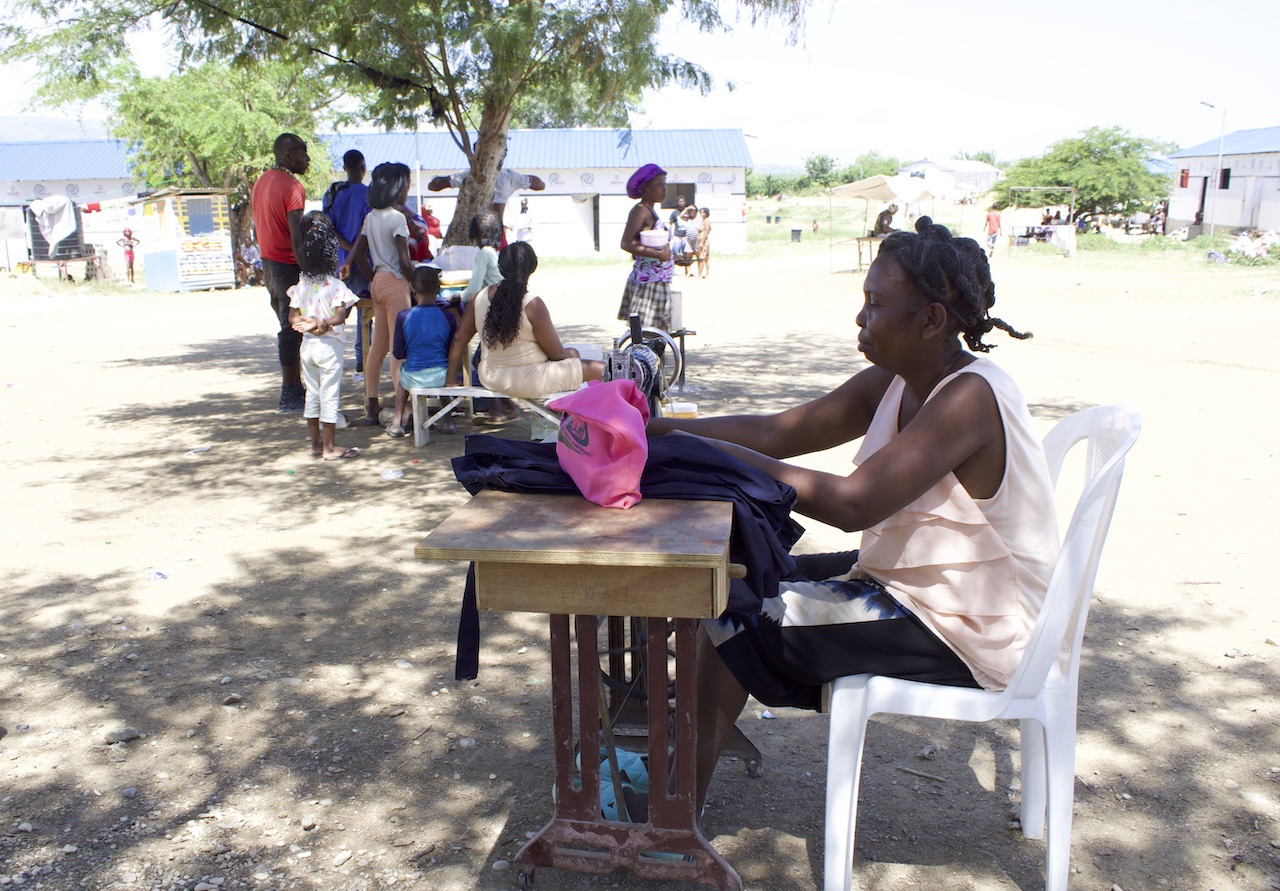
In the Papaya farm camp, in the Central Plateau, hundreds of displaced families are trying to rebuild their daily lives after fleeing insecurity.
In the camp at Papaye Farm, in the Central Plateau, hundreds of displaced families are trying to rebuild their daily lives after fleeing insecurity. Amid complaints about living conditions, Marlène Georges, 49, has chosen to work. With a second-hand sewing machine, this former resident of Saut-d’Eau mends the clothes of the displaced and finds, through her work, a way to keep standing.I am at the Papaye farm camp, in the Central Plateau. Hundreds of families, mainly from Mirebalais, Saut-d’Eau, and Port-au-Prince, have found refuge in this space where the bright green grass and the trees provide a striking contrast with the displaced persons camps I know in the capital.
In Port-au-Prince, entering some camps means first confronting the smells. Dirty plastic bags, garbage, swarming rats. You sometimes have to resist all of that to keep working, microphone in hand.
In Papaye, the displaced people complain too. They criticize the quality of the food and water, as well as the tarp shelters that don’t hold up well against wind and sun. But the setting is different. Despite the difficulties, the camp seems cleaner. The grass is green. The trees are there.And then, in the middle of this life of fortune, I come across a woman who isn’t like all the others who come to complain in front of my microphone. She’s sitting outside, away from the lawn, on a dirt field, in front of her second-hand sewing machine. Her foot operates the pedal. She’s working.
Her name is Marlène Georges. She’s 49 years old. Born in Saut-d’Eau, a town known for its pilgrimages, she had to flee this major pilgrimage site in Haiti.
Every year, from July 14 to 16, pilgrims flock to the foot of Our Lady of Mount Carmel and the waterfall, for ritual baths and in an amazing mix of religious practices.
Marlène, she had to leave.Flee, then start over
“I was living in Saut-d’Eau. Insecurity made me run. I went to take refuge with my two boys in Hinche.” Her story is that of thousands of displaced people forced to leave, then leave again. “Before coming here, I was at the Immaculée camp. Over there, we were buried under trash. And on top of that, there was stagnant water. We were covered in mosquitoes. Here in Papaye, thank God, things aren’t worse.”
Marlène is married and a mother of four. Today, she lives in cramped conditions that are far from ideal.
The International Organization for Migration, IOM, has placed three families in the same room. Marlène calls this space a ‘hangar.’ A man in his thirties lives there with his eight-year-old daughter. Marlène shares the space with her two boys, aged 18 and 20.Yet, she doesn’t want to complain. Because here, she has found work. Her sewing machine, bought for her by an organization, isn’t new. It’s a second-hand machine, bought in Hinche. But it allows her to work. She pedals, and the customers come.
“In this camp, I find work. Everyone comes to me.” Torn clothes, garments to patch up, pieces to sew. Everything passes through her hands. And when she talks about her work, a little laugh slips out. “It’s still me,” she says giggling.
In this camp where many wait for help, Marlène works. The displaced people come to bring her their clothes. She uses a skill she had before losing everything.
Around her, the camp goes about its life.
Conversations mix with the steady noise of the machine. Residents walk by, look, and wait their turn.