
|
Getting your Trinity Audio player ready...
|
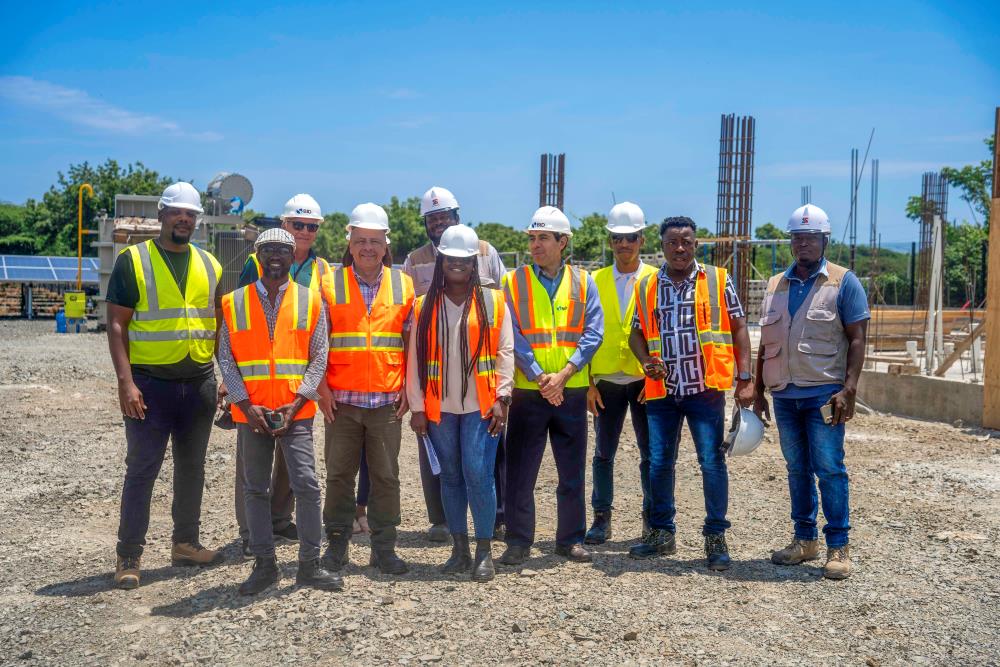
A delegation from the Technical Implementation Unit of the Ministry of Economy and Finance (UTE/MEF), accompanied by representatives from the energy sector of the Inter-American Development Bank (IDB), conducted a supervision visit from May 12 to 15 to assess the progress of the AMACEH program works.
A delegation from the Technical Implementation Unit of the Ministry of Economy and Finance (UTE/MEF), accompanied by representatives from the energy sector of the Inter-American Development Bank (IDB), conducted a supervision visit from May 12 to 15 to assess the progress of work on the AMACEH program. With the support of the MTPTC, through its Energy Unit, and the National Authority for the Regulation of the Energy Sector (ANARSE), this electrification program focuses on solar energy and promotes public-private partnerships to strengthen sustainable access to electricity in Haiti.
In several municipalities across the country, access to electricity is gradually becoming a reality thanks to the support of the “Improvement of Access to Electricity in Haiti” (AMACEH) program. Mini-grid electricity projects are notably under construction in Génipailler, in the municipality of Milot, North Department; in Carice, in the Northeast; and in Marfranc, in Grand’Anse.One example of a public-private partnership with a strong impact on local development is the Génipailler project, where a collective of intellectuals and professionals, gathered within the Reflection and Action Group for a New Haiti (GRAHN), set up several educational and community infrastructures on a former sugarcane plantation, to transform and revitalize the area following the earthquake of January 12, 2010. This initiative made it possible to provide this community with basic social services: early childhood, primary, and secondary schools, a university, businesses, as well as a health center, grouped under the name ‘City of Knowledge’.The next step to continue the development of this vision was to provide electrical power to the already established infrastructures, as well as to the surrounding communities. It is in this perspective that the Génipaillers mini-grid project “Pi Gran Enèji” was launched, initiated by the GRANH collective and funded by the Haitian government with IDB funds through the AMACEH program. The project plans the construction of a solar power plant capable of producing 400 kilowatts of electricity.
The future solar power plant will include 672 photovoltaic panels of 570 watts each. This energy infrastructure will make it possible to supply all the buildings of the City of Knowledge, including our school, the ISTEAH university, as well as the community health center. Génipailler will not be the only locality benefiting from the project. About 1,400 households will have access to electricity thanks to the network, which will be extended to the localities of Laurie, Carrefour des Pères, and Baudin, where energy will also be distributed and sold,” anticipates engineer Freud Francisque, project director.The populations concerned should benefit from a continuous power supply, available 24 hours a day at an affordable cost. Rates will be established in consultation with the National Energy Sector Regulatory Authority (ANARSE). Transformers as well as electricity transmission lines will be installed to ensure the distribution of power. Project officials estimate that once electrified, the area will have the opportunity to enter a new phase of modernization and economic development.Such is the goal of the AMACEH program, which places at the heart of its action the support for private initiatives and the strengthening of public-private partnership for better access to electricity. Launched in 2019, this program mainly uses solar energy to electrify remote areas, while stimulating the local economy. The program’s strategy consists of developing mini electrical networks to ensure stable and sustainable access to energy, with priority given to rural areas. This energy transition, accompanied by private partners, presents many advantages for the Haitian state, as decentralized solar energy allows access to environmentally friendly and resilient electricity.In Carice, residents and partners join forces to electrify the town
In Carice, in the Northeast, the population does not just await the arrival of electricity; they actively participate in its implementation. This civic mobilization represents one of the most striking aspects of the AMACEH program, which relies not only on public-private partnerships but also on the direct involvement of communities in the construction and rehabilitation of mini electrical networks.Located about two hours from the main road of Ouanaminthe, the municipality of Carice is accessible by a steep dirt road. This municipality, which has a little over 10,000 inhabitants spread across two communal sections, now harbors great hopes around the revival of its solar power plant. Built in 2020 by Electricity of Haiti (EDH), the plant had remained unfinished until now. In order to allow the resumption of work, the Haitian state, through the MTPTC, grants a concession contract authorizing the operation of the network within the framework of an agreement with the actors involved in the project.
When the residents learned that the AMACEH program would finance 60% of the rehabilitation work, the private developer SKDK quickly mobilized to raise the remaining amount through a loan from the community credit union intended to finance the rest of the work. “It must be understood that before the construction of this plant, the residents did not have access to electricity. Only those who could afford to buy a generator could benefit from power,” explains Jacquelin Osias, president of the Carice Community Engagement Committee. The solar plant, currently under rehabilitation, is expected to supply more than a thousand households as well as schools and small businesses in the municipality. The project includes modernizing the existing system by adding about a hundred additional solar panels.