
|
Getting your Trinity Audio player ready...
|
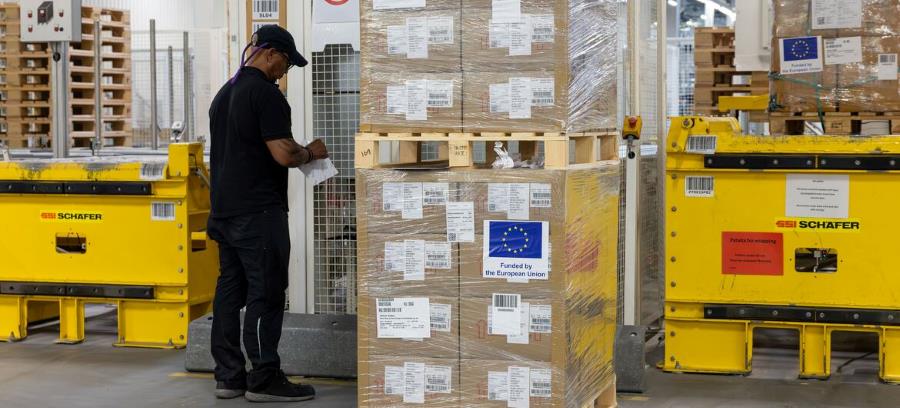
Emergency supplies are being loaded at UNICEF’s logistics center in Copenhagen to be shipped to the DRC during the Ebola outbreak.
Emergency supplies are being loaded at UNICEF’s logistics center in Copenhagen to be shipped to the DRC during the Ebola outbreak.
Nearly 100 days after the latest escalation in the Middle East, the crisis continues to shake the world. UNICEF warns about the rising transport costs that are paralyzing the delivery of vital supplies for children. The persistent congestion in humanitarian supply chains now threatens access to aid for children globally.According to the United Nations Children’s Fund (UNICEF), this situation significantly reduces the room for maneuver for humanitarian agencies. “What begins as a disruption of maritime routes can escalate into a humanitarian crisis,” warned Jean-Cédric Meeus, UNICEF’s global head of transport and logistics, from Mogadishu (Somalia), during a regular UN press briefing in Geneva.
Air freight capacity has decreased on routes to the Middle East, while port congestion is spreading across Africa and beyond. At the same time, transport and logistics costs alone have a considerable impact. Maritime detours around the Cape of Good Hope now extend delivery times by two to four weeks.”And behind this cascading disruption lies a simple and brutal equation: every additional dollar that UNICEF spends on transportation is one less dollar devoted to supplies for children. The operational impact of these past few months is already very significant,” added Mr. Meeus.A female vaccinator supported by the UN in Afghanistan administers a polio vaccine to a young child (archives).
Difficult trade-offs
Humanitarian transportation costs are soaring. Air freight for vaccines from India to Ethiopia, Nigeria, and the DRC has jumped by 50 to 70%, while road transport of therapeutic foods from Kenya to Somalia, South Sudan, and the DRC has increased by 30%. Sea freight for educational materials from China to Yemen and Mozambique has risen by 100 to 150%.In Nigeria, the polio vaccination campaign has seen its transportation costs increase by 56%. In Mali, the freight budget has already increased by 36% in the first quarter, forcing UNICEF to make trade-offs between child care and other essential programs.
Beyond Mali, these logistical pressures are being felt across all African humanitarian corridors, where delays are accumulating and worsening the difficulties of delivering aid. The African ports of Beira, Conakry, Abidjan, Dar es Salaam, and Mombasa are all experiencing significant delays.Landlocked countries that depend on these corridors continue to suffer cascading effects. the Ethiopian corridor of Djibouti, the country’s main humanitarian entry point, is under increasing pressure.Maintaining supply despite unprecedented logistical pressure
While UNICEF has almost exhausted the annual funds allocated for transport by its logistical partners – an unprecedented situation – these disruptions could delay the delivery of essential supplies by four to six months. “For a child in a crisis zone, a delay in the delivery of vaccines or nutritional interventions can make the difference between life and death,” emphasized Mr. Meeus.Despite all these difficulties, UNICEF continues to deliver essential supplies. In addition to activating alternative routes by air, land, or sea, the agency is also relocating production. It now works with more than 20 manufacturers of ready-to-use therapeutic foods (RUTF) worldwide, notably in Ethiopia, Kenya, Haiti, and Egypt. This reduces dependence on long international sea routes.”We will not let these difficulties compromise the life and well-being of children (…). When supply chains are disrupted, it is the children who pay the highest price,” argued the global head of transport and logistics at UNICEF.
The Impact of Oil Shocks on Vulnerable Economies
A concern all the more acute because these logistical disruptions occur in a context of persistent tensions on the major routes of global trade. According to UN Conference on Trade and Development (UNCTAD), disruptions in the Strait of Hormuz send shockwaves through the global energy system.
The most vulnerable economies are on the front line. Among 75 of the least developed countries (LDCs) and small island developing states (SIDS), 65 depend on oil imports. According to UNCTAD, a sustained 50% increase in refined petroleum product prices could raise their import bills by more than 20 billion dollars per year: about 16 billion for LDCs and 4 billion for SIDS.This pressure risks forcing these states to choose between paying energy bills and funding essential public services, with repercussions for nearly a billion people. “This goes far beyond a simple calculation on a spreadsheet. Together, these countries have nearly a billion inhabitants, and more than 30% of their population lives on $3 a day,” emphasized Marcelo Risi, spokesperson for UNCTAD.
The impact could exceed 5% of GDP in many countries, notably Mauritania, Gambia, Vanuatu, and the Maldives. “This leads us to talk about impossible choices between financing essential imports and investing in development priorities,” insisted Mr. Risi. For, according to him, the issue goes beyond oil prices alone: it concerns “how a geopolitical disruption translates into a development challenge.”