
|
Getting your Trinity Audio player ready...
|
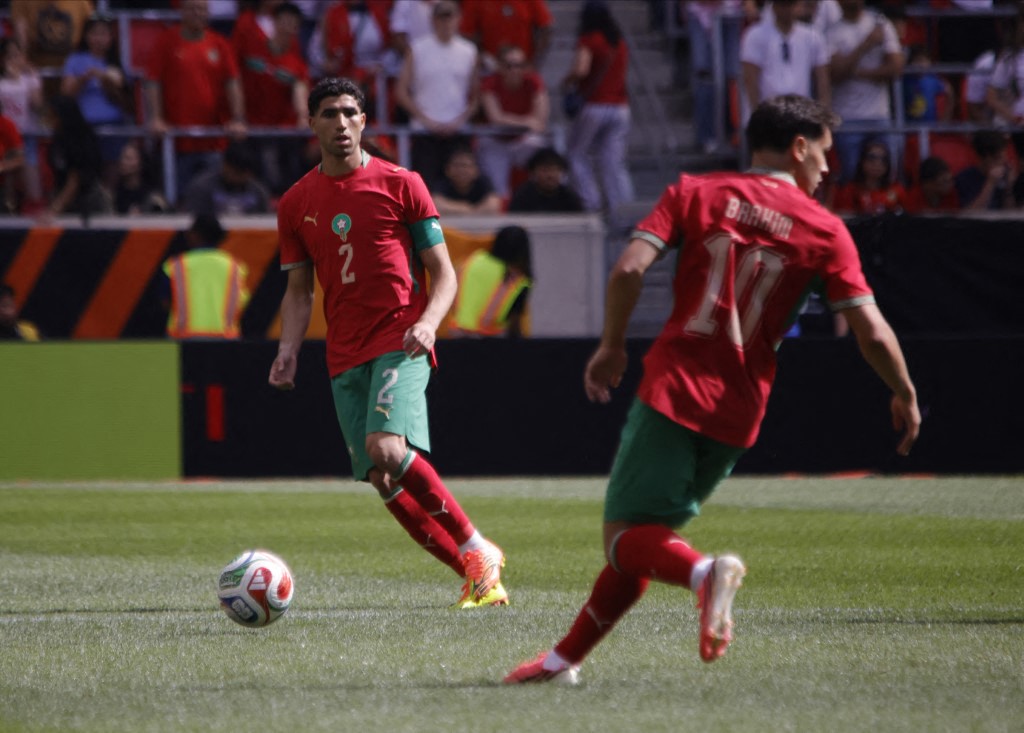
Their names are Hachraf Hakimi, Ryan Mmaee, Hakim Ziyech, and Ayyoub Bouaddi, and they are among the dual-nationality players who show the depth of Morocco’s squad, eager to compete with the top football nations in the race for talent.
Their names are Hachraf Hakimi, Ryan Mmaee, Hakim Zyech, and Ayyoub Bouaddi, and they are among the dual-nationality players who reflect the strength of Morocco’s squad, eager to compete with the biggest football nations in the world in the talent race.
Unexpected semi-finalists in the last edition in Qatar, the Atlas Lions are now seen as serious outsiders for the 2026 World Cup, just before facing Brazil on Saturday in East Rutherford (New Jersey) for their Group C opener.
For a long time, recruiting dual-nationality players was seen as a backup solution, which led Morocco to miss out on many players who chose their birth countries, like Ibrahim Afellay (Netherlands), Marouane Fellaini (Belgium), or Adil Rami, World Cup champion with France in 2018.After becoming aware, the trend has reversed in recent years.
To successfully carry out its project, Morocco relies on a network of recruiters across Europe who spot players from a very young age, counting on the strong attachment of the Moroccan diaspora to the country and the influence of families on the players.
“Since 2021, we have been engaged in a performance-driven dynamic guided by a clear strategic vision,” confirms the technical director of the Moroccan Federation, Fathi Jamal.
“We have a hybrid and smart model: some players come from local training, through national academies and club training centers, while others were spotted in Europe, thanks to a dedicated unit that follows young dual-nationality talents,” he explains.
“A choice of the heart”
“For me, it was a pretty easy choice to make,” recalls Ryan Mmaee, who chose Morocco in 2018 along with his brother Sami, instead of Cameroon and Belgium.
“When I was called up, I saw that Morocco was making a lot of effort to put players in good conditions. Everything was well thought out, a real project. That’s what attracted me,” the 29-year-old forward for Cypriot club Omonia Nicosia told AFP.
The coach Mohamed Ouahbi, appointed three months ago, explained to RTBF that “the Federation works with lists of dual-nationality players. And all these players are monitored in reports by our scouts. When the report is good, there’s an initial contact to find out if the player has already made a choice. There’s nothing aggressive. We don’t offer anything. No money, nothing.””What I do, on the other hand, is go there in person to talk with the parents and propose a sports project for the short, medium, and long term,” emphasized the one who led Morocco to the U-20 World Cup title in 2025.
“I tried the experience (with Spain) but I didn’t feel comfortable. The decision to represent a country has to be made from the start, and you have to feel at ease with it, both personally and with your family,” recounted PSG player Achraf Hakimi, one of the pillars of the Moroccan squad, which was a ‘choice of the heart.It’s their right.
A feeling shared by Hakim Ziyech: “In my case, it was Morocco without hesitation. I have always felt Moroccan even though I was born here (in the Netherlands). Many people will never understand this feeling.”
Morocco’s investments in infrastructure and support finally paid off: semi-finalists at the 2022 World Cup, U-23 African champions in 2023, bronze medalists at the 2024 Olympics, U-20 African runners-up in 2025, U-20 World Champions the same year, and African champions in January on paper while waiting for a CAS decision.
The influx of dual-nationality players to Morocco has sparked criticism, particularly in Belgium and the Netherlands.’
“Moroccans who aren’t good enough here (in the Netherlands) will go play for Morocco,” joked former Dutch international Rafael van der Vaart.
Belgium’s national team sporting director Vincent Mannaert, a bit more lenient, notes, “They were born here and got their education in Belgium, where clubs have invested a lot of time and energy,” but “if at some point they can’t choose Belgium, it’s their right.”
On the other hand, some players choose to represent their country of birth. And not just anyone: FC Barcelona star Lamine Yamal, approached by Morocco, opted for Spain.”