
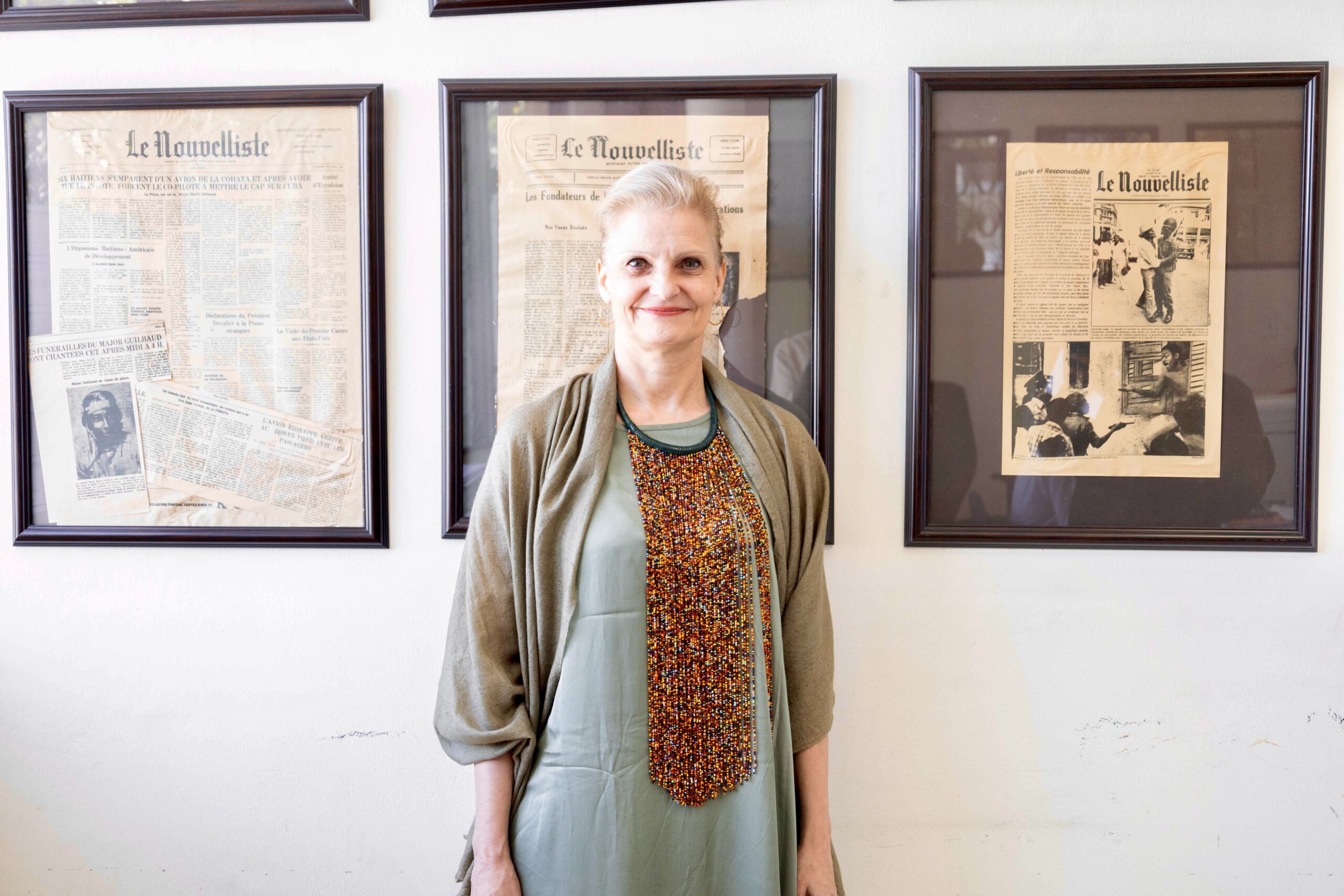
The representative of the United Nations Support Office in Haiti (UNSOH), Daniela Kroslak, visited Le Nouvelliste this Wednesday, September 30, 2026, 24 hours after the mandates of the Gang Suppression Force (FRG) and UNSOH were renewed.
The representative of the United Nations Support Office in Haiti (UNSOH), Daniela Kroslak, visited Le Nouvelliste this Wednesday, September 30, 2026, 24 hours after the renewal of the mandates of the Gang Suppression Force (FRG) and UNSOH. She answered the newspaper’s questions about the support provided by her institution to the FRG, the progress report on the Force’s deployment, the challenges faced, and the prospects for its reinforcement in the coming months.
LN: What support do you provide to the Gang Suppression Force?
DK: We provide all logistical, operational, and administrative support, meaning meals, fuel, housing, and communications. We also transport the troops and their equipment to Haiti. We receive them here to make sure they have everything they need to carry out gang suppression operations.LN: The first contingent of the Gang Suppression Force arrived in April. Today, it’s practically October, and we’re talking about around 1,500 officers on the ground. Are you able to give an initial assessment of your support to the Gang Suppression Force?
DK: The setup between the Gang Suppression Force, which is a non-UN mission with a Security Council mandate, and us, is that we transport the troops and their equipment to Haiti as soon as they’re ready.
There are all sorts of preparations that need to be done beforehand, including training, screening, and other procedures. But as soon as the troops are ready, we bring them here with their equipment.There were indeed delays in the preparations and in various aspects related to the arrival of the troops and their equipment. But as soon as the troops were ready, we were able to transport them.
It might be worth noting that UNSOH does not choose the troops or the equipment. That responsibility lies with the Standing Group of Partners, chaired by the United States and Canada, and which includes countries such as Guatemala, El Salvador, the Bahamas, and Jamaica. This group makes decisions regarding the selection of troops and their equipment and ensures that everything is ready at that level. That’s how the allocation of tasks is done.
Once the preparations are complete, we transport the troops. So far, there have been no delays on our part. On the contrary, regarding the deployment in Artibonite, we were able to move up the initial schedule. When I arrived at the end of March, we accelerated this deployment because of the worsening situation in the monthSo there have been delays for various reasons, which explains why we currently have just under 1,600 members. But over the next three or four months, you’ll see a boost in deployments and the arrival of troops from different countries, who will be stationed in several parts of Haiti to deal with gangs and help the FRG strengthen its capabilities.
LN: It was said that by October, the Gang Enforcement Force was supposed to have 5,500 members. In the end, we realized that wasn’t possible. Its mandate has now been extended until March 31. By March 31, will the Force have all its capabilities?
DK: According to the plan, yes. We should have the full staffing.Once again, regarding UNSOH, it will depend on the preparations and the contributing countries, which need to be ready to send their troops and equipment. Some also need to get equipment, which can sometimes cause delays.
Deploying a force of this size, made up of so many nationalities, is complicated. But I think that by the end of the mandate set by resolution 2829, I’m pretty confident we’ll be able to reach the planned numbers.
LN: Is there a funding issue slowing down the deployment, or more of a transportation problem, since each contingent has to arrive with its soldiers, equipment, weapons, etc.? What caused the delay?
DK: Each contingent arrives with the equipment agreed upon with the group and that also meets the mandate’s requirements. This equipment is sent according to the priorities of the contingent in question.This is indeed a major logistical operation, but the problem isn’t with the financial resources allocated to our part. MSS had encountered financial problems. On the other hand, everything related to logistics, the delivery of equipment, and troop transport is included in the UNSOH budget.
Once a year, we present a budget that needs to be approved. It was approved on June 30. So at this level, the funding is secured, and we handle this logistics. Again, the troops and their equipment need to be ready for us to transport them according to the agreed plan.The soldiers are paid from a trust fund that was originally set up for the MSS. This fund currently stands at $225 million, with $194 million available in cash. About $70 million has been spent so far, so there’s roughly $120 million left.
This fund is used to pay salaries as well as some smaller projects that don’t fall under the UNSOH mandate and therefore can’t be included in our budget, which is funded by UN member states.With the increase in staff, this fund will obviously need to be replenished. You were in New York and you know that a fundraising campaign was carried out for this purpose. It will need to continue being funded as expenses arise. This fund is managed by the United Nations headquarters, especially by the Department of Operational Support, which oversees the spending.
So, there isn’t really a financing problem as such. However, when delays accumulate in the preparations, it can have an impact on costs. Planning usually involves maritime transport, which is much cheaper than air transport (about ten times cheaper).
If delays pile up and we still need to get the equipment there quickly, it obviously becomes much more expensive. So we’re trying to figure out how to cover that gap.We had set up our planning based on the schedule that had been communicated to us. In case of delays, we asked some member states if they could provide transportation for us free of charge. This is especially what the Germans are doing to transport equipment from Bangladesh, which helps us a lot since it wasn’t planned initially.
It would be difficult to absorb these extra costs within the budget set up based on the initial plan. Logistics costs a lot of money and is quite complex since the contingents come from different parts of the world and we need to find the aircraft and other means required to transport them.But as soon as the contingents are ready, we bring them here. By the end of the year, you’re going to see several contingents arriving to reinforce the Force.
LN: Does UNSOH have the necessary capacity to accommodate the 5,500 members of the Force if, hypothetically, they all arrived in Haiti today?
DK: The troops arrive with a certain level of self-sufficiency at the start. The Chadians, for example, are set up under tents at Camp Vertières. The same goes for the Sri Lankans. So the initial conditions are a bit tough, but that’s part of what was agreed upon.
At Camp Vertières, we’ve made a lot of progress in accommodating troops in transit before they’re deployed to other parts of the city or the country.If 5,500 members were deployed today, it would obviously be a hypothetical situation. But we’ve made good progress. What’s important is that the deployment also follows the geographic plan. We’re not going to host everyone in Vertières.
We have positions at the former IGPNH facilities in Delmas. Another site also needs to be set up. At the airport, we took over the facilities used by the Kenyans and expanded them to accommodate Guatemala and El Salvador in particular, as well as the aircraft and the hospital.
So we have Vertières and facilities in the Artibonite. Other deployments are also planned.LN: Are other regions planned to host contingents? I’m thinking specifically of Mirebalais or Kenscoff.
DK: As UNSOH, we follow the pace of operations and FRG’s plans. It’s up to the FRG to decide, based on the security situation, where it wants to deploy its contingents. Then, we adjust our support to their plan.
So this is really a question that should be asked to the FRG. Obviously, the deployment needs to be adapted to how the situation evolves.
LN: Has UNSOH helped to build or maintain forward operating bases? How many are there?DK: For now, there’s one, and we’re starting to set up a second one. The airport isn’t really an outpost, but more of a facility.
In Port-au-Prince, there are currently three facilities and another one in preparation, so four in total. In Gonaïves, there’s one and another is being prepared. So that makes two in Artibonite and six in total.
LN: UNSOH also provides support to the FRG in terms of communications. What kind of communications are we talking about exactly?
DK: This mainly concerns the troops’ means of communication: mobile phones, internet, radios, and satellite phones.Each contingent arrives with its own radio equipment and takes care of its maintenance themselves. However, for communications between the contingents, we specifically set up the radio room in Vertières.
Everything to do with IT equipment and the operations center is also our responsibility. We also have to make sure there is Internet coverage, which is obviously essential nowadays. We have three levels of connection to ensure Internet is always available, including Starlink.
So that’s our responsibility. On the other hand, the radio equipment that belongs to the contingents is brought by them.
LN: So you don’t really get involved in the intelligence field?DK: No. The equipment related to this field is provided by the troop-contributing countries. The choice of this equipment is not up to UNSOH, but to the Standing Group of Partners. When they select the troops, this group also determines which equipment will be sent.
Our responsibility is to make sure the necessary facilities are available to allow their use, but we do not provide this equipment directly.
LN: Does UNSOH have any say in how operations are conducted, the methods used, and the actors the FRG works with in the field?DK: Our mandate asks us to make sure that our support respects human rights and doesn’t contribute to any violations.
So, we have a team in charge of identifying human rights risks and figuring out the necessary mitigation measures. This applies both to the FRG troops and the support we provide them, as well as to joint operations with the PNH, since we also support the Haitian National Police during certain joint operations.We also provide support to BINUH. So, a whole framework has been set up. We’ve also established a consultation mechanism with the FRG to identify potential risks and issues and figure out how to prevent them in advance.
The goal isn’t to block operations, but to make sure they’re carried out properly and that any issues that arise are addressed. So, there’s a whole system and a team dedicated to these matters.LN: Do you anticipate any risks of human rights violations during operations, especially when the FRG is working alongside the Haitian National Police, the Haitian Armed Forces, or private security companies?
DK: The Security Council has set up this human rights framework specifically to prevent potential violations. So this is part of what’s been asked of us and what the Security Council has put in place.
However, we’re not directly involved in making operational decisions. We provide support and monitoring. We work with the Force, but also with the HNP and the Armed Forces, during the planning of operations to prevent human rights violations.But we do not take part in operational decision-making. The Security Council included these provisions in the resolution to ensure that if any problems arise, the support we provide remains in line with the established rules.
LN: Have any special instructions been set up regarding the care of children associated with armed groups?
DK: You would need to ask that to the FRG, because it really falls under operational matters.
We are all aware that gangs have recruited or forced many children to join their ranks. Obviously, this problem should not be downplayed. But it’s the FRG that consults, notably with UNICEF, to determine the ways to handle this situation.This also falls under the human rights framework I mentioned earlier. But when it comes to the specific operational provisions, that’s really up to the FRG to answer.
LN: What are your plans for the next six months, up to March 31, 2027, beyond the full deployment of the 5,500 members of the Force?
DK: Our role basically has two parts. First, we need to make sure the contingents arrive here with the necessary equipment and on schedule. Second, once they arrive, we have to make sure they have everything they need to operate: housing, meals, fuel, medical care, etc.Our goal, in line with our mandate, is therefore to complete the deployment over the next six months and make enough progress on the facilities to allow the Force to carry out its operations.
Not everything will necessarily be finished. There will always be facilities to complete or improve. One of the objectives is also to gradually move soldiers out of the tents they are currently in and provide them with more permanent housing, depending on the pace at which they arrive.
A plan has been set up with the Force. As you mentioned earlier, deployments will also depend on the security situation and the FRG’s requests regarding where facilities will be needed.So we will need to identify the land and set up the necessary infrastructure in the areas concerned. All of this can change and evolve. We need to adapt to the pace of operations.
The next six months will be very busy, but we hope so. It’s important for Haiti.
LN: There was talk of a Gang Suppression Force with capabilities allowing it to carry out land, air, and maritime operations. Are you able to describe the equipment currently at its disposal or the ones that still need to arrive?
DK: That question falls under the GSF. I wish I could help, but it’s really up to its leaders to provide that information.
I can, however, confirm that the maritime component is planned. That’s all I can say on the matter.
Interview conducted by Jean Daniel Sénat

