
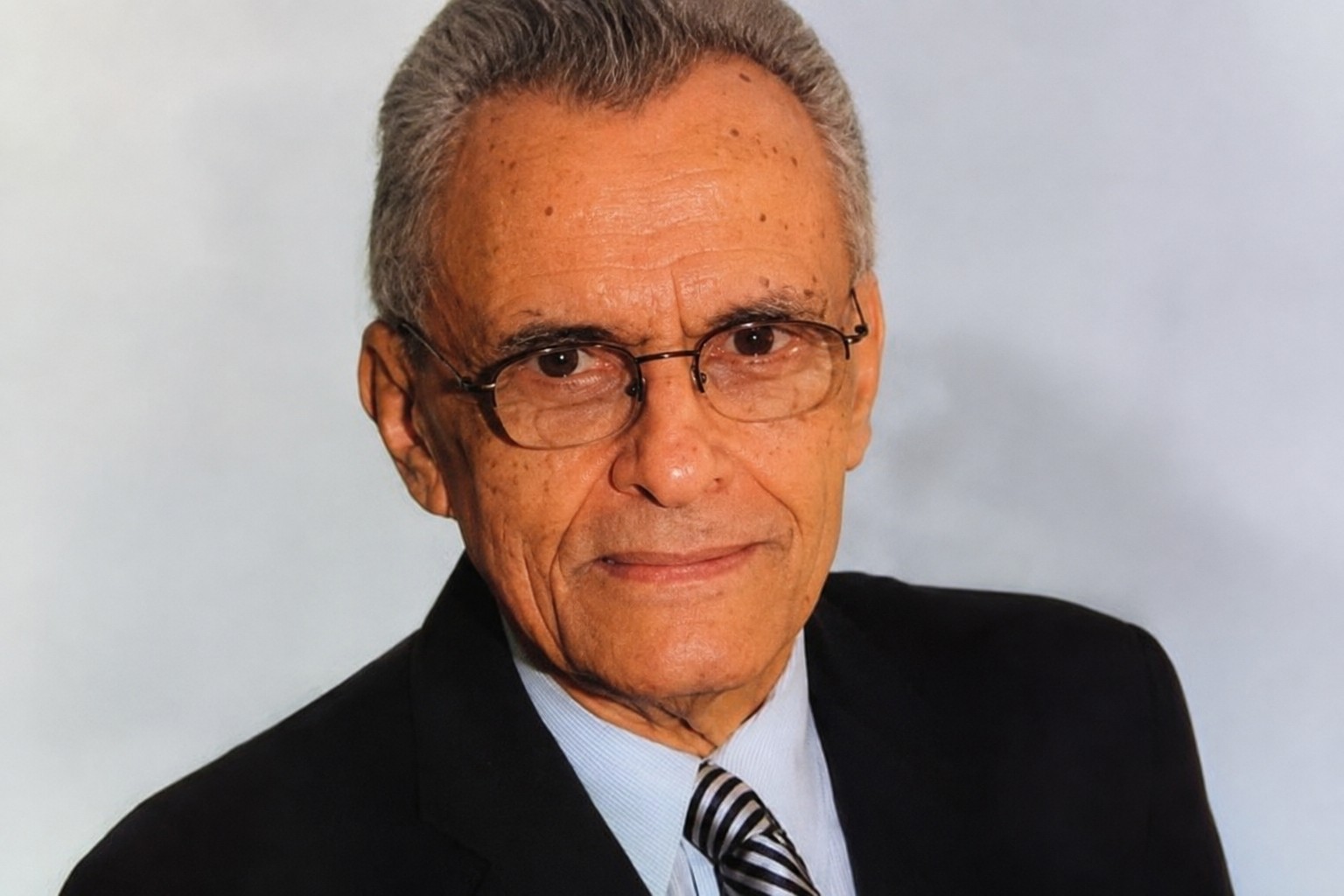
Georges Corvington would have been 100 years old on November 6, 2026.
Georges Corvington would have turned one hundred this November 6, 2026. Our times—full of squabbles, easy criticisms, fleeting words on social media, questions about the city and its impossibilities, about artificial intelligence and its frenzied use—invite us to think of him in a special way. A passionate researcher and historian, he left us on April 3, 2013. The 2010 earthquake had already partially destroyed his favorite subject of study: Port-au-Prince. His city.Georges Corvington had also lost his house in the earthquake on January 12, 2010. He had been barely rescued by Dr. Pierre-Yves Decastro, an ophthalmologist who has his clinic on Rue Cheriez, near Corvington’s place. Seeing the nephew who lived with the historian, the doctor asked him where his uncle was. The young man replied that he was dead, buried under the rubble, while sitting in his rocking chair. The doctor shouted his name. Groans answered him. Then the two men dug with their hands and got him out of there. He was suffocating, Dr. Decastro reports, but he was alive. His library, on the other hand, remained under the rubble for several weeks. After the clearing, the books were stored in a container. What happened next belongs to the little stories, those tales of waste and despair that we know all too well here, for far too long.And then Georges Corvington, like his house, like his library, like his city, faded away. The places where he was most often seen no longer existed or, by the way things had turned out—the rubble blocking the streets, the sight of collapses, those endless funerals, that indescribable sadness that stretched across time—had become inaccessible to him. You ran into Georges Corvington a lot at funerals. Even before the disaster. He liked it, going to pay tribute to people he sometimes barely knew. A resident of Port-au-Prince always had something to share, a word, an anecdote. And churches were places where you would run into old acquaintances who hardly ever went out anymore.
It’s with the Port-au-Prince series over the years, the first volume of which was published in 1970 by Imprimerie Henri Deschamps, that Georges Corvington became well known.
The seven volumes of the original edition, published between 1970 and 1991, cover more than two centuries, from 1743 to 1950. Éditions du CIDIHCA compiled them into four volumes; an eighth volume, published in 2009 by Éditions Deschamps, extends the story up to 1956. In this work, the city is never just a backdrop. It is the main character.The first volume witnesses a birth. Port-au-Prince starts out as just a plan to be debated – arguments over location, military and commercial calculations, rivalries between towns, land to negotiate – before its actual founding in 1749. Corvington watches the streets being laid out, the public buildings and fountains going up, then sees the young city shake from the earthquakes of 1751 and 1770. Already, the city has to rebuild what it has barely finished building. Already, it rests on a slave-based society whose contradictions the Revolution will tear apart, leading to the collapse of colonial order and the violent birth of the new state.The second volume follows the capital through 19th-century Haiti. From Pétion to Boyer, and then from one regime to another, Corvington shows how each government leaves its mark in stone: projects started, work halted, crackdowns, destruction. Port-au-Prince is both the place where power is won and the one that pays the price. Schools, newspapers, learned societies, and the Bord-de-Mer trade continue to develop there, right up until the bloody days of July 1915 and the American landing.
The third volume examines the occupation in all its complexity. Streets are rebuilt, electricity, water, and sanitation improve, but sovereignty is taken away. The city keeps on living, creating, and debating through its press, associations, arts, sports, nationalist movements, and the 1929 strike, up until the troops leave in 1934.The fourth volume, finally, paints a broad picture of a capital finding its own footing but caught up in the turbulences of the years of Vincent, Lescot, and Estimé, and the shocks of 1946. Squares, monuments, hotels, restaurants, shows, bourgeois leisure activities, and popular festivals—all of it is covered, right up to the 1949 International Bicentennial Exhibition, that moment when the city dreams of shining on the world.Corvington’s approach is based on the belief that a country’s history can be read in the places where its people live. A financial crisis hits a school; a clash destroys a neighborhood; an administrative decision creates a square. He refuses to separate the palace from the street. His attention lingers on what the grand overviews overlook—a theater performance, a song, a walk, a sought-after address, a vanished establishment. The maps, photographs, and documents he collects turn his work into a real cadastre of memory. And he built all of this on the side of his day job as a civil servant at the Ministry of Finance, between libraries, his notes, and his typewriter. The patience of a craftsman. The devotion of a lover.We can imagine him today, standing at the corner of a street whose name no one even says anymore. He would look for the Main Street and find only blank facades. He would search for the Seafront, its warehouses, the smells of coffee and salt, and find closed doors, empty neighborhoods, families scattered along the roads or huddled under tarps. The downtown he used to wander, whose every house, every shop sign, every change of owner he knew, has slipped out of our lives like a tide that will never return.He wouldn’t cry, we believe. He would take notes. That was his way of loving. For him, you had to observe, record, not let anything slip away. He would want to know where the people from Bel-Air, Rue Pavée, and the surroundings of Champ-de-Mars had gone. What people eat now, what they sing, how they greet each other when they no longer know if they will meet again. How a mother calculates her child’s way to school. How people bury today those they can no longer accompany to the cemetery.
Because that’s what threatens us, not just the loss of walls, but the loss of gestures. Our ways of doing things, selling, praying, getting by, laughing despite everything. The dust of the days. What no one thinks to write down because it seems obvious, and which disappears precisely for that reason.After him, who will keep the city’s chronicle? Who will tell the story of the decades that followed, the earthquake, and then that so difficult time? We would need another Corvington. Better yet, we would need several. Citizens of the city who take notes, photograph, archive, gather the words of the elders before they disappear. Researchers, journalists, writers, but also ordinary residents, armed with a notebook, a phone, a memory. The tools have changed; even artificial intelligence could help classify, find, connect. But no machine will replace that loving gaze that knows a vanished sign tells something about us.
Without this work, our children will inherit a city without a story. They won’t know what we were, and therefore not quite who they areWe owe Georges Corvington for making Port-au-Prince knowable. For proving that a Haitian city deserved a history worthy of it—detailed, documented, tender. We owe him street names, dates, faces, forgotten celebrations that, without him, no one would have been able to recover. We also owe him a lesson in perseverance: one man, almost alone, built over decades what our institutions never managed to accomplish.
His legacy is not only in his books. It is in the standard he leaves us—the need to look at our city, even when wounded, even when disfigured, as a place worth telling stories about. It is in the responsibility he passes on to us to preserve who we are.
One hundred years after his birth, Port-au-Prince is searching for itself. His books, however, still know where it is. It’s up to us to carry on. The best way to honor him would be to continue, with the same faithfulness, to lose nothing of ourselves..

