
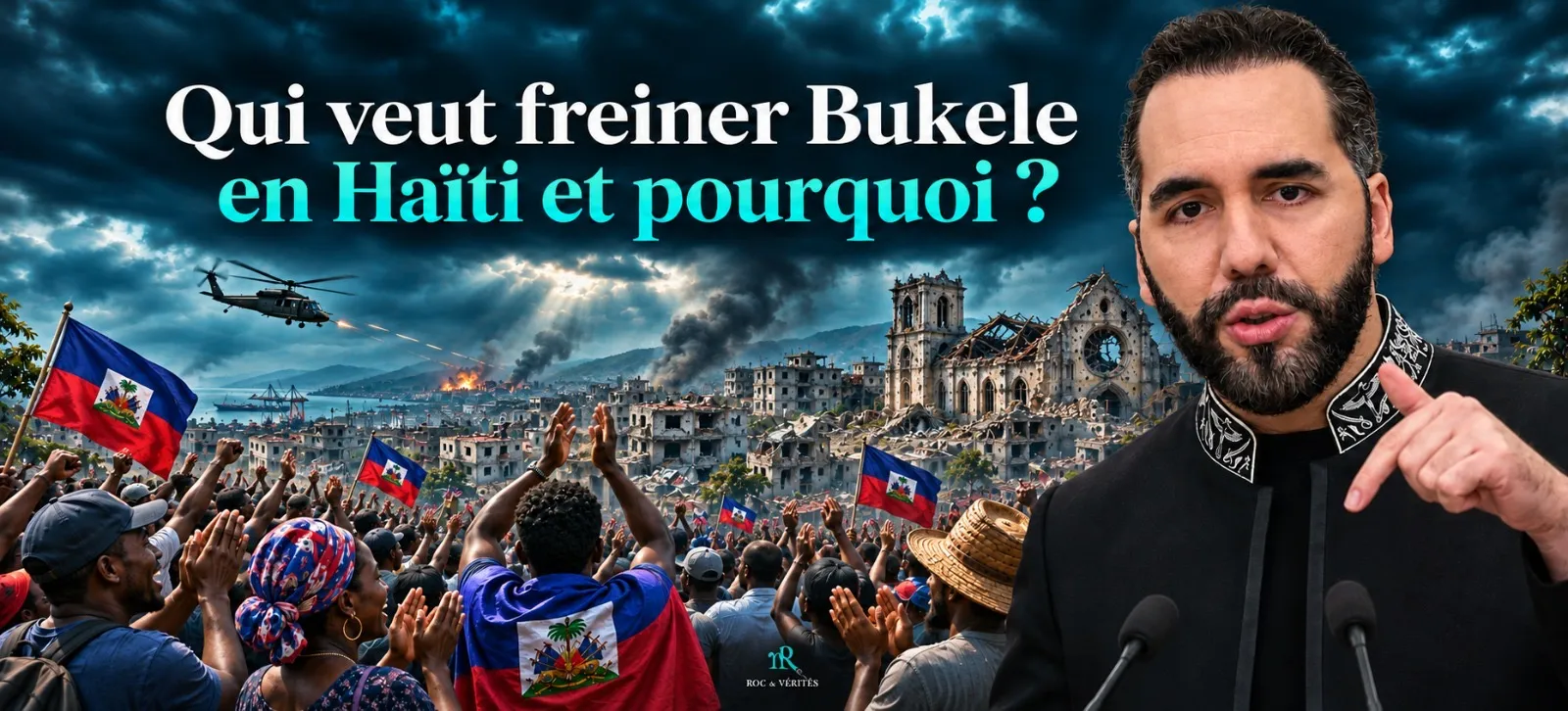
As Salvadoran soldiers step up their operations against gangs in Haiti, a controversy has now erupted between U.S. diplomats and Nayib Bukele’s government. According to an Axios investigation, Washington asked for a halt to the operations, citing coordination issues and risks to civilians and international contingents. Yet, Donald Trump had approved the Salvadoran offensive. In an interview with Roc & Vérités, Haitian sociologist and researcher Michèle Oriol reflects on the historical responsibilities of the international community and raises a key question: who is really looking out for the interests of Haitians today?
A society falling apart before our eyes
For Michèle Oriol, gang violence is not an accident. It is the result of several decades of weakening of the state. She points to a turning point in 1994, during the intervention of the international coalition (United States, Canada, France) that brought Jean-Bertrand Aristide back to power, and then in the demobilization of the Haitian Armed Forces. In her view, the disappearance of the army left fundamental needs unanswered: intelligence, border control, and territorial security.
She sums up the situation like this: ‘The very notion of authority and hierarchy has disappeared.’
Michèle Oriol believes that the prolonged presence of peacekeeping missions led to ‘a complete abdication of responsibility by the Haitian political authorities regarding national security issues.’ The Haitian National Police was created, but its resources, management, and ability to resist political influence remained insufficient.Michèle Oriol particularly highlights the role of Canada. “It’s Canada that had the upper hand in the police development plans and actually in the daily follow-up,” she writes. She criticizes it for making the ratio of police officers to population the main goal of the police, “disregarding institutional development,” especially the relationships between the police and the justice system and officer training.
For her, handing out uniforms alone isn’t enough to build a state. You need a chain of command, investigations, courts, prisons, and above all, political authority that can be held accountable.Organized crime takes advantage of the void
“Haiti, without a national defense system, has been crushed by the explosion of drug trafficking in the Americas,” says the sociologist.
Michèle Oriol emphasizes the economic dimension of the crisis. Gangs don’t just live off ransom. They control territories, supply chains, and profitable activities. They also thrive thanks to accomplices who need to be identified and prosecuted. Thus, Haitian gangs “find themselves at the heart of international organized crime.”
How can these networks be sustainably dismantled without investigating those who finance, arm, or protect them? This question should be at the heart of any security strategy. A military operation can retake a neighborhood. Alone, it cannot make the mechanisms that allowed criminal groups to establish themselves disappear.The approach of Wilson Joseph, aka Lanmò San Jou, leader of 400 Mawozo, who sought mediation from the UN, shows just how much the balance of power has shifted. The organization clarified that receiving such a communication does not mean recognition or approval of its author. The victims, on the other hand, are entitled to justice. No political deal should erase the crimes committed. Oriol is also calling for state aid to “physically rebuild the neighborhoods – houses and infrastructure – destroyed by the gangs.”
Bukele shakes things up
After the disappearance of four Salvadoran technicians on October 18, Nayib Bukele stepped up his military presence in Haiti. Operations have increased in the Croix-des-Bouquets region. On Sunday, November 8, Haitian police and Salvadoran soldiers destroyed a house linked to Wilson Joseph, without capturing the gang leader, according to the Associated Press.Michèle Oriol wonders about the intensity of some reactions sparked by this offensive. Why does international outrage sometimes seem louder in response to Bukele’s operations than to the massacres suffered by Haitians? She specifically mentions the Wharf Jérémie massacre in December 2024 and the long-standing ineffectiveness of previous measures.
Michèle Oriol defends the record of this offensive. “It’s the first time in ten years that we really see action against gangs.”
Her questioning doesn’t mean Salvadoran forces should operate without rules. Protecting civilians and respecting the law remain essential. But she points out a too often forgotten truth: inaction also has a huge human cost.“The operating method is well known: we settle problems elsewhere through Haiti, whose voice doesn’t carry, whose voice doesn’t matter.”
A foreign president speaks to Haitians
There’s a politically troubling phenomenon in this crisis. Since the arrival of Salvadoran reinforcements, part of the population has been learning more about the military intentions and actions through Bukele’s posts on X, sometimes written in Creole, rather than through explanations from their own government.
On November 6, the Salvadoran president publicly asked where a house used by Lanmò San Jou was located. Two days later, a residence linked to the gang leader was destroyed. At the same time, Haitian authorities communicated little about the exact nature of the Salvadoran involvement.Who is in command of these troops? What agreement governs their operations? Who are they accountable to if an intervention goes wrong? Even the details of the agreement between the two governments have not been made public.[3] When a foreign head of state becomes the most visible voice of an offensive carried out on Haitian soil, it means our leaders have left a troubling political gap.
Axios reveals the U.S. disagreement
The investigation published on November 10 by Marc Caputo in Axios gives a new dimension to the case. On November 4, David Howell, the U.S. chargé d’affaires in Haiti, reportedly asked Prime Minister Alix Didier Fils-Aimé to suspend the Salvadoran operations until better coordination with the Gang Suppression Force (FRG) could be ensured.[1]The next day, the U.S. Embassy in El Salvador sent a diplomatic protest. According to this note, Salvadoran gunfire had reached the American embassy facilities in Port-au-Prince. El Salvador denies this accusation. In its response on November 9, its government said it had coordinated its actions and rejected several pieces of information put forward by the American side.[1]
So, we’re looking at two conflicting accounts. But the political contradiction is even more striking: according to Axios, Trump had personally given Bukele the green light. So how do we explain representatives from his own State Department calling for a temporary halt to operations? Is it just an operational disagreement, or a sign of deeper differences? At this point, there’s nothing to say for sure.Fils-Aimé’s Trip in Question
This tension comes as a visit by the Haitian Prime Minister to El Salvador was announced for the following week. A Salvadoran official confirmed it to the Associated Press, which noted that the discussions were supposed to focus on the future of the troops deployed in Haiti.[3]
However, according to a usually well-informed source contacted by Roc & Vérités, Alix Didier Fils-Aimé’s trip may no longer be planned. The head of government might instead send one of his ministers. Our source believes that the information behind the initial announcement came from exchanges prior to the latest diplomatic turn.
This possible change has not been officially confirmed either in Port-au-Prince or in San Salvador. So it would be premature to speak of a definitive cancellation. If it does happen, however, it would raise a question: did the dispute with Washington weigh on the Haitian decision?Trump, Rubio, and the shadow of 2028
All this controversy erupts the day after the U.S. midterm elections, as ambitions for 2028 start to fuel speculation. The British newspaper The Independent reported on November 5 that Marco Rubio could be considering leaving the administration to prepare for a presidential run.
However, we should be careful not to jump to conclusions. A media hypothesis about Rubio’s future does not establish any link between his ambitions and diplomatic efforts involving Salvadoran soldiers. There is no public evidence to personally attribute the suspension request to him. The State Department continues to assert its support for the fight against gangs while calling for closer coordination.
But the political question remains: are American diplomats and the White House actually backing the same strategy in Haiti?And what about the Haitians in all of this?
Michèle Oriol brings the discussion back to focus. “Haiti is the heart of the problem. Not Bukele, not Trump.”
“So who will handle the gangs’ anger if Bukele leaves and the gangs regain control?” she asks. The sociologist thinks Bukele has shown the difference between an intervention carried out by “an actor with no direct or indirect ties to the gangs” and the posturing of actors whose links to gangs are suspected but not well documented. It’s also important to know that national responsibility goes beyond police or military operations. And if the operations succeed, what happens next? Without justice, functional prisons, gun control, and credible institutions, other gangs could replace the ones that were neutralized.Legal questions are not secondary. On November 10, Amnesty International specifically called on the Haitian and Salvadoran governments to make public the agreement governing the deployment and to clarify the rules for the use of force as well as the accountability mechanisms.
But beyond these institutional and legal issues, Michèle Oriol emphasizes the anthropological crisis that goes far beyond security questions. This is seen both in the forms taken by gang violence and in the way the struggling population responds to the gangs.
“The cruelty that marks everyday insecurity clearly shows us that we have lost the benchmarks that allowed for life in society, a dehumanization that is spreading. Cannibalism, torture, destruction, de-urbanization — we need to name what is hidden behind the euphemism ‘insecurity.’ We need to stop it immediately. The future is at stake.”One thing is certain: for now, a large part of the Haitian people supports the Salvadoran intervention. But nothing guarantees that Nayib Bukele won’t one day decide to turn his back on them, especially because of what seems like the Americans playing a double game.
And if that were to happen, two scenarios could unfold: either a disaster, with gangs and their funders coming back strong; or a revolt by a people who have nothing left to lose, which could descend into a bloodbath that would make the 1986 déchoukaj look like child’s play.
Because there’s one thing the international community seems to have forgotten: even a people’s despair has its limits.
Nancy Roc, November 11, 2026.
© Nancy Roc — Roc & Vérités. Any reproduction, in whole or in part, is prohibited without prior authorization.

