
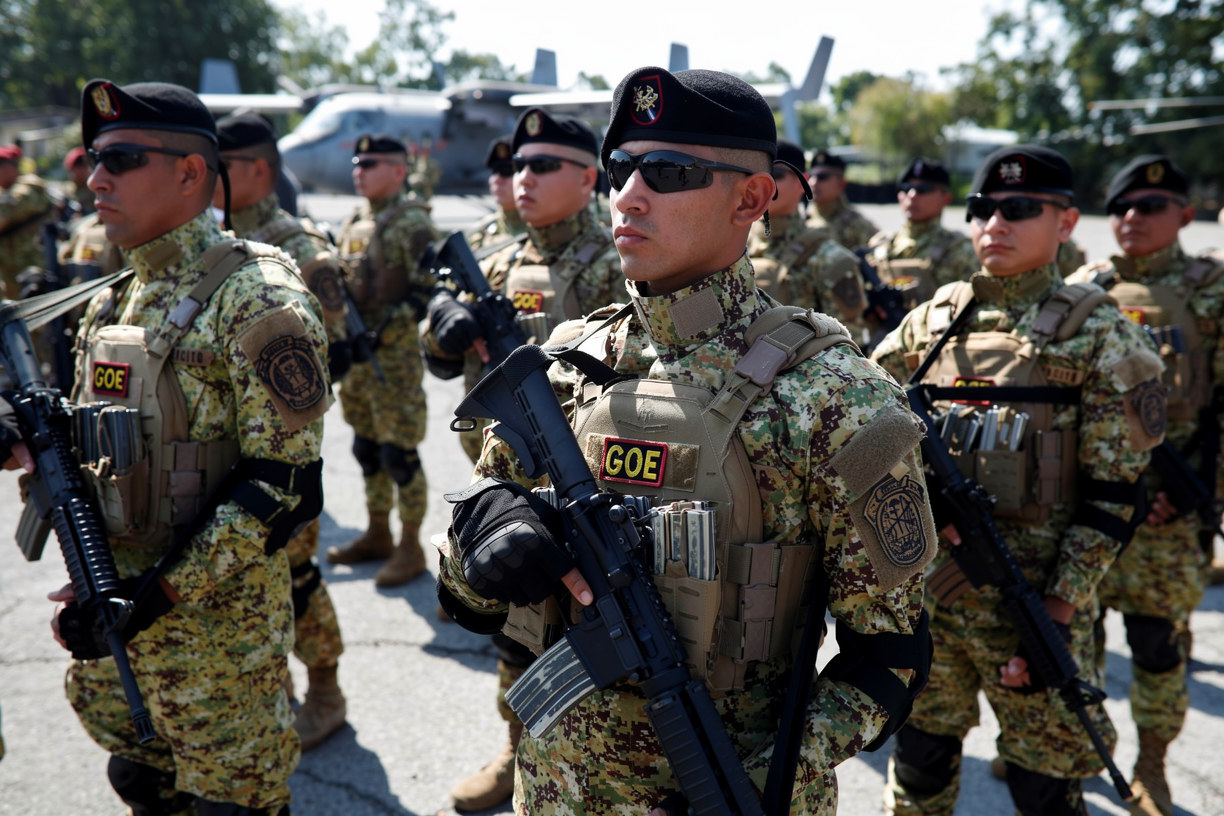
The arrival of Salvadoran soldiers in Haiti, adding to the four other forces already there, makes it necessary to coordinate between the security forces, according to Diego Da Rin.
The deployment of more than 2,000 Salvadoran armed forces soldiers adds a new player to the security landscape in Haiti, which is now marked by five forces: the Haitian National Police (PNH), the Haitian Armed Forces (FAd’H), the Gang Suppression Force (FRG), the military company Vectus Global, and now, the Salvadoran Armed Forces. The latter might even be slightly larger in number than the FRG, which currently has around 2,000 members, compared to the 5,500 planned. However, the abrupt nature of this deployment raises several issues, the main one being coordination. Speaking on the Panel Magik show this Thursday, November 12, 2026, Diego Da Rin, an analyst at the International Crisis Group, shared his thoughts on these challenges.For the expert, the coordination of all forces present should be done under the leadership of the Haitian authorities. “All efforts from the different forces should be directed by Haitian security institutions,” the analyst believes. “That’s what would be ideal: for the Haitian authorities to continue refining their understanding of security problems, strategic and tactical needs for carrying out operations, and a comprehensive plan for reclaiming territory,” he continued.His stance can be explained in part by the visible lack of coordination between the different security forces present, whose goals don’t always seem to align. While the PNH, the FAd’H, and the FRG aim to curb the actions of armed gangs, the Salvadoran forces are more focused on locating their soldiers who went missing last October in a gang-controlled area. And the Salvadoran forces don’t seem willing to be placed under the command of the FRG, let alone under the control of Haitian leaders, who are accused of colluding with the armed gangs, while the Prime Minister reminded on November 3 that the Haitian state “remains responsible for the political and strategic direction of operations.”
For Diego Da Rin, coordination between the forces remains essential. “We really need to move toward joint planning of what each force is doing,” he argues. Even without unified coordination, communication is necessary, he says, to define “complementary objectives that are brought together in an overall strategy.” A first effort was started as early as last week with the creation, by the Prime Minister’s Office, of a “deconfliction center,” which brings together a representative from each force to avoid friction between the forces themselves and to prevent overlapping operations.The creation of this office, mentioned by Diego Da Rin, is a “first step in the right direction” toward unified coordination, led by the Haitian authorities, of operations in Haiti. “We’re starting to see, in a way, better coordination, which became necessary because these five forces were scattered on the ground without unified command. Setting up this information-sharing and deconfliction office is a first step toward stronger leadership by the Haitian authorities to coordinate all these efforts,” he explained.Can Nayib Bukele succeed in Haiti?
If the actions of the Salvadoran military are supposed to be limited in time, since their deployment’s main objective would be to find their missing colleagues, their presence gives hope to many Haitians. After about five years of international cooperation, with the deployment of two international forces (the MMAS and the FRG) in recent years, the results in the fight against gangs have not met expectations. On the other hand, in just three weeks, the power of the Salvadoran forces and Bukele’s displayed determination have already struck fear in the ranks of the armed gangs. The leader of the 400 Mawozo, Wilson Joseph, also known as Lanmò San Jou, even reportedly fled his headquarters just days after unsuccessfully trying to get the United Nations to mediate for a ‘peace talk.’Salvadoran President Nayib Bukele has quite an impressive record when it comes to fighting gangs. Since coming to power in his country in 2019, he has drastically reduced gang capacity in El Salvador, taking San Salvador from being the capital with the highest homicide rate per capita between 2015 and 2016 (199.3 and 136.7 homicides per 100,000 people in those two years, according to the Igarapé Institute) to one of the capitals with the lowest homicide rates in the world. It’s a reputation the Salvadoran leader rides on, claiming he wants to “teach the gangs a lesson” like he did with Haitian gangs.But the prospects for a spectacular result are not yet guaranteed. According to several security experts, cited by Diego Da Rin, the two contexts are different and, even more, the gangs in El Salvador and Haiti show notable differences in their organization and control of territory. The difference is even more pronounced when it comes to weapons, Da Rin points out, “especially the level of military power that some gangs in Haiti have reached, which far exceeds the security threat capacity that gangs in El Salvador had.” Moreover, according to him, unlike the Salvadoran gangs, the gangs have shown that they have the ability to join forces when they have a common enemy.
While waiting to see more concrete, long-lasting results capable of shaking up the structure of armed groups, Salvadoran forces have already shown that the supposed omnipotence of the gangs is due more than anything else to the weakness of the forces facing them or, worse, to the lack of political will to eradicate them. Indeed, the first Salvadoran operations, although carried out hastily, hint at progress in complete contrast to the actions taken so far. But one question remains: how far can Salvadoran forces push back the gangs that have been terrorizing Haitian society for several years? Only time will tell.

