
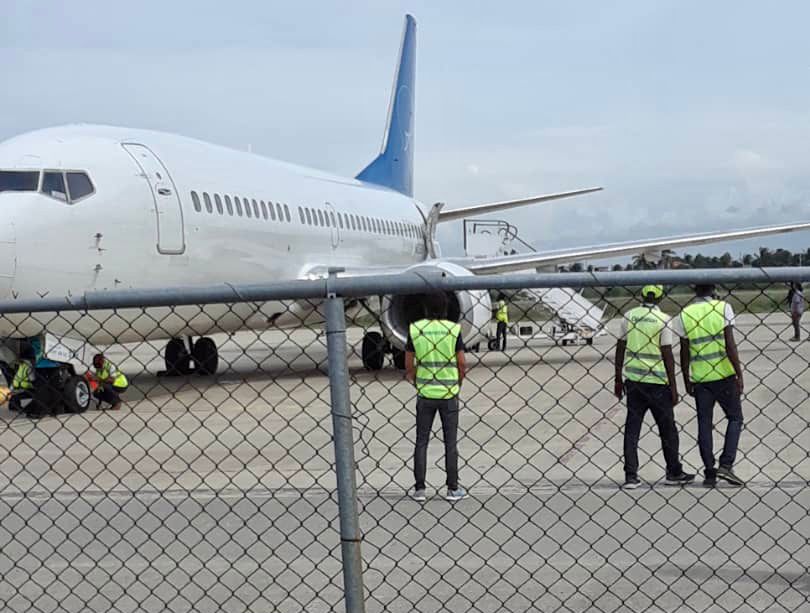
On Thursday, November 12, 2026, the U.S. authorities carried out the repatriation of 65 Haitian nationals, who arrived at Cap-Haïtien International Airport on a plane chartered by U.S. immigration services (ICE).
On Thursday, November 12, 2026, U.S. authorities carried out the repatriation of 65 Haitian nationals, who arrived at Cap-Haitien International Airport on a plane chartered by U.S. Immigration services (ICE). Among them was the Haitian TikToker Djouly Jean, better known by her pseudonym Djouly Best.
Upon getting off the plane, Djouly Jean had her face partially covered. Her demeanor showed a certain sadness and deep discouragement. She stayed aside for a while with an acquaintance and didn’t touch the meal provided to her by the ONM. She then took off the white jumpsuit she was wearing, like the other people deported from the U.S.Several of her repatriated compatriots have shown her their sympathy and support. Some encouraged her to stay strong and not let this ordeal get her down, reminding her that life goes on despite the difficulties.
Djouly explained that, in her view, her previous public statements had contributed to the circumstances that led to her expulsion.
Djouly Jean claims she spent eight days in detention in the United States without access to her medications, even though she had undergone surgery for fibroids about two weeks before her repatriation.Looking back on the circumstances of her arrest, she said that she was first stopped by U.S. immigration authorities before being released. After that episode, she apparently went live on social media to share her experience.
According to her account, more than 200 people then contacted U.S. immigration services to challenge her release, while other migrants remained in detention. She believes these reactions led to her second arrest, followed by her deportation to Haiti.
Originally from La Gonâve, Djouly Jean said she doesn’t plan to settle in Haiti permanently. She would rather return to the Dominican Republic, where she lived before. She also says she keeps business activities in the U.S., despite her deportation.During her time at SDPJ/Nord, she publicly spoke on the phone with a man named Marguado, whom she introduced as her husband. She asked him not to give too much importance to the criticisms and derogatory remarks circulating on social media. According to her, her husband had taken several steps to try to prevent her repatriation. She also contacted a woman to ask her to stop verbally attacking him.
Despite this situation, Djouly Jean says she wants to continue her activities and find ways to rebuild her life, regardless of where she will live next.
In a press release published on November 12, 2026, the National Migration Office stated that this twelfth group of Haitian nationals repatriated from the United States includes 57 men and 8 women.The institution says it organized their reception in Cap-Haïtien, on the instruction of Prime Minister Alix Didier Fils-Aimé, under the coordination of its director general, Jean Négot Bonheur Delva.
According to the statement, each repatriated person receives an individual allowance of 25,000 gourdes to meet their immediate needs and help them return to their home community.
The assistance setup also includes the distribution of meals, drinks, and drinking water, as well as medical and psychosocial support. Arrangements have been made to provide transportation for the beneficiaries and give them an information booklet along with a reception certificate.The ONM also reported covering expenses related to Catholic Relief Services (CRS), totaling 44,850 gourdes, as well as hotel accommodation for 60 of the 65 people received.
When they arrived at Cap-Haïtien International Airport, the Haitian nationals were greeted to the music of a group of troubadours. Essential items, including underwear and swimsuits, were also distributed to them.
This operation involved several institutions and partner organizations, including the Haitian National Police, the Haitian Red Cross, the Ministry of Foreign Affairs and Worship, the Institute for Social Welfare and Research (IBESR), the International Organization for Migration (IOM), the Ministry of Public Health and Population (MSPP), and Catholic Relief Services (CRS).

