
Environmental activists are holding up a banner that reads ‘Electrification based on renewable energy for the people and the planet,’ along with signs, including a poster of a missing cat, at an outdoor climate summit.
Environmental activists are holding up a banner that reads “Electrification based on renewable energy for people and the planet,” along with signs, including a missing cat poster, during an outdoor climate summit.
© UN News/ Laura Quinones Activists at COP31 are calling for more climate ambition.
At COP31 this Thursday, a cat named “Ambition” was once again reported missing. Behind this humorous campaign by climate activists lies a very real concern: the latest draft of the conference agreement no longer explicitly mentions phasing out coal, oil, and gas. On the eve of the summit’s close, negotiations remain stuck on several crucial issues, including financing and adaptation, while calls for greater ambition keep growing.Today at COP31:
Fossil fuels disappear from the text: the new draft agreement no longer explicitly refers to the transition away from coal, oil, and gas, but acknowledges that the 1.5°C threshold will be exceeded.
Negotiations still stuck: discussions on financing, adaptation, and a just transition remain at a standstill as Friday’s deadline approaches.
A new push for electrification: an initiative presented at the conference highlights investments in clean energy and progress made in over 150 countries and the European Union.
Insufficient climate progress: according to the new UN Climate Action Yearbook, only 44 out of 96 global indicators show positive progress.El Niño worries Africa: young Ugandan activists are calling for investments in disaster preparedness to protect vulnerable communities.
Where did ‘Ambition’ go?
Under a gray sky on Thursday morning in Antalya, climate activists were holding up missing animal posters around the COP31 site. The posters showed a green-eyed cat wearing a pink collar and another tabby with red stripes.
Their name: ‘Ambition.’ And both had, once again, gone missing.
The posters gave a few hints about their profile: ‘Ambition’ cannot tolerate exceeding the 1.5°C threshold, is deeply committed to the transition away from fossil fuels, and believes in climate justice.
Philippine Menager, from the Ecología y Desarrollo foundation, explained to UN News the meaning behind this campaign.”At the moment, during this COP, ambition is lacking,” she said, noting that the cats would only reappear if governments adopted a concrete roadmap to phase out fossil fuels.
Launched during COP29, this campaign humorously highlights the persistent lack of sufficiently ambitious commitments. Behind the posters of missing cats lies a demand that has been echoing through the conference hallways for ten days: governments need to agree on how to phase out coal, oil, and gas, without leaving workers and affected communities behind.
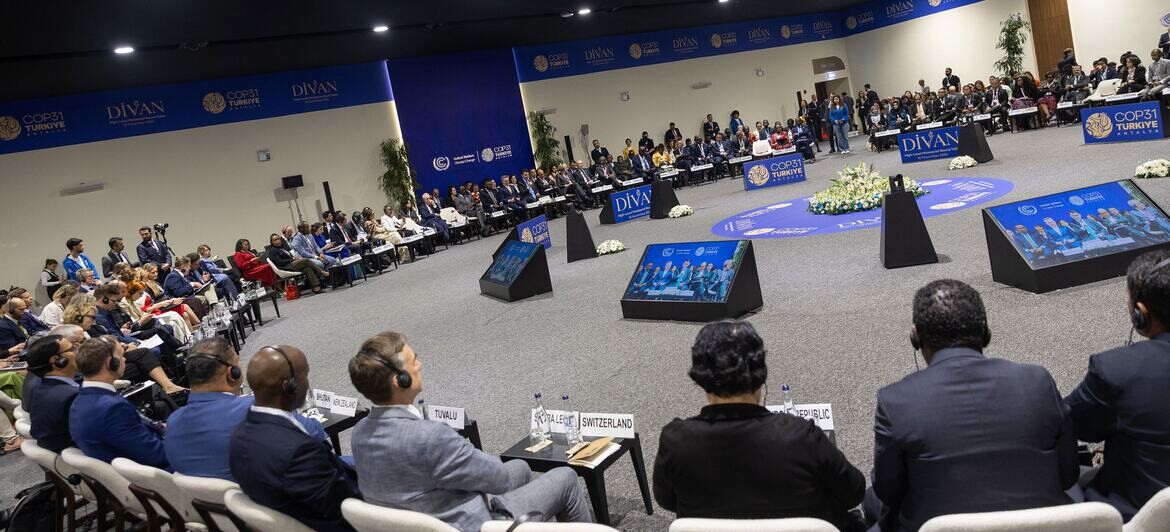
Delegates are sitting in a large circular conference room with COP31 Türkiye blue backgrounds and screens during a ministerial roundtable in Antalya.Ministers join a roundtable at COP31 in Antalya, Turkey
Fossil fuels removed from the draft agreement
The negotiators themselves seemed to struggle to find a way forward.
On Wednesday evening, COP31 President Murat Kurum brought ministers together in a “Divan,” a political meeting inspired by Ottoman tradition, to try to unblock the talks. While some participants described the exchange as constructive, representatives from the most vulnerable countries reported limited progress.
By Thursday afternoon, the latest version of the conference’s draft political decision no longer contained any explicit mention of phasing out fossil fuels.
The text now focuses on clean energy and electrification, notably through Turkey’s proposed “35 by 2035” goal.On adaptation funding, he reaffirmed the commitment to triple the funds by 2035, but left key issues, including how exactly this increase would be calculated, to later discussions.
During the project presentation, Chris Bowen, Australia’s representative and one of the lead negotiators, highlighted that COP31 would be the first climate conference to acknowledge that the world won’t manage to keep warming to 1.5°C, in line with the 2015 Paris Agreement target.
“But we’re determined that COP31 won’t be remembered for that; we want it to be known as the COP that made a clear and firm decision that this is unacceptable,” he said.
He was referring to a provision in the text calling for minimizing both the extent and the duration of any exceedance of the 1.5°C threshold as much as possible.Mr. Bowen has committed to continuing consultations throughout the night, assuring: “We won’t leave the rooms in Antalya until we have found this consensus.”
But as Friday’s deadline approaches, civil society organizations are showing their impatience.
“The announcements in the final decision cannot hide the fact that the negotiations are stalling,” denounced Teresa Anderson from ActionAid International.
She particularly criticized the fact that developing countries are still being asked to step up their efforts without receiving the necessary funding.
“Adaptation funding is not just an optional extra. Adaptation is what will allow all of us to survive this climate crisis together.”Progress, but an insufficient climate record
Alongside the negotiations, a new UN report presents a mixed overview of global climate action.
The Global Climate Action Program brings together governments, businesses, cities, and civil society organizations around voluntary initiatives. Its annual report measures progress made and identifies areas where efforts are still lacking.
The 2026 edition shows that only 44 of the 96 tracked indicators are moving in the right direction. Nineteen are stagnant, while available data are insufficient to assess the remaining 33.
Renewable energy production capacity increased by 17% between 2024 and 2025. But energy efficiency gains are still far below what’s needed. Even more concerning, funding for adaptation has dropped, falling from $81.5 billion in 2022 to $64.1 billion in 2024.On Thursday, during a high-level meeting, the COP31 presidency also introduced an initiative for electrification, aimed at supporting Turkey’s goal of increasing the share of electricity in global final energy consumption to 35% by 2035.
It brings together initiatives from over 150 countries and the European Union, as well as 37 cities and more than 260 companies. The projects range from developing electric grids to electrifying transport and industry.
Among the highlighted outcomes are the construction of over 21,000 kilometers of electric grids by 2025 and annual investment projects of at least $156 billion in grids, renewable energy, and storage.But the benefits of this transformation need to be shared more fairly, warned Simon Stiell, head of UN Climate.
“Vulnerable developing countries need affordable financing and technology. Workers and communities need to be involved in these major changes and supported during this transition. At all levels, we need to act much faster to meet the demands of science,” he said.
The human cost of climate inaction
At the conference, several participants also wanted to remind delegates that the decisions made in Antalya have direct consequences on people’s lives.Kneeling in front of a group of participants, a doctor told the story of Carter, a Canadian boy with asthma. After playing in the water at the park and attending a birthday party, the child was exposed to air that had become unbreathable due to wildfires raging nearby.
Carter began to have trouble breathing. His parents rushed him to the hospital, but he didn’t make it.
“Sometimes, emergency doctors just can’t fix everything,” the doctor said, noting that Carter’s parents wanted his story to be shared at COP31.
Meanwhile, young Ugandans warned about the increasing risks linked to the El Niño phenomenon.Alison Nisima, from the village of Kakonkoma in southwestern Uganda, described the impact of heavy rains on communities: children forced to cross flooded paths to get to school, women having to walk long distances to find drinking water, and families whose livelihoods depend on increasingly unpredictable rainfall.
“For some, heavy rainfall just means grabbing an umbrella or changing plans. For a child whose way to school is flooded, it can mean missing classes,” she explained at a press conference.
As the El Niño phenomenon raises fears of more flooding in parts of East Africa, she questioned the ability of communities to respond to warnings before a disaster strikes.“A family can know that a flood is coming, but where can they go?” she asked.
She called on leaders to invest in access to drinking water, road infrastructure, and disaster preparedness plans, while involving young people more in decision-making. Their knowledge of the ground allows them to identify the most exposed areas.
“The goal of an early warning should never just be to tell people that danger is coming. It should give them a real chance to deal with it,” she stressed.

