
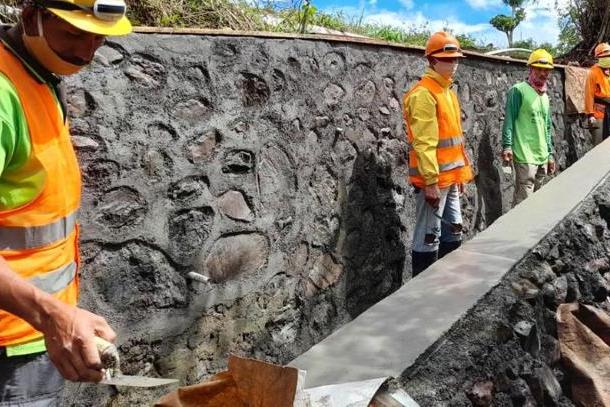
In Indonesia, workers are building a wall to prevent flooding.
In Indonesia, workers are building a wall to prevent flooding.
UN member states have reaffirmed their commitment to the Sustainable Development Goals (SDGs) by adopting a declaration on Wednesday announcing the implementation of reforms aimed at closing the SDG financing gap, estimated at $4 trillion.
These reforms, largely stemming from the commitments made by member states at last year’s historic financing for development summit in Seville, include mobilizing public and private investments, expanding debt relief mechanisms for developing countries, and fighting corruption.”Today’s outcome shows that, through dialogue, mutual respect, and compromise, multilateralism can produce concrete results,” said Lok Bahadur Thapa, President of the Economic and Social Council (ECOSOC).
This annual ministerial statement marked the closing of the United Nations High-Level Political Forum on Sustainable Development (HLPF), which took place in New York starting July 7 under the auspices of ECOSOC.
In their statement, the member states also acknowledged the UN’s cash flow constraints, condemned attacks on critical infrastructures like shipping routes, identified eradicating poverty as the biggest global challenge, stressed the need for inclusive governance of artificial intelligence (AI), and criticized unilateral trade measures, reflecting the current geopolitical challenges.
Progress on the SDGs slowing down
Most of the funding needed to achieve the SDGs comes from national sources, but UN reports have pointed out that official development assistance (ODA) is essential for financing sustainable development in the poorest countries.Despite the Seville Commitment and repeated multilateral agreements aimed at increasing SDG funding, ODA dropped by 23.1% between 2024 and 2025, mainly due to decreased aid from the United States, the United Kingdom, Germany, France, and Japan, according to data from the Organisation for Economic Co-operation and Development (OECD).
In the 2026 statement, the signatories urged developed countries to raise ODA to the UN target of 0.7% of gross national income (GNI). If all member countries of the OECD Development Assistance Committee had met this target in 2023, an additional $200 billion in aid would have been available.Two new UN reports, presented on Thursday by Navid Hanif, Under-Secretary-General for Economic Development at the Department of Economic and Social Affairs (DESA), show that existing initiatives, such as coordinating actions and reducing the digital divide, can help achieve the SDGs.
The Chair of the UN Committee on Development Policy, José Antonio Ocampo, said on Thursday that lowering the high cost of borrowing and strengthening the capacities of multilateral development banks will be essential to speed up progress toward achieving the SDGs.
‘Leaving no one behind, especially no country, remains a must to achieve sustainable development by 2030 and beyond,’ Ocampo said.
The UN looks to the future
Throughout the High-Level Political Forum (HLPF), UN officials repeatedly acknowledged that many SDGs will not be fully achieved by 2030, but they also began exploring what development policy could look like in the years ahead.
“While the focus remains on accelerating progress on the SDGs before the 2030 deadline, it’s time to start thinking about the requirements for sustainable development beyond 2030,” said Mr. Ocampo.
Next year, in addition to the annual HLPF, the UN will hold its quadrennial High-Level Summit on the SDGs, where member states will look at the future of sustainable development.Unshakeable Optimism
Deputy Secretary-General Amina J. Mohammed drew lessons from eleven years of SDGs, noting their “transformative” impact on multilateralism, while also acknowledging the challenges posed by the recent trend of prioritizing national interests over such cooperation.
Ms. Mohammed said the UN is not looking for a successor to the 2030 Agenda for Sustainable Development, but is exploring several options, including another set of goals.
“The next five years will be devoted to achieving the SDGs and laying the foundations for the future,” she said.