
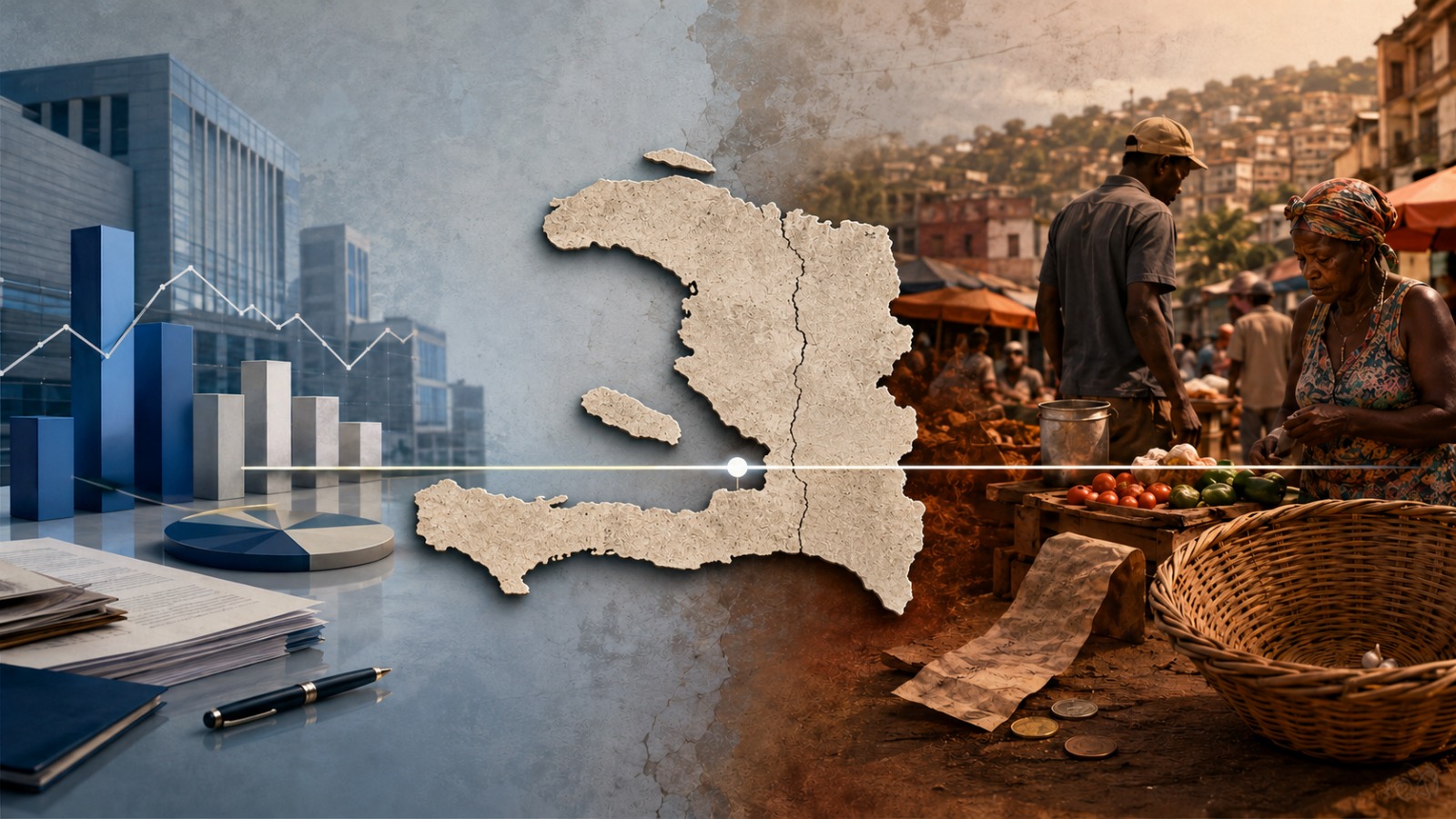
Despite seven consecutive years of economic contraction, high inflation, and nearly half of its population living on less than three dollars a day, Haiti is still ranked as a lower-middle-income economy.
Despite seven consecutive years of economic contraction, high inflation, and nearly half of its population living on less than three dollars a day, Haiti is still classified as a lower middle-income economy. Far from signaling an improvement, this statistical label mostly highlights the limits of average income per person in measuring real living conditions.After seven consecutive years of contraction, Haiti officially remains a lower-middle-income country. This may seem contradictory. The economy is shrinking, national production is weakening, inflation is eating away at purchasing power, and poverty remains widespread. Yet, in the World Bank’s new classification, the country doesn’t fall into the low-income category.
The contradiction is only apparent. The classification published on July 1, 2026, is neither a comprehensive assessment of Haiti’s development nor a report on the living standards of its population. It is based on a specific indicator: gross national income (GNI) per capita, expressed in dollars according to the World Bank’s Atlas method.For the 2027 fiscal year, low-income economies have a GNI per capita of $1,175 or less. The lower-middle bracket ranges from $1,176 to $4,635, while the upper-middle bracket goes from $4,636 to $14,375. Any economy above $14,375 is considered high-income. These thresholds are based on 2025 GNI per capita estimates and will remain the reference until the end of June 2027.
A ranking that hides seven years of decline
Haiti’s GNI per capita used for the 2027 classification isn’t shown separately in the public ranking table consulted. The last value directly available in the World Bank’s World Development Indicators was $1,760 in 2024.For reference, this value would be $585 above the current low-income country threshold, but still $2,876 below the entry threshold for the upper-middle-income bracket. However, this comparison should be interpreted with caution: the thresholds are revised each year, and the 2027 classification is based on 2025 data, which may themselves be subject to revision.
Over a longer period, Haiti’s per capita GNI rose from $800 in 2014, according to an older World Bank report, to $1,760 in 2024. This nominal increase does not mean that the standard of living has doubled. It reflects the effects of prices, exchange rates, statistical revisions, demographics, and the method of conversion to dollars.Keeping Haiti in the lower middle-income bracket therefore doesn’t allow us to conclude that there is economic stability. The current indicators tell a much more worrying story. According to the World Bank, real GDP fell by 2.7% in 2025, marking a seventh consecutive year of contraction. Average inflation reached 28.3%, up from 25.8% in 2024, while public revenues dropped to 4.8% of GDP.
The same institution estimates that 49% of the Haitian population were living on less than three dollars a day in 2025, based on 2021 purchasing power parity. These figures are hardly compatible with the idea of economic or social stability, even if the country formally keeps its ranking.Keeping Haiti in the lower middle-income bracket therefore doesn’t allow us to conclude that there is economic stability. The current indicators tell a much more worrying story. According to the World Bank, real GDP fell by 2.7% in 2025, marking a seventh consecutive year of contraction. Average inflation reached 28.3%, up from 25.8% in 2024, while public revenues dropped to 4.8% of GDP.
The same institution estimates that 49% of the Haitian population were living on less than three dollars a day in 2025, based on 2021 purchasing power parity. These figures are hardly compatible with the idea of economic or social stability, even if the country formally keeps its ranking.GDP, GNI, and household income: three different realities
Gross Domestic Product measures the value created within the national territory. Gross National Income adds to GDP the net income received from abroad by residents, while subtracting what is transferred to non-residents. In an economy with significant ties to the outside world, these two aggregates don’t tell exactly the same story.
GNI per capita is obtained by dividing the gross national income by the population. It’s an accounting average, not the amount actually received by each Haitian.A small minority can concentrate a large share of the income while a big part of the population lives in precarious conditions. Two countries with the same GNI per capita can therefore have very different levels of inequality, access to education, health coverage, food security, or public services.
The Atlas method, on the other hand, aims to smooth out the effects of sudden exchange rate changes. It uses a conversion rate calculated over several years and adjusted for inflation differences. This way, it provides a measure that’s more stable than simply converting national income at the exchange rate of a given date.This methodological stability has a trade-off: the indicator doesn’t always immediately reflect the hardship felt by households. A spike in food prices, the loss of a job, a business shutting down, or being unable to get healthcare can deeply impoverish a family without, in the short term, causing the country’s classification to change.
A minority position in the region
Haiti belongs to a small group of Latin American and Caribbean economies classified in the lower middle range. Unlike the initial list, which included only Haiti, Bolivia, Honduras, and Nicaragua, the official 2027 list also includes Venezuela. So the region has five economies in this category.
The Dominican Republic, Jamaica, and Cuba are in the upper middle range. The Bahamas, Barbados, and Puerto Rico are considered high-income economies.The distance between Haiti and its neighbors isn’t just about average income. It’s also about productive diversification, institutional continuity, infrastructure, exports, tourism, investment, and the ability of governments to produce data and implement public policies.
The category changes seen in 2026 show several possible paths. Vietnam benefited from strong growth and an export-driven model. Its GNI grew by about 10% per year on average from 2021 to 2025. Sri Lanka moved back up into the upper bracket after its economy bounced back, especially in financial services and tourism.Jordan was reclassified after a revision of its national accounts showed that its economy was nearly 10% bigger than previously estimated. Togo moved from low income to lower-middle income after its population estimate was revised down by 11.7%, combined with economic growth and exchange rate movements.
These examples aren’t recipes that can be directly applied to Haiti. They mainly show that a reclassification can result from real growth, a recovery after a crisis, or a statistical revision. Improving Haiti’s national accounts could also change the assessment of its economy, but not necessarily upward.Middle-income status and access to IDA resources
Income classification should not be confused with the funding status granted by the World Bank. Haiti remains eligible for resources from the International Development Association, better known by its English acronym IDA.
For fiscal year 2027, the IDA operational threshold is set at $1,365 GNI per capita. However, eligibility does not depend on this criterion alone. The IDA can support economies above this threshold when they do not have sufficient creditworthiness to borrow under the regular terms of the International Bank for Reconstruction and Development.Haiti is currently among the 78 countries eligible for IDA resources. This status can give it access to grants, concessional loans, and funding aimed particularly at infrastructure, health, education, agriculture, or institutional strengthening.
However, it doesn’t guarantee an automatic amount of resources or an effective capacity to turn financial commitments into results. Allocations, financing conditions, the risk of over-indebtedness, project quality, and implementation capacities remain key factors.The real threshold to cross
Moving up one day to the upper-middle bracket would only really matter if this progress led to more production, formal jobs, and household income. A category change mainly due to exchange rate effects, demographic adjustments, or accounting improvements wouldn’t be enough to change living conditions.
For Haiti, the first priority remains restoring a minimum level of security that allows people and goods to move around. It will also be necessary to get businesses running again, rebuild trade routes, support agriculture, attract productive investment, and strengthen sectors capable of exporting.This progress also assumes a functional education and healthcare system, an administration capable of collecting revenue, better-equipped statistical institutions, and a state able to carry out public investments.
So the 2027 ranking is neither a victory nor a sign of an imminent downgrade. With the latest officially available figure, Haiti remains above the low-income threshold, without being close to the upper range. Its real position is measured less by the label it’s given than by the country’s ability to turn average national income into economic security, public services, and real opportunities for its people.