
How the parasite spreads, why its resurgence should be taken seriously, and how the FAO is acting to support prevention and control
Contrary to what its English name – New World Screwworm – might suggest, the butcher fly isn’t a worm, but a parasitic fly. The name Screwworm refers to the movement its larva makes to burrow into tissues, similar to the rotation of a screw. This condition, painful and potentially deadly if untreated, also affects humans, though more rarely. In short, it should be taken very seriously.Like other transboundary animal diseases that have spread, the screw-worm fly is making a comeback across the Americas and has crossed borders, threatening animal production, disrupting trade, and putting extra pressure on farmers and veterinary services. Its effects can reach far beyond animal health: reduced productivity, disruption of food production, and putting at risk the livelihoods of people who depend on livestock.
The current outbreak is being driven by several factors: increased movement of animals, people, and products; informal or illegal trade; low awareness among producers about the importance of early prevention and control; climate and environmental pressures; and inadequate capacity of veterinary services and surveillance and response programs.Here are five things to know about the blowfly and the FAO’s efforts to help countries prevent and fight its spread:
- It mainly affects animals, but humans are at risk too.
The blowfly is a parasitic fly whose larvae feed on living flesh. All warm-blooded animals can be affected, including cattle, horses, pets, wildlife, and humans. Young animals are especially vulnerable, particularly in the days after birth.
After eggs are laid in a wound, the hatched larvae quickly destroy tissue, causing a condition called myiasis. Without treatment, the infestation can be deadly.It’s making a comeback in American countries
The fly is native to much of South America. Over the past five years, it has reappeared in Central America and spread to Mexico, reestablishing itself in much of its historical range. Eight countries—Belize, Costa Rica, El Salvador, Guatemala, Honduras, Mexico, Panama, and more recently, the United States—have reported active cases.Endemic to South America
- It spreads due to animal movements rather than direct contact between animals
The screw-worm fly does not spread through direct contact between animals or between animals and humans, but during the movement of infested animals, when adult flies cross a border, during wild animal migrations, and through accidental transport. That’s why international coordination and border monitoring are essential for controlling outbreaks.
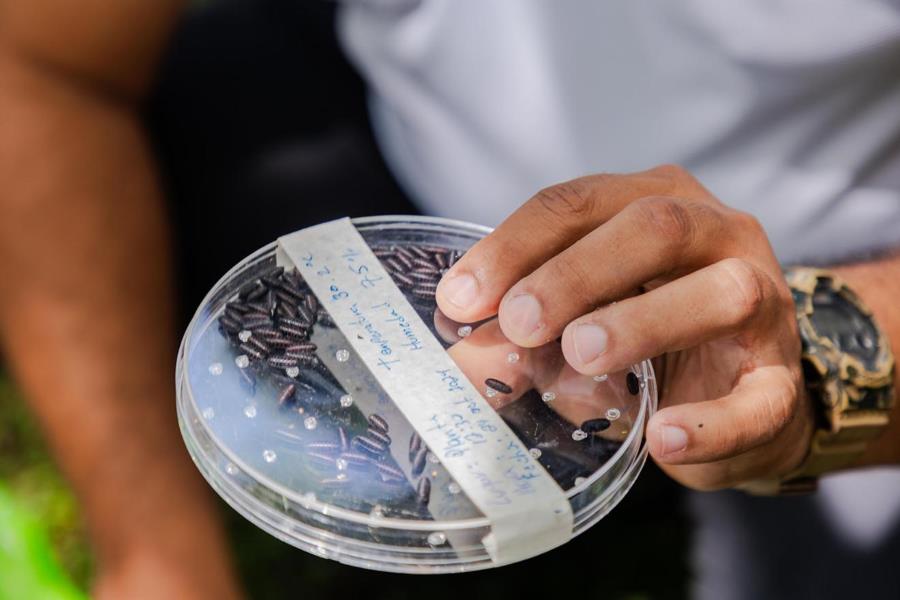
The sterile insect technique is a proven method to fight the screw-worm flyThanks to the sterile insect technique, the screw-worm fly was eradicated from the United States in 1966 and from Mexico in 1984, as well as from several Central American countries afterward.
The sterile insect technique is based on using radiation to produce sterile male flies, which are then released into the wild. Mating with these males doesn’t produce any offspring, so the wild population declines over time. This technique, which has proven to be very effective and cost-efficient, also has the advantage of not requiring pesticides and being environmentally friendly.As part of a coordinated effort involving 22 donors, eight countries, and other United Nations agencies, FAO and the International Atomic Energy Agency (IAEA) used the sterile insect technique to eradicate the Libyan sheep blowfly in 1991, at a time when an outbreak had caused significant damage and there were fears that the fly could spread elsewhere in Africa and even to Europe. The success of this intensive international cooperation showed that quick and coordinated action was effective against the disease.
Today, through the FAO/IAEA Joint Division of Nuclear Techniques in Food and Agriculture, the two organizations continue to provide scientific support and assistance in research to help implement the sterile insect technique.In the face of this condition, solutions exist, but countries need to invest and act together
Blowfly infestations can be prevented, controlled, and even eradicated, but this requires sustained international collaboration and joint investment in systems, technical skills, and technologies to stop the spread of the parasite. Like other transboundary animal diseases, blowflies don’t respect borders, so no single country or organization can slow their progress alone. Countries need to invest together because protecting one country depends on the preparedness and response capacity of its neighbors. That’s why the FAO coordinates global and regional interventions.As the UN system’s specialized technical agency, FAO enjoys a privileged position that allows it to help countries strengthen their veterinary services, surveillance, and cross-border coordination. It provides policy guidance and technical support to public authorities to help countries improve the monitoring of the blowfly, as well as prevention and biosecurity measures. Additionally, it offers emergency technical assistance on the ground, trains national veterinary staff, and supports diagnostic research to help affected countries strengthen their long-term prevention and control strategies.At the beginning of 2026, the FAO led workshops on best practices for managing emergency situations in El Salvador and Honduras.
Across the Americas, the FAO is also working alongside the Panama-United States Commission for the eradication and prevention of the screwworm in livestock (COPEG) and with national veterinary services throughout Central America to strengthen prevention and control measures in countries where the screwworm has reappeared.
Under the Global Framework for the Progressive Control of Transboundary Animal Diseases, the FAO is working, in collaboration with the World Organisation for Animal Health (WOAH), to support coordination with other regional partners.Rapid detection is a top priority. Through its Animal Health Emergency Prevention System (EMPRES Animal Health), FAO tracks cases detected in animals and provides easily accessible data on where the disease has appeared, allowing national authorities to better understand the spread patterns of the screwworm and the potential threats of cross-border transmission. This early warning system helps centralize information and carry out coordinated and swift action across borders.In the past, the sterile insect technique helped eradicate the New World screw-worm fly in some countries.
With over 80 years of experience, the FAO works with its members and partners to strengthen global capacities for preventing, preparing for, and responding to transboundary animal diseases.
No country can fight this threat alone. In fact, protecting animal health in any given country depends on how strong the prevention, surveillance, and rapid response programs are in neighboring countries. Sustained investments and coordinated action are therefore a shared responsibility and essential to prevent the parasite from spreading further.